
An Early Muslim and Crusader fortress was built on a sandstone ridge along the ancient trade route on the Carmel coast.
Home > Sites > Carmel> Coast > Habonim> Cafarlet fortress
Contents:
Location
History
Aerial Map
Photos
* Fortress
* Gate
* South West
* Southern Courtyard
* Central Courtyard
* Northern area
* Eastern Exterior
* Byzantine Burial
Video tour
Archaeological
Historical
Etymology
Background:
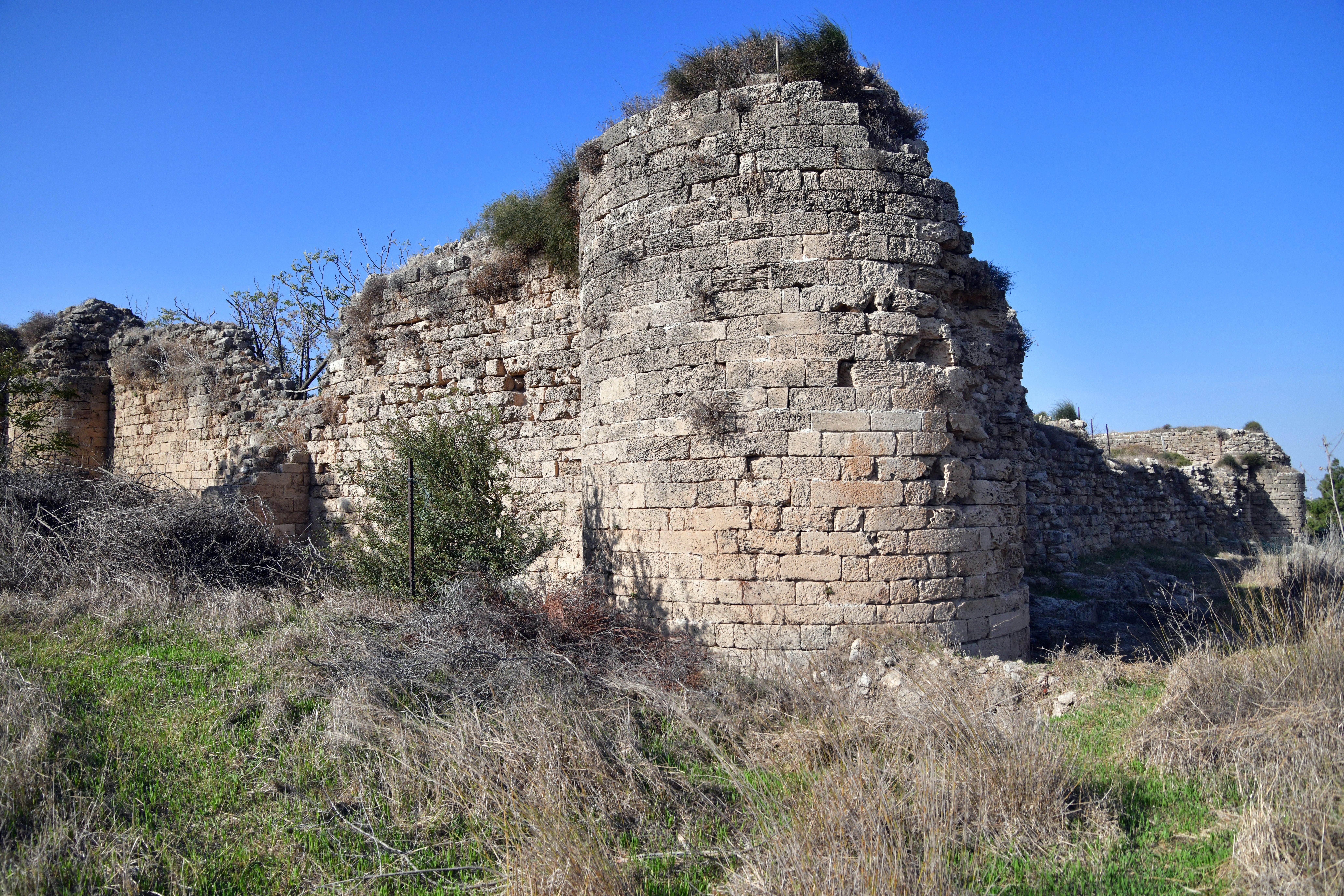
The Crusaders built a fortress (“Cafarlet” or “Capharlet”) on the north-eastern side of the sandstone ridge. The fortress was a 58M x 50M rectangular structure with round towers on all corners, and two towers flanking the gate that is located on its southern wall. It was first constructed in the 8th Century and followed a Roman castrum design to protect against Byzantine seaborne invasions. Four hundred years later it became a Crusader castle, part of the coastal fortifications, built along the pilgrimage route from the north (Acre, Haifa, Atlit), to the south (Caesarea and further to Jerusalem).
The fortress belonged to the Crusaders seigneuria of Caesarea. In 1213 the fortress was given to the order of “Hospitallers” – the order of the Knights of the Hospital of Saint John – as a loan collateral. It was later sold to the order of the Templars in 1232. The Muslims captured and destroyed it in 1265, but the fortress was reconstructed later by the Templars. The fort was finally abandoned in 1291 when the Crusaders left the Holy Land.
Location:
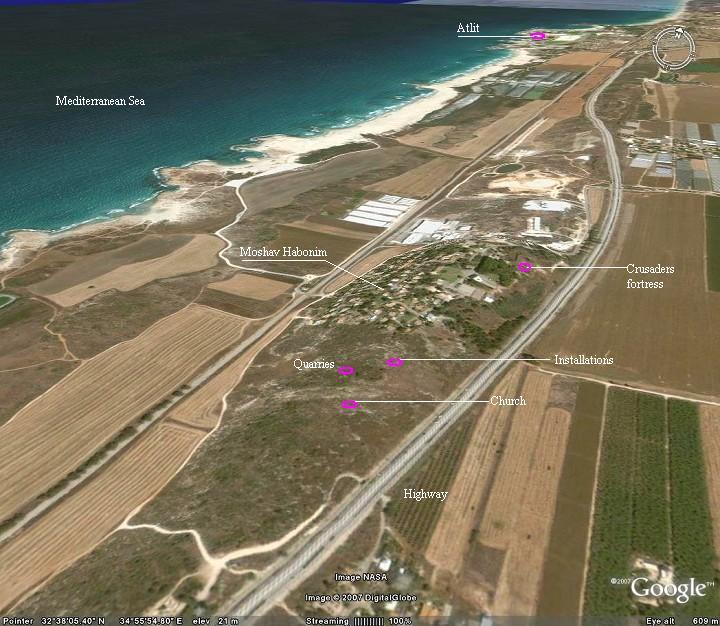
The site is located on a sandstone (Kurkar) hill, 25M above sea level. An ancient road used to pass at the eastern side of the site, and the new Haifa-Tel-Aviv highway was constructed at the same location. When you drive by the site on the highway, you can easily see the eastern side of the Crusaders fortress – which is the best preserved wall. The Byzantine village is located several hundred meters to the south of the fortress.
Moshav HaBonim is located 27KM south of Haifa, 1KM east to the sea shore, 3 KM west of Mount Carmel. It can be accessed from the old highway (route #4) adjacent to Moshav Zerufa. If you arrive to the site, be sure to visit the remarkable nature reserve park, which is located on the shore west to the Moshav.
An aerial photo is shown below, indicating the major points of interest. The site is located along the Haifa-Tel-Aviv main highway.
Photos:
History of the place:
-
Earlier periods
Survey in the area of the site revealed artifacts dated to the Chalcolithic, Persian and Hellenistic periods.
The lowest layer within the fortress was of the Persian period.
-
Roman/Byzantine
The village was established in the late Roman period and grew at the Byzantine period. These periods witnessed a surge of the sites in the Carmel coast area (a total of 50 villages from Caesarea to Haifa, more than one village per KM). The village was located in two locations on the sandstone ridge: in the center (where the church was excavated) and on the north-eastern side (where the fortress is located).
Stone cutting may have been its main occupation, as attested by the large number of quarries that cover most of the ridge. The village occupation was also based on agriculture, such as wine production, and it also provided services to the trade route that passed on its eastern foothills.
See more on this site in another page.
-
Arab period
The Byzantine village was destroyed and abandoned after the Arab conquest in the 7th century, as what happened to most of the Carmel sites.
A fortress was built during the reign of the Umayyad caliph Hisham ibn Abd al-Malik (691-743, ruled from 724). It was named “Kafarlab” or “KaferLab” (=village of Lab), and was built on the north-eastern side. The purpose of the fortifications, here and in other coastal sites, was to protect the Arabs against a Byzantine invasion. It was a ribāt (Arabic: رِبَاط), an Arabic term for a fortified building that served a dual purpose in the early Islamic period, functioning as both a fortress and a religious center. Originally established along frontiers and coastal areas, particularly during the Muslim conquest of North Africa (the Maghreb), the ribāṭ housed military volunteers known as murābiṭūn (or murabitun), who were dedicated to the defense of Islam (jihād) and border patrol. Similar ribat were found in Arsuf, Jaffa, Yavne-Yam, Ashkelon and Gaza.
According to an article by H. S. Khalilieh, it may have been built in memory of Mujāhid ibn Jabr, one of the most prominent early Islamic scholars. Mujāhid was the most distinguished student of ʿAbdullāh ibn ʿAbbās, the Prophet Muhammad’s cousin and the companion often referred to as the “Father of Tafsīr.” The text known as Tafsir is one of the most authentic windows into the earliest generation’s understanding of the Qur’an. He was born around 642 AD (21 AH) and reported to have died in Mecca around 722 CE (104 AH).
An excavation was conducted on the site for 1 season (1999), headed by Barbé, Lehrer and Avissar. They opened 3 excavation areas outside the fortress (areas 30, 40, 60 and A) and three areas inside the fortress (areas 10, 20, 70). Through the analysis of architectural features (which show a blend of Roman-Byzantine and Sassanid influences typical of Umayyad architecture) and artifacts such as pottery and glass, they dated the fortress’s first construction to the 7th and early 8th centuries CE.
-
Crusaders fortress
The Crusaders built a fortress (“Cafarlet” or “Capharlet”) on the ruin of the Muslim fortress. The fortress was a 58M x 50M rectangular structure with round towers on all corners, and a gate located on its southern wall. At a later stage, the Crusaders added a chapel on the external side of the western wall. This chapel served the needs of the fortress’s occupants, likely the Knights Hospitallers.
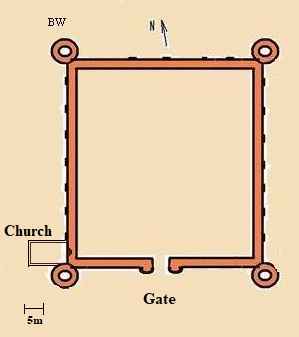
It was reconstructed from the earlier Arab fortress which gave it a unique structure (of round corner towers, which is not a Crusaders standard design). The fortress was part of the Crusaders coastal fortifications, built along the pilgrimage route from the north (Acre, Haifa, Atlit), to the south (Caesarea and further to Jerusalem).
The fortress belonged to the Crusaders seigneuria of Caesarea. In 1213 the fortress was given to the order of “Hospitallers” – the order of the Knights of the Hospital of Saint John – as a loan collateral. It was later sold to the order of the Templars in 1232. The Muslims captured and destroyed it in 1265, but the fortress was reconstructed later by the Templars.
-
Post Crusader Periods
The fort was finally abandoned in 1291 when the Crusaders left the Holy Land. The site stayed in ruins since the Mamlukes period until the 19th century.
- Ottoman period
The area was examined in the PEF survey (1866-1877) by Wilson, Conder and Kitchener. A section of their map is seen here. At that time HaBonim was not yet founded (only in 1949). The fortress is located south of Kefr Lam. The quarries and installations are located along the Kurkar limestone ridge. The Ottoman period coastal road passed along the western foothills of the ridge.
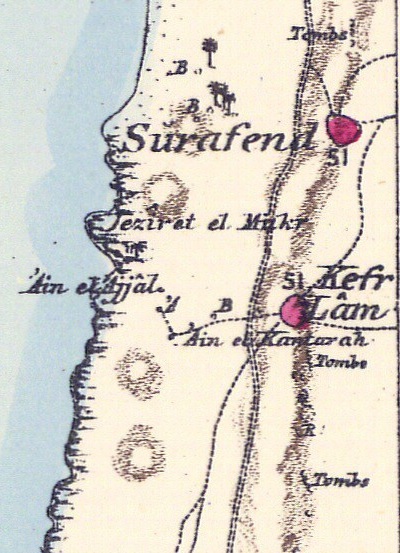
Part of Map sheet 7 of Survey of Western Palestine,
by Conder and Kitchener, 1872-1877.
(Published 1880, reprinted by LifeintheHolyLand.com)
The surveyors wrote about the fortress and the quarry and the stone cut tombs (SWP, Vol 2, Sheet VII, pp 29-30):
“Kefr Lam —The Crusading fort at this village appears to have been about 70 feet square, with round towers at the angles. Those on the east wall are best preserved ; along the wall between the towers were six buttresses about 2 feet thick. The towers are about 1 5 feet diameter. The stones are small, about 1 foot long by 6 inches high ; the joints of the masonry fine and regular. The mortar is thinly laid, and very dark in colour, and hard in consistency. The walls stand some 12 to 15 feet in height, and the fort is on rising ground, commanding the road. The general effect is similar to that of the castle at Minet el Kulah (Sheet XVI.), which is also attributable to Crusading times. The twelfth century castles in Syria have similar masonry, and round towers. The fort at Kefr Lam is called el Kusr, ‘ the tower.’ …
Visited 8th March, 1873“.
In 1882 Wilson, one of the PEF surveyors, described in his book (Ch. W. Wilson, Picturesque Palestine, 1882, Vol III pp 114-116) about his stay in Kfar Lamm:
“Half a mile south of Surafend, which is famous for its fig-orchards, there is another village. It is called Kefr Lamm, and though built on the broad smooth summit of the widening coast range, it is only fifty-one feet above the sea-level. On one occasion, when I was travelling along the coast with my brother, we spent a night here. It was the last week in the month of July, and we approached the village through fields of rapidly ripening Indian corn (maize) and fruit and vegetable gardens. The sheikh and all the chief men came out to meet us with pleasant words of welcome, for we were expected and well known there. We alighted on the outskirts of the village, which is very compact and built of sun-dried bricks ; close to it there is a large enclosure, with buttressed walls, built of stone, for the protection of flocks and herds, and for storage of grain and fuel. I found my tent already pitched amid little mountains of wheat and barley, near to an extensive threshing-floor, where oxen were busy treading out the corn”.
- British Mandate
A section of the 1940s British map shows the area around Kafar Lam. The Arab village, now destroyed, covered the area of the fortress and north of it.
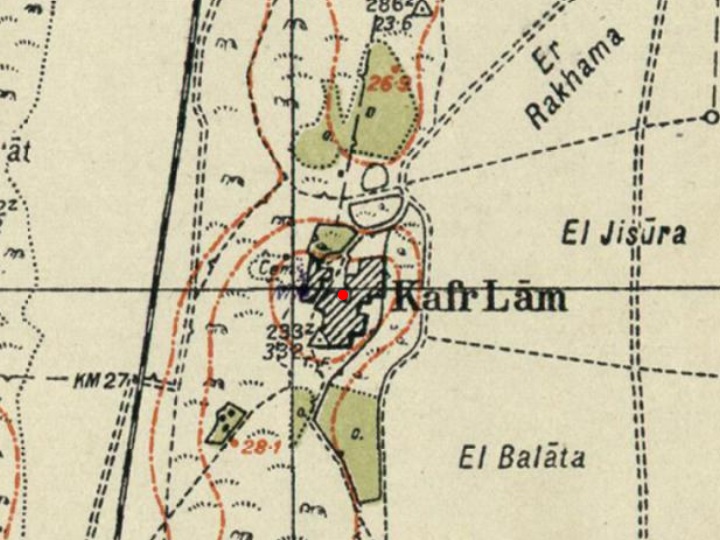
British survey map 1942-1948 – https://palopenmaps.org topo maps
License: public domain under the UK Copyright, Designs and Patent Act 1998
-
Modern Times
Kefar-Lam was a small Arabic village, and its houses were built inside and around the fort. Its name preserved the earlier names. The village was demolished in 1948 during the Israeli Independence war. Moshav Ha-Bonim (“the builders“) was established in 1949 on its ruins by Jewish immigrants from South Africa and England, members of the Habonim youth Zionist organization.
(a) Overview
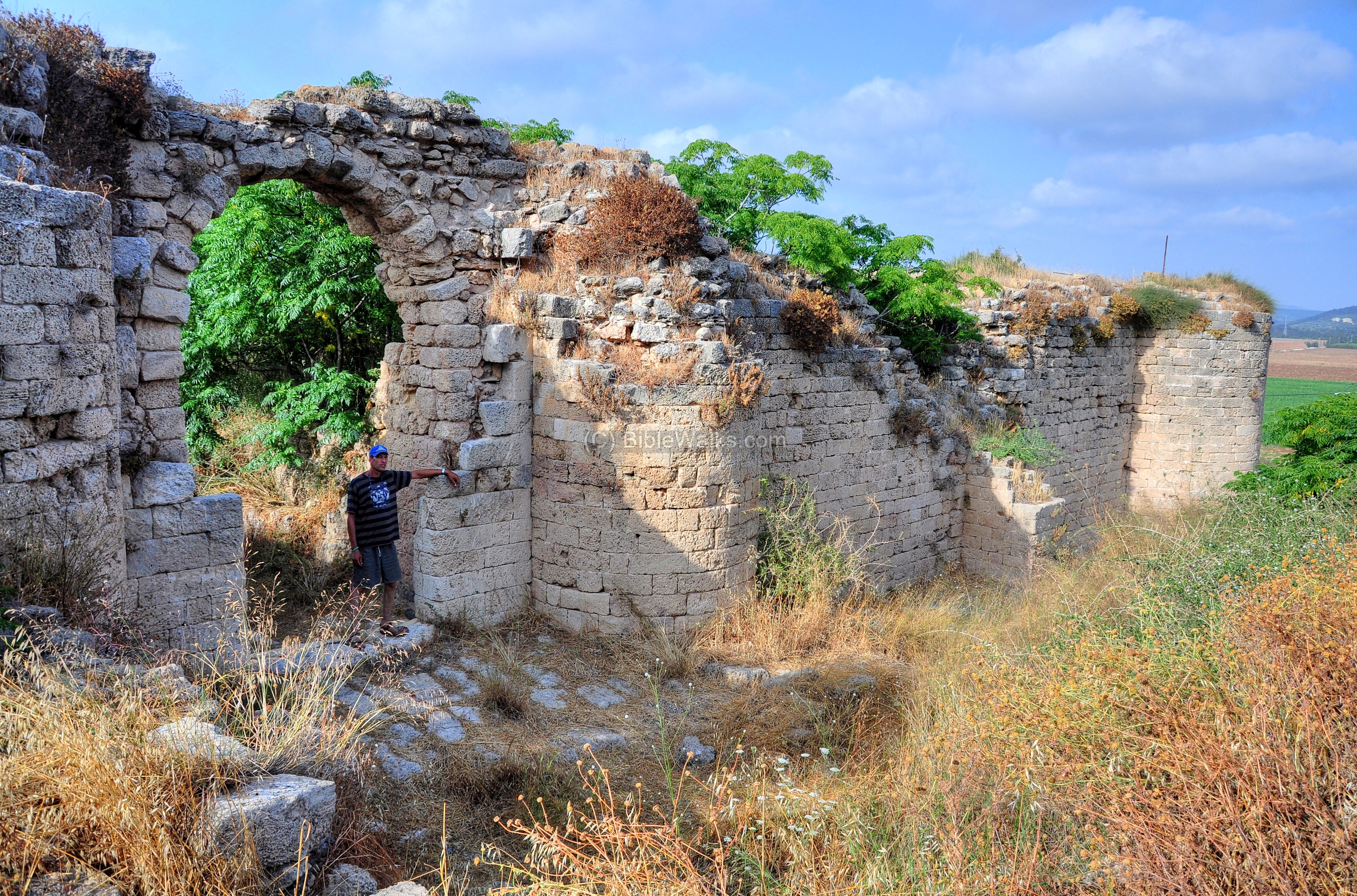
The Crusaders built a fortress (“Cafarlet” or “Capharlet”) on the north-eastern side of the sandstone ridge. The fortress was a 58M x 50M rectangular structure with circular solid towers on all corners, and a gate located on its southern wall. The photo below shows the gate on its southern side, and the south eastern section of the wall. A corner tower is seen at the edge of the wall.
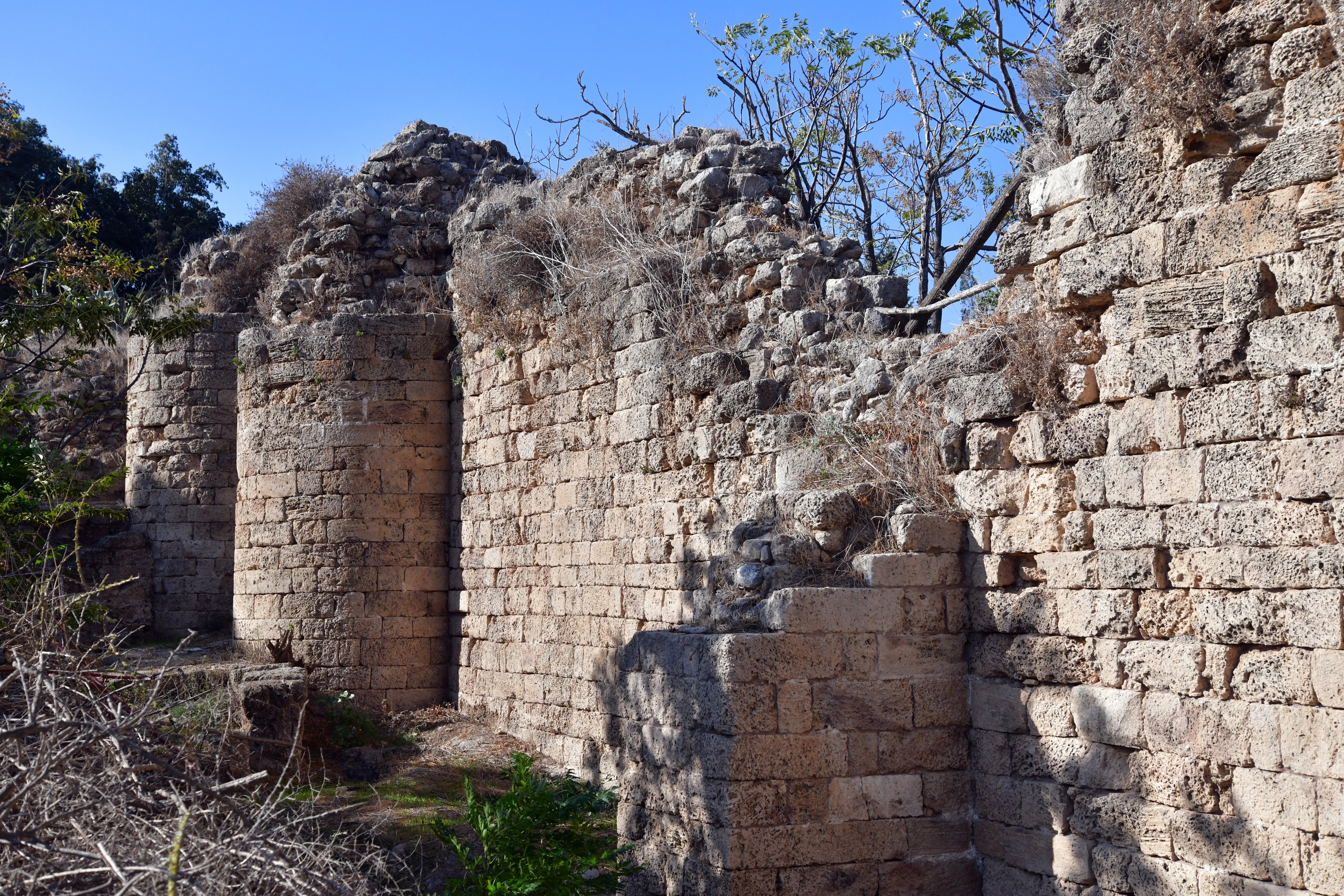
Another more recent view of the southern wall is below. Two semi-circular solid towers flank the gate, as seen here in the middle of the southern wall.
Along the entire length of the fortress walls were 18 external buttresses, such as the one seen here leaning against the wall. Buttresses are architectural supports built against or projecting from a wall to reinforce it against lateral forces.
Martin Telinius, who guided our recent tour to the castle, volunteers to keep the fortress clean of weeds and brushes.
(b) Gate
The only gate is in the center of the southern wall. Circular towers flank the gate on both sides.
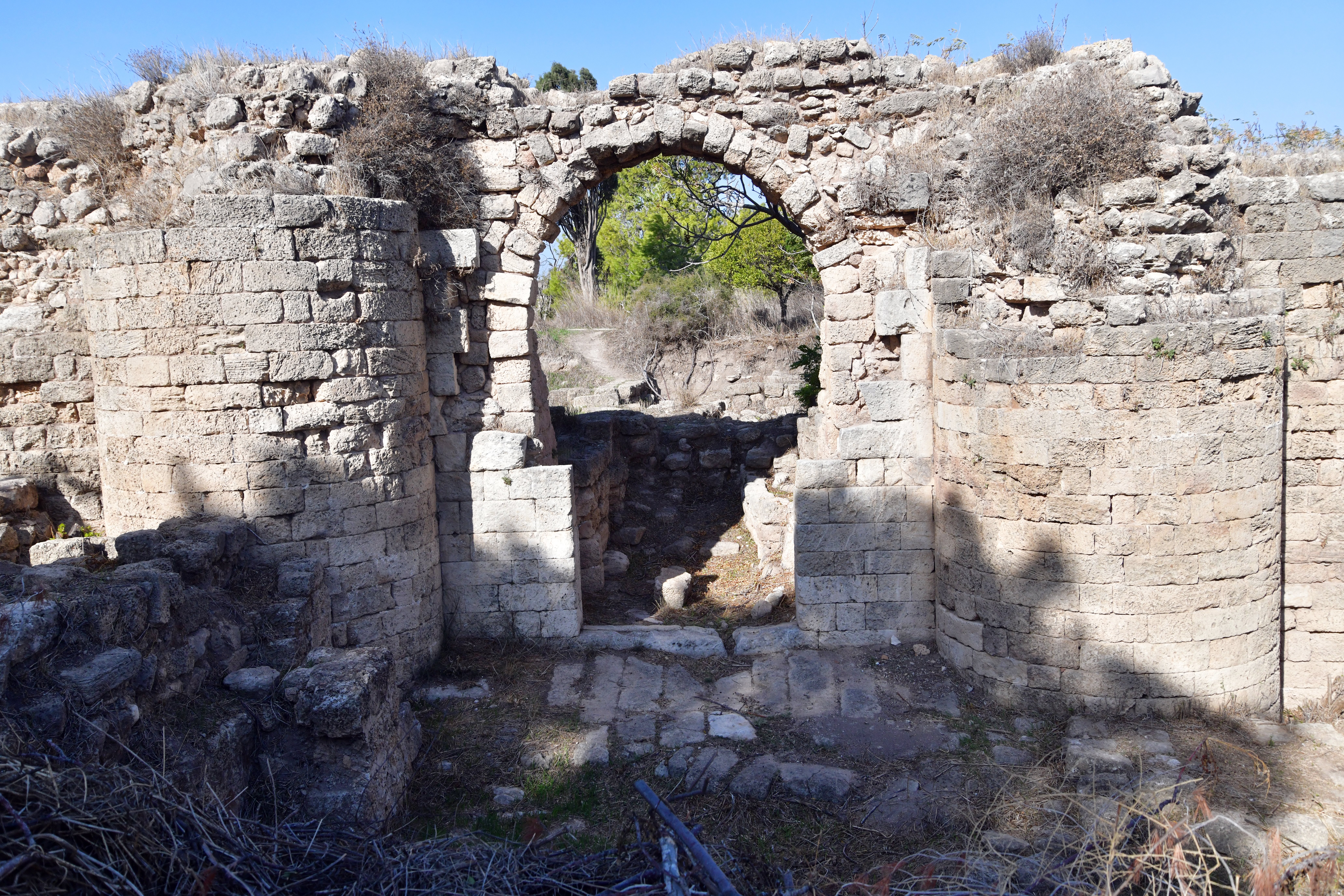
Access through the gate was controlled by a drawbridge spanning a dry moat. For defense, the bridge could be pulled up to close the gate opening entirely. To allow entry, it was drawn down to serve as a pathway across the moat.
The drawbridge was of the type Bascule with internal counterweight. The bridge deck extended into the gate passage past its pivot point. The bridge’s pivot point was anchored by axles that fit into corresponding holes on the flanking walls. The draw bridge reaches over a dry moat that was dug in parallel to the walls. The internal section would swing down into a pit when the external part was raised, offering an additional obstacle to attackers who might breach the gatehouse. Counterweighted beams would drop into slots in the floor or walls as the bridge lifted. In some instances of medieval castles, the heavy portcullis (a heavy, latticed grille of wood and metal) served as the counterweight itself.
An illustration of a draw bridge is shown here. Note that in Cafarlet fortifications there were no loopholes in the wall , and the active defense was only made from the curtain way.
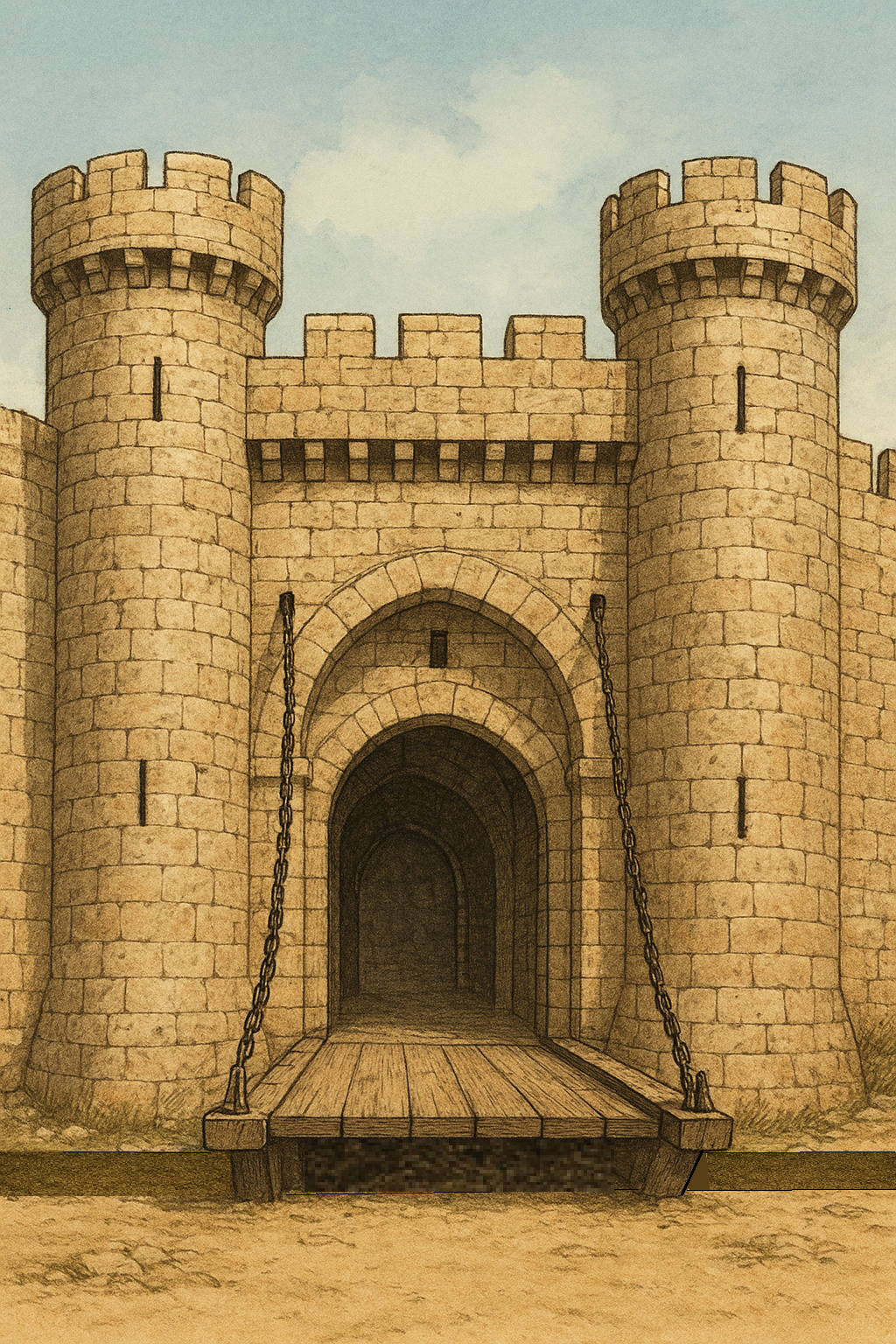
Illustration of draw bridge (Image created by AI using OpenAI’s ChatGPT)
(c) South West exterior
This area, from the gate to the south western tower, was excavated in 1999 and was designated as area “30”.
Standing against the lower side of the wall is one of the more intact buttresses.
The corner tower is 6m in diameter, the only corner with this size (the others were 5.2m in diameter). Its higher height implies that it may have served as a watchtower.
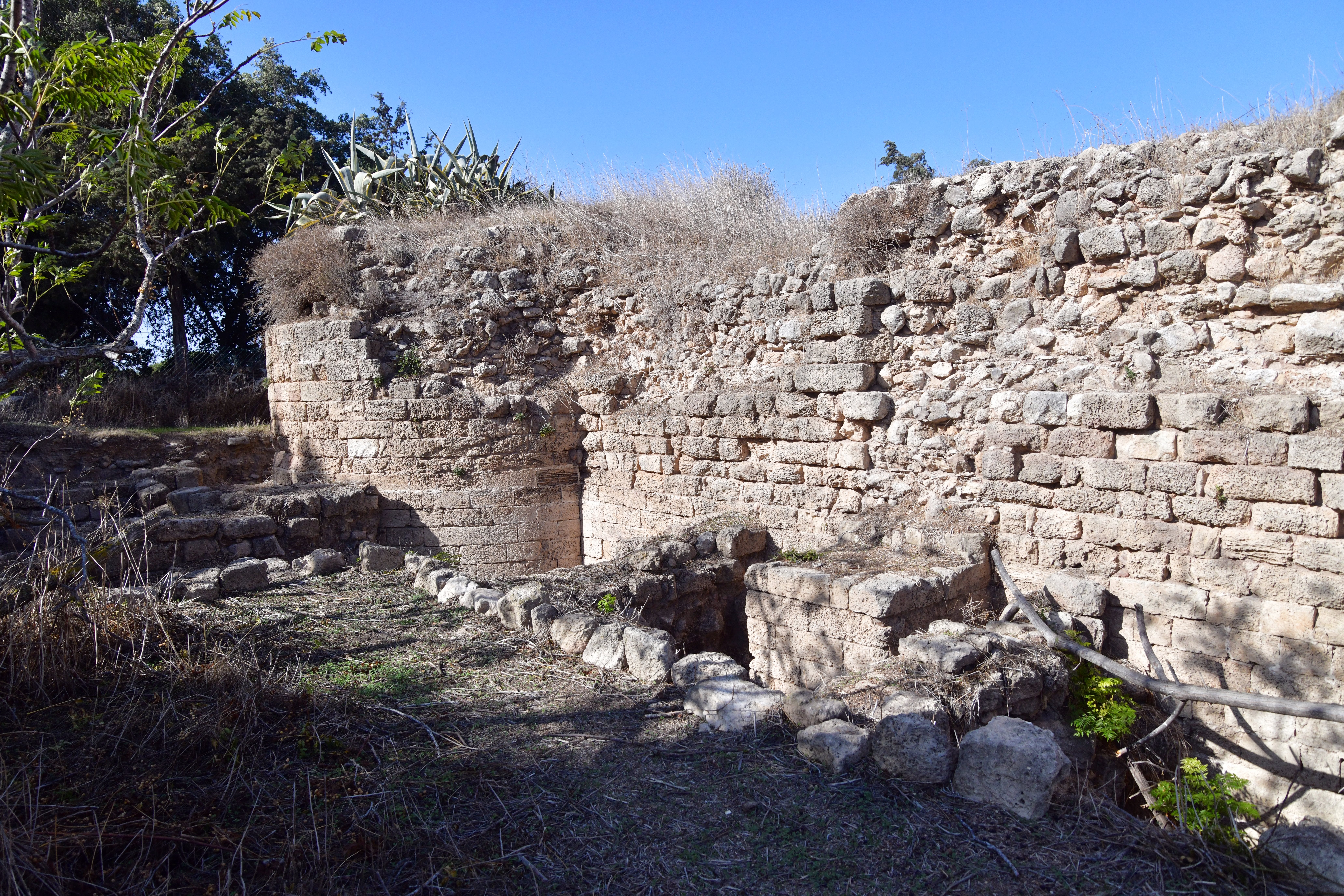
Foundations of walls are built perpendicular to the wall, but these were probably from a later phase.
(d) Southern courtyard
The area on the southern side of the fortress, near the gate, was excavated in 1999 and was designated as “Area 20”. In this area are vaults and foundations of structures.
In this view, towards the west, is the end of one of the vaults (marked “V23” on the excavation plan). In the castle were 5 more vaulted rooms, marked “V10”, “V11”, “v20”, “V21″, V22”.
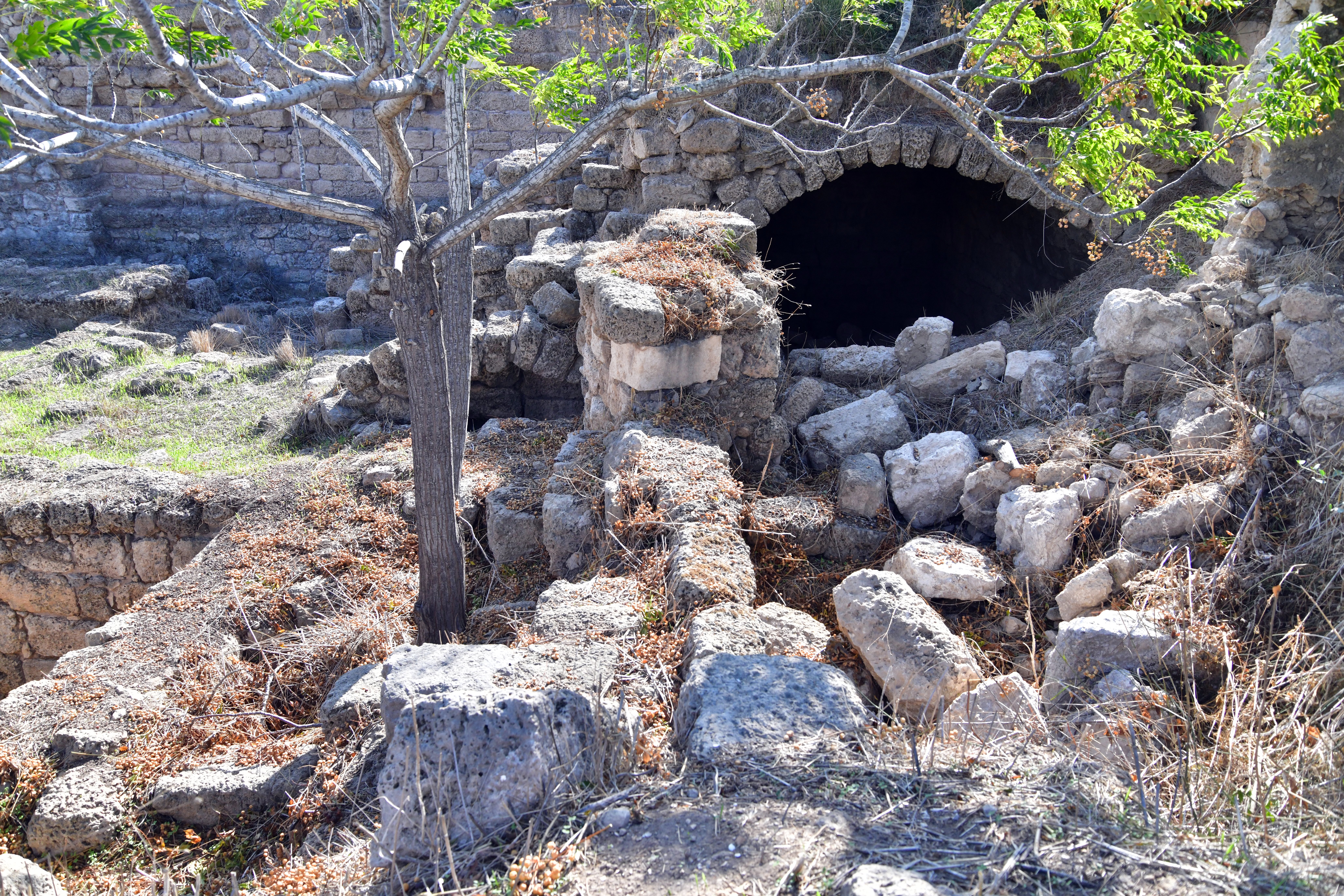
A square structure, built in the ground, is near the vault. Since its walls are not plastered, it rules out the function of holding water.
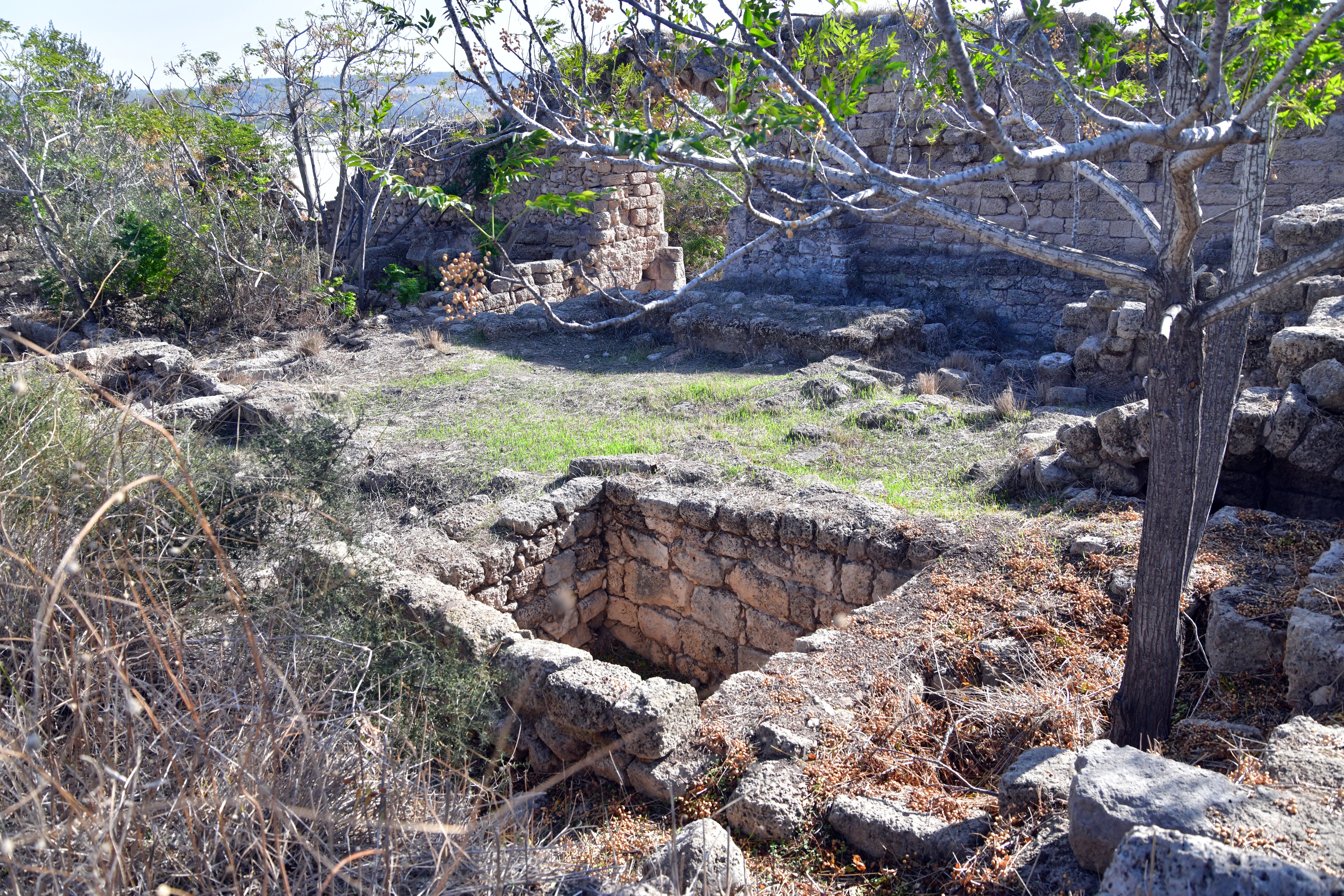
On the east side of the area are 3 vaults (V20, V21, V22 on the excavation map). In this view is the edge of one of the vaults.
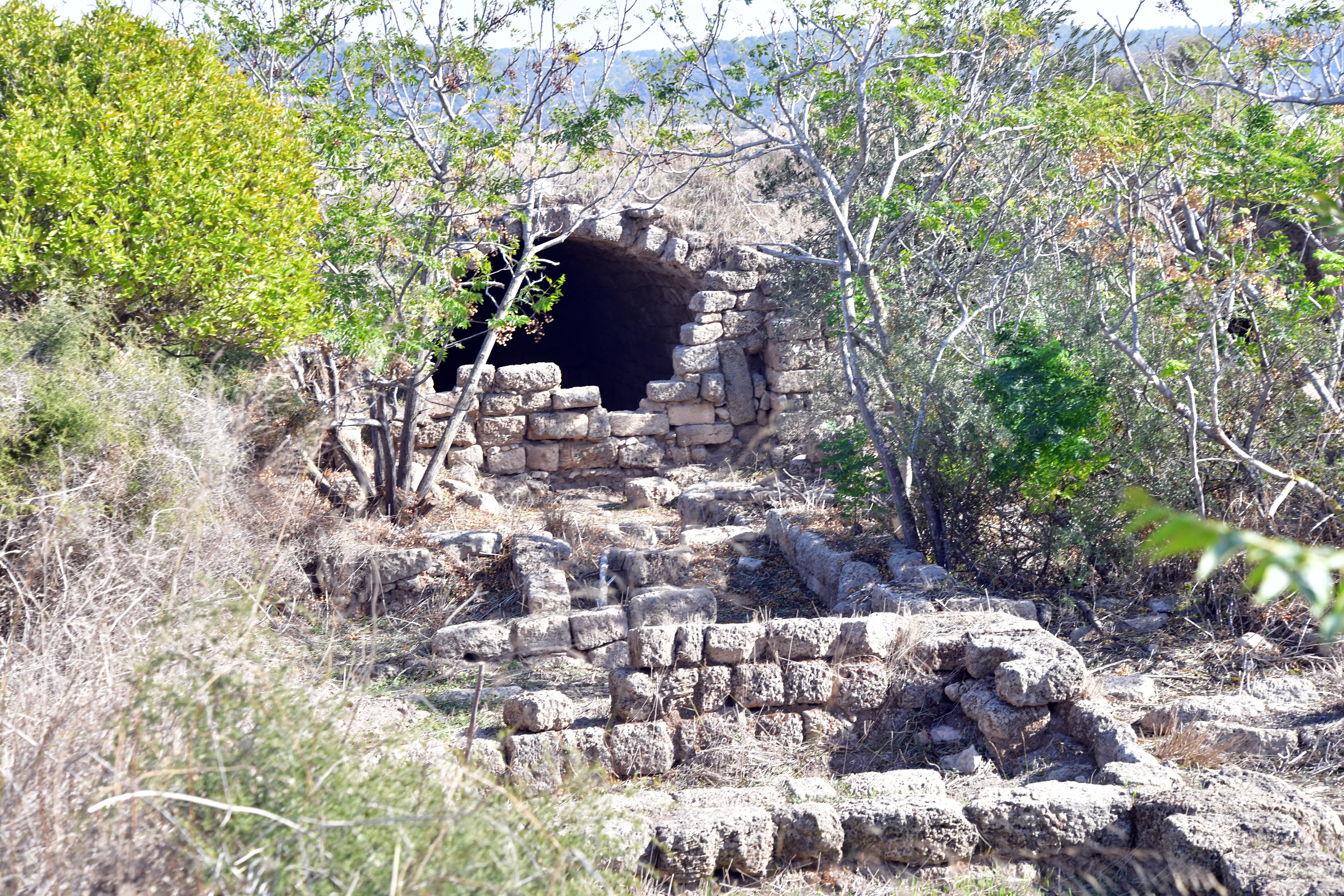
(e) Central courtyard
The area in the center of the fortress courtyard was excavated in 1999 and was designated as “Area 10”.
This photo shows one of the walled areas. Behind the left wall is a winepress.
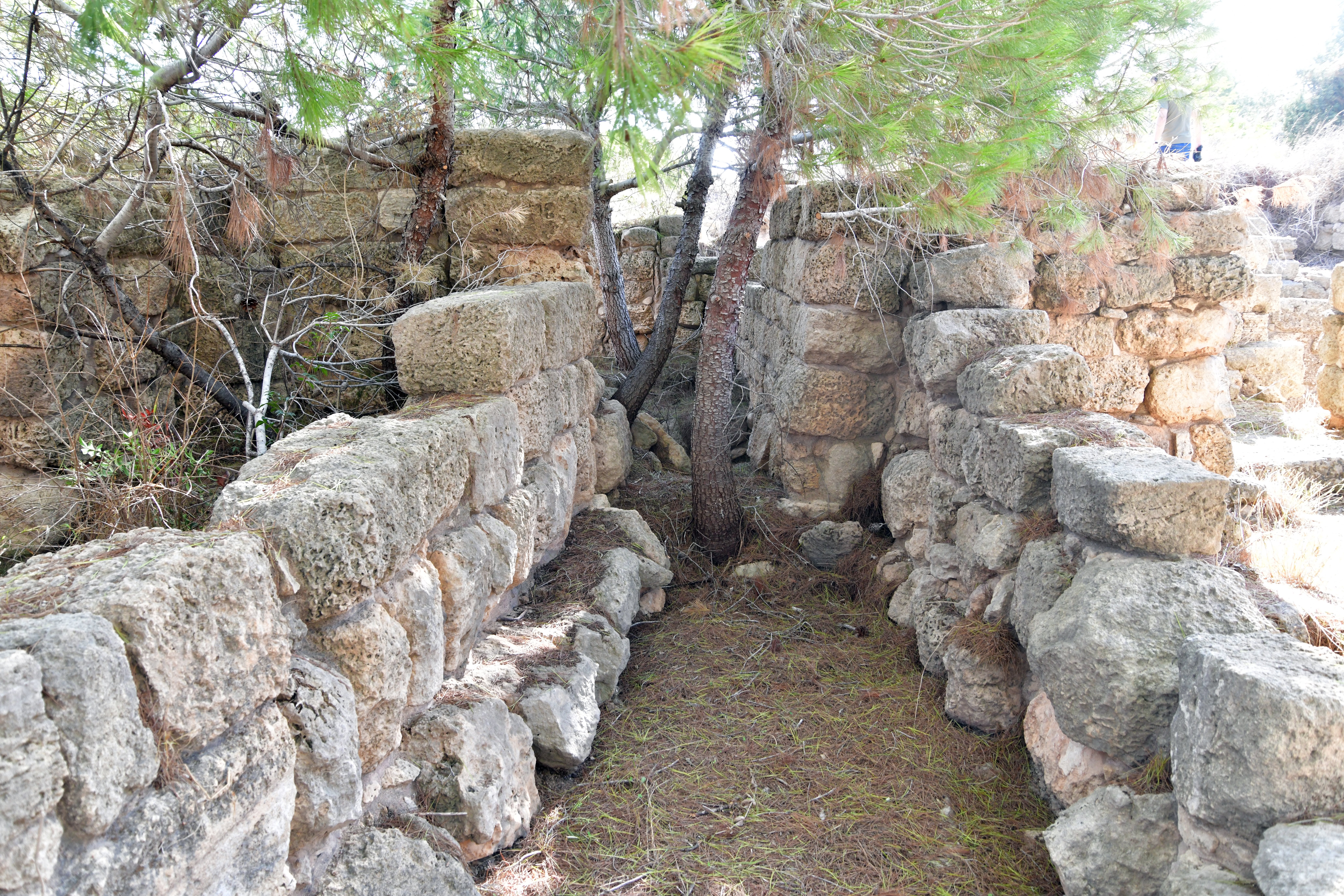
This Byzantine-era winepress, situated within the walled area, highlights typical local construction techniques. What we see today is primarily the collecting pool, complete with its original mosaic floor and hydraulic plastered walls. Both the pool and the four staits were cut entirely into bedrrock. The treading floor, which would have been located above the pool, is no longer visible. When the site was converted into an Early Muslim period fortress, the no-longer-used winepress was cleverly repurposed into a water reservoir.
Other identical installations are found below the eastern wall and nearby on the ridge.
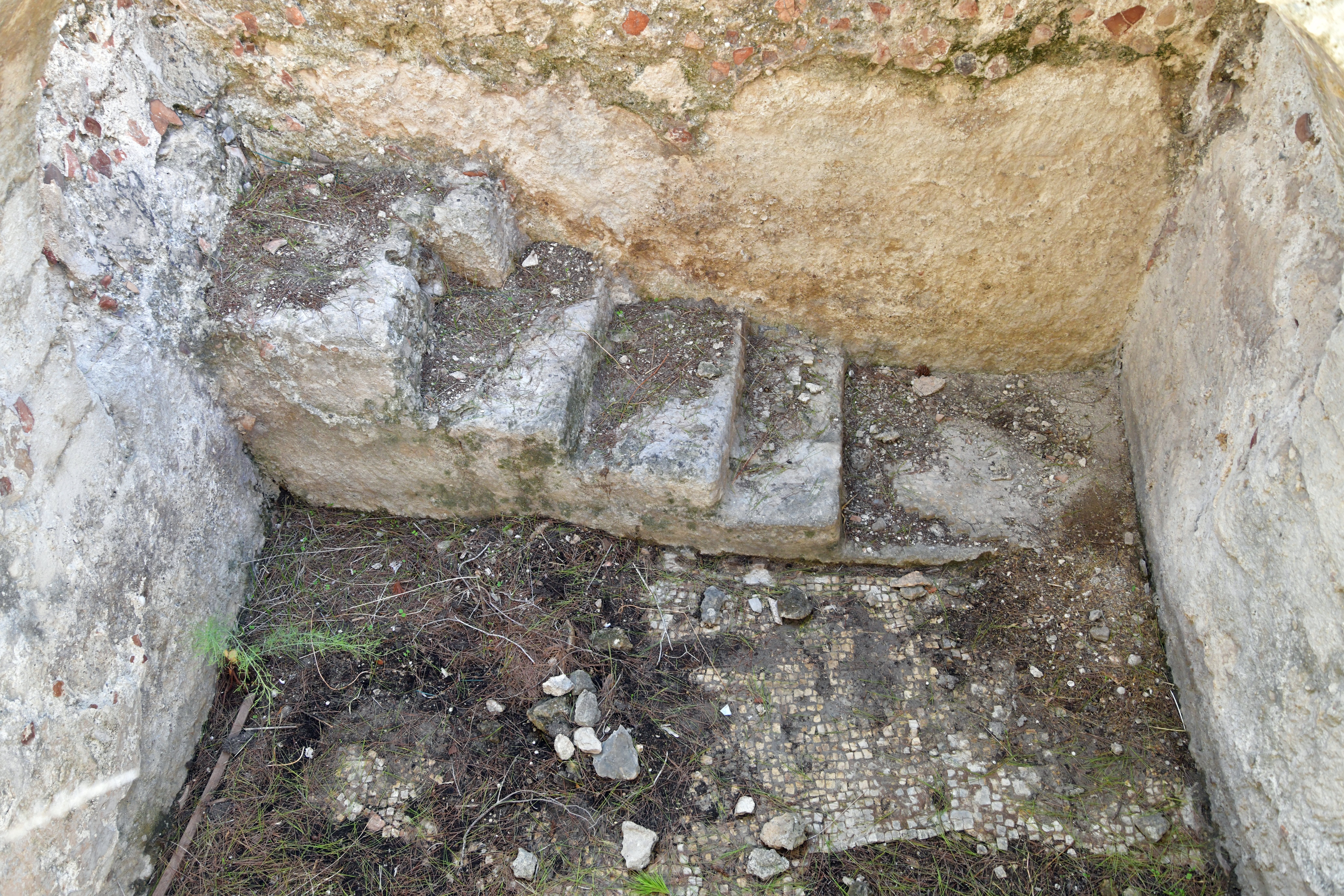
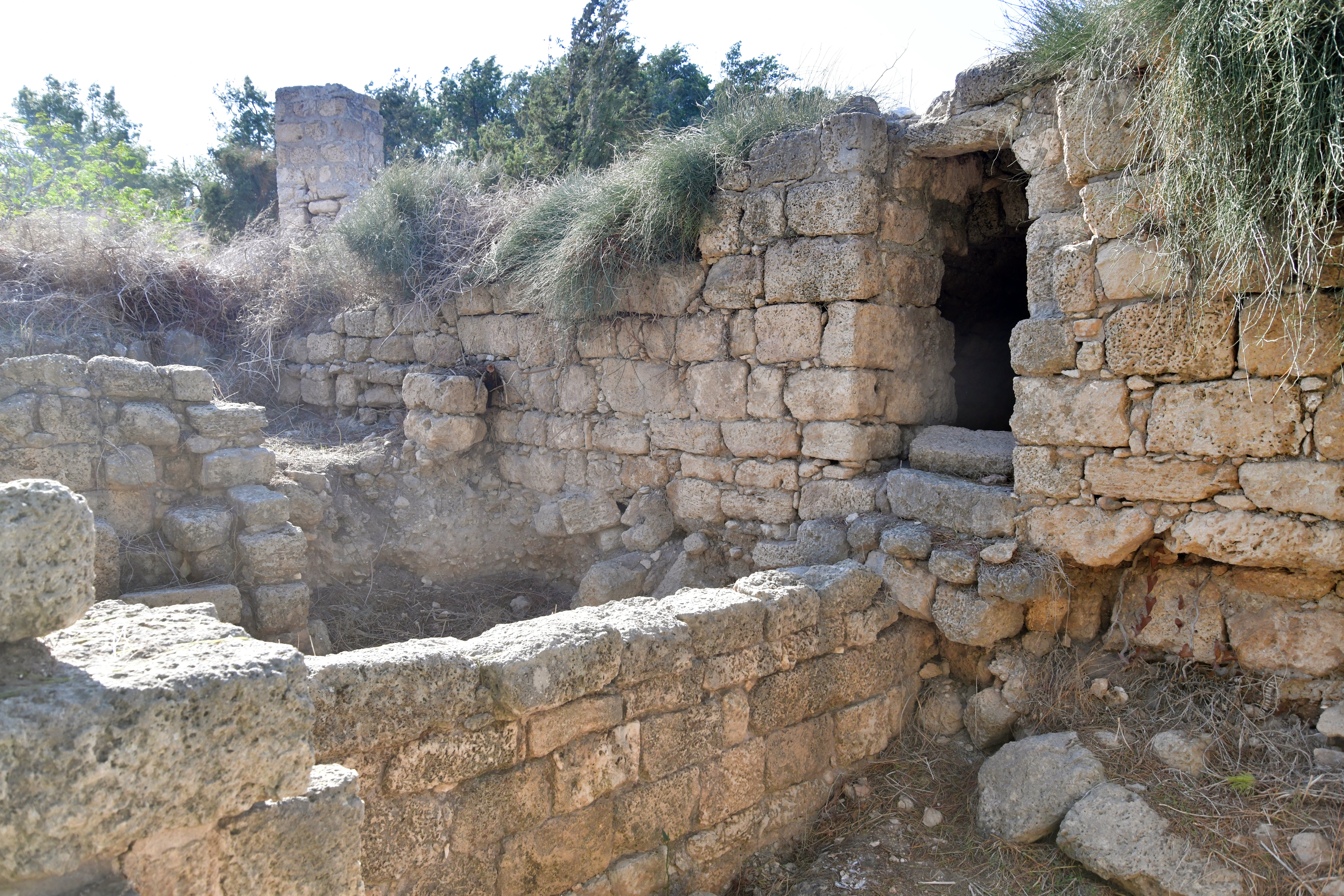
The roof above the winepress is constructed from long stone slabs supported by arches.
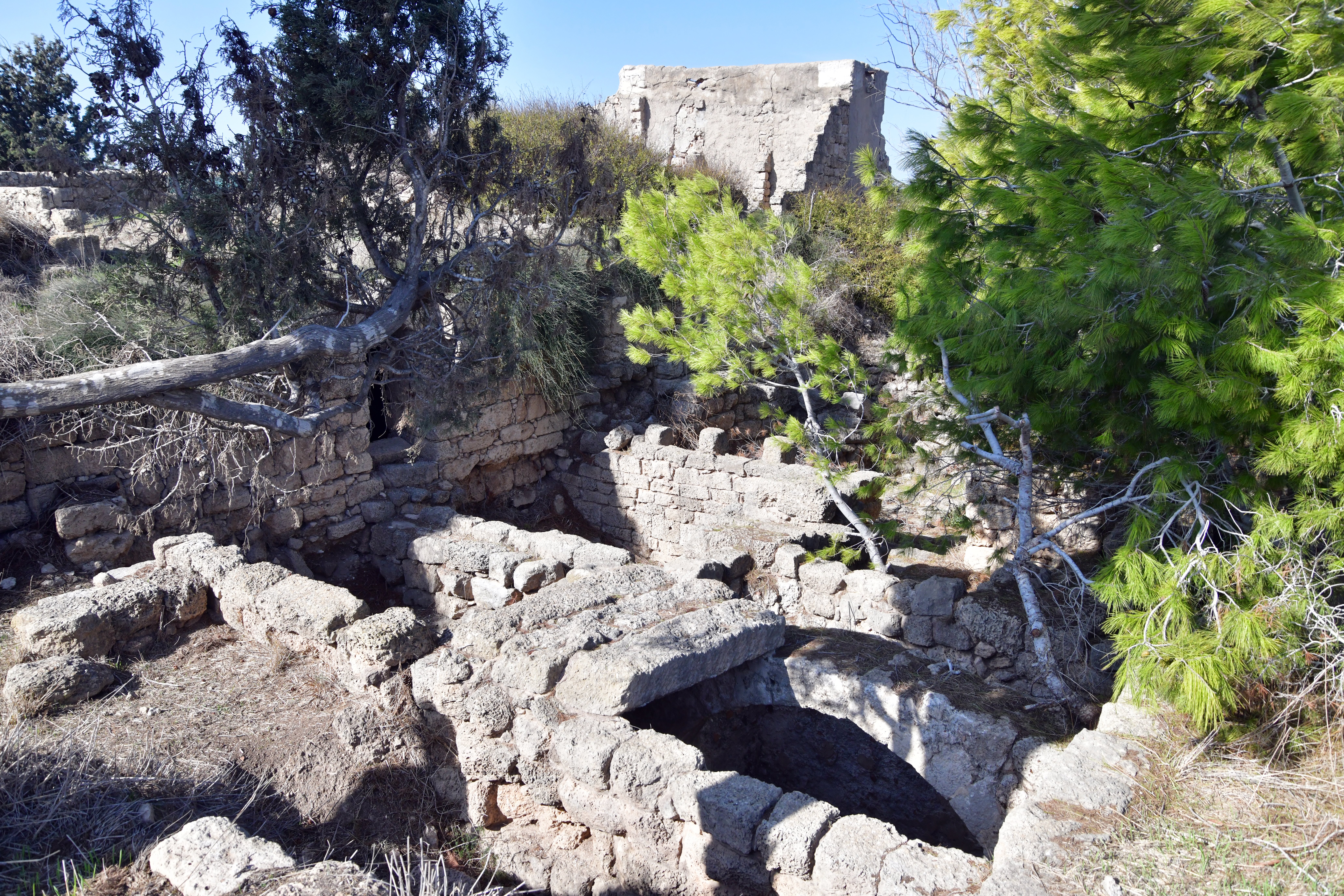
There are two other staircases in area ’10’, but they were used to climb up to an upper floor.
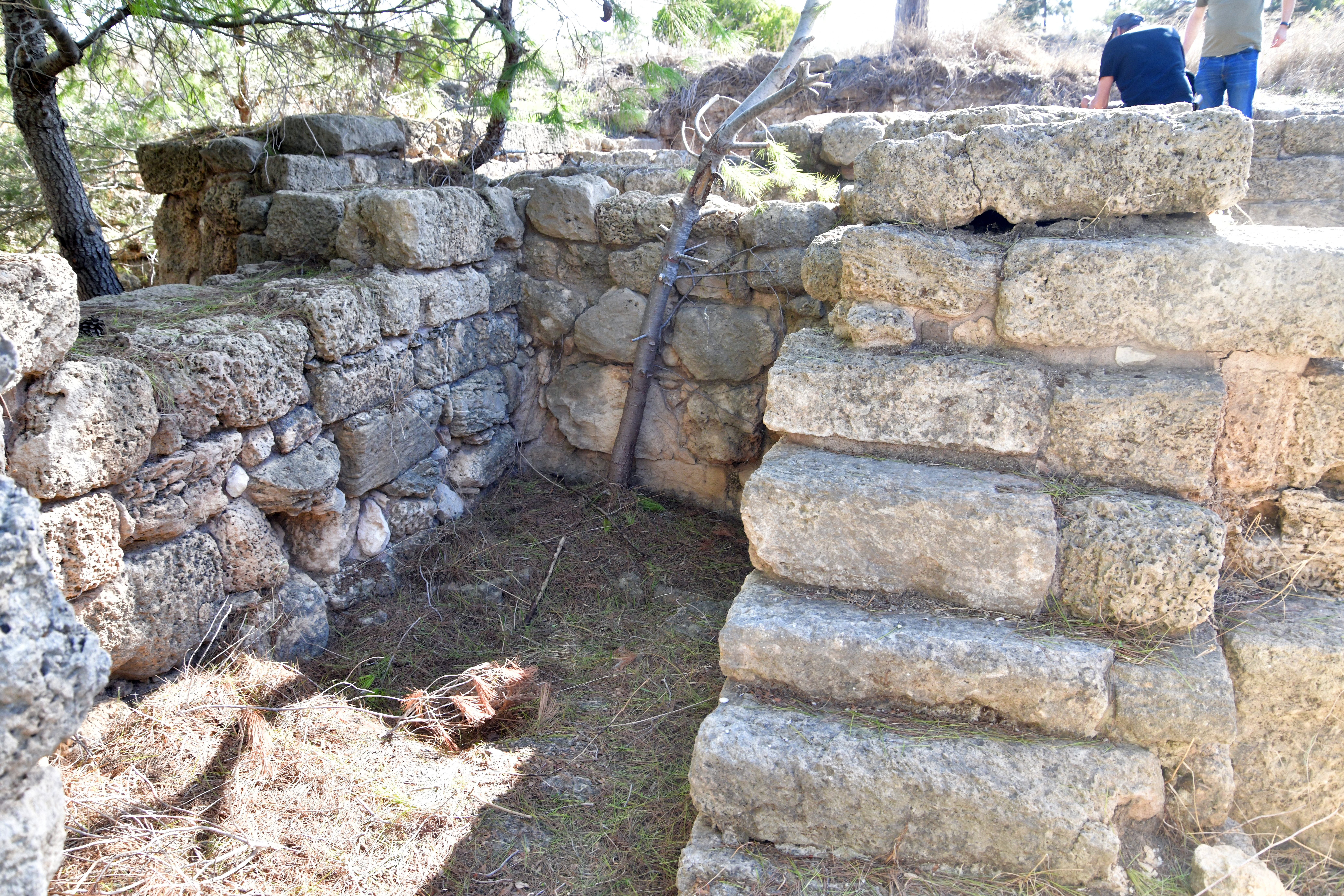
On the west side of this area are a pair of vaults (‘V10’, ‘V11’).
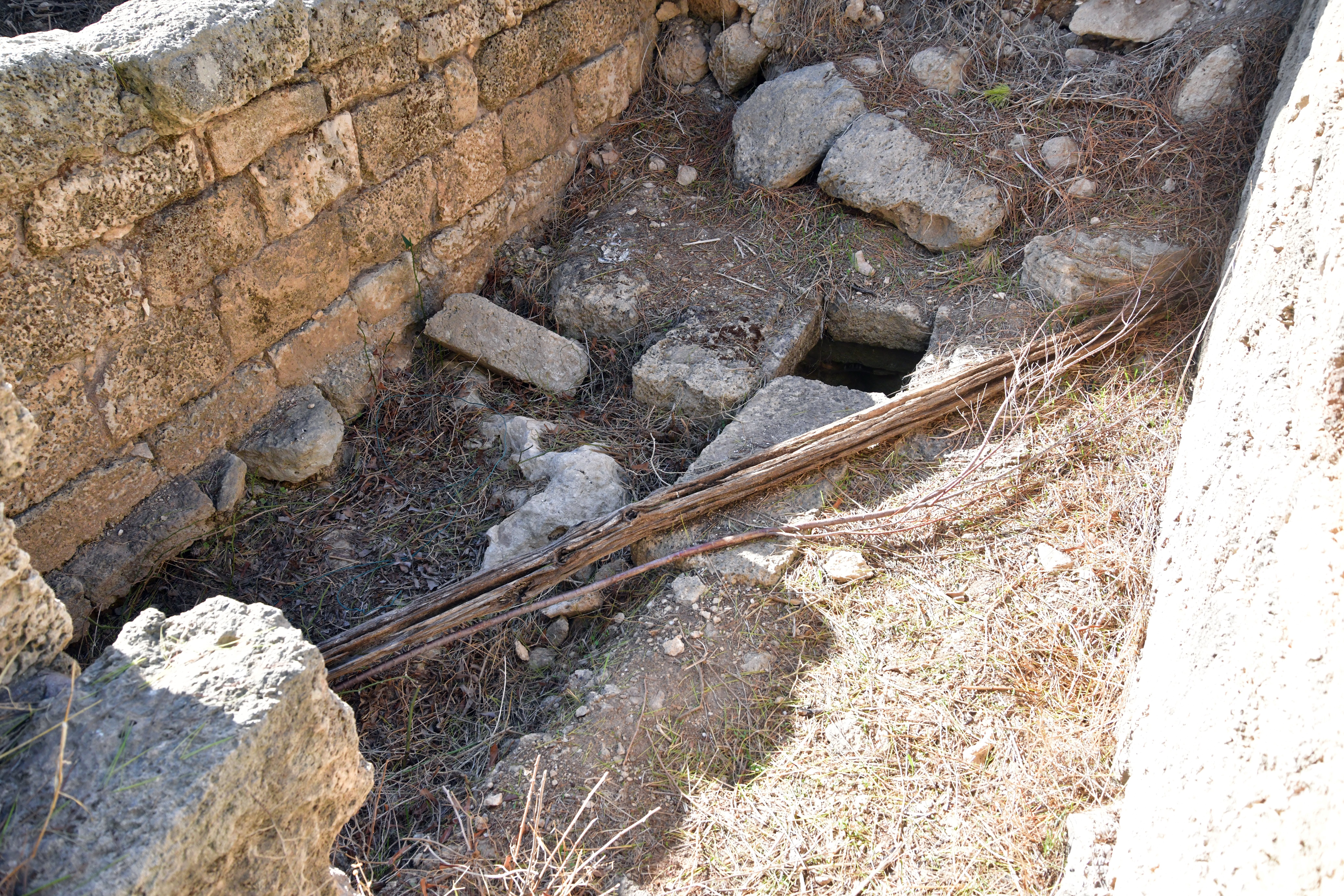
This area also contains two bell-shaped cisterns, which collected runoff rainwater to supply the fortress with water. Their walls are coated with hydraulic plaster.
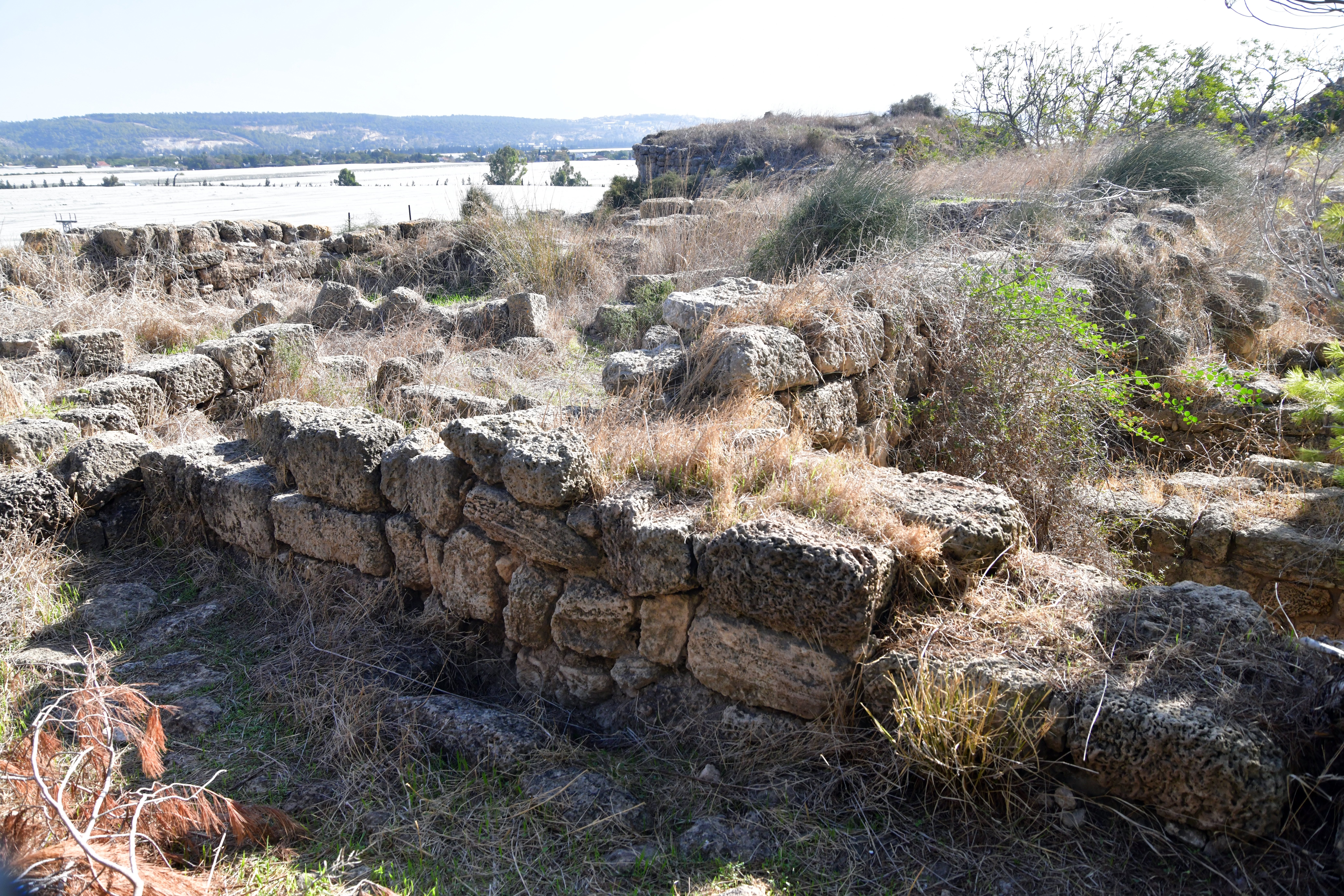
The following photo is of the eastern side of the area. These walls are the bases of several rooms.
In the far background is the western edge of Mt Carmel.
The eastern side of the fortress, seen here, was not yet excavated.
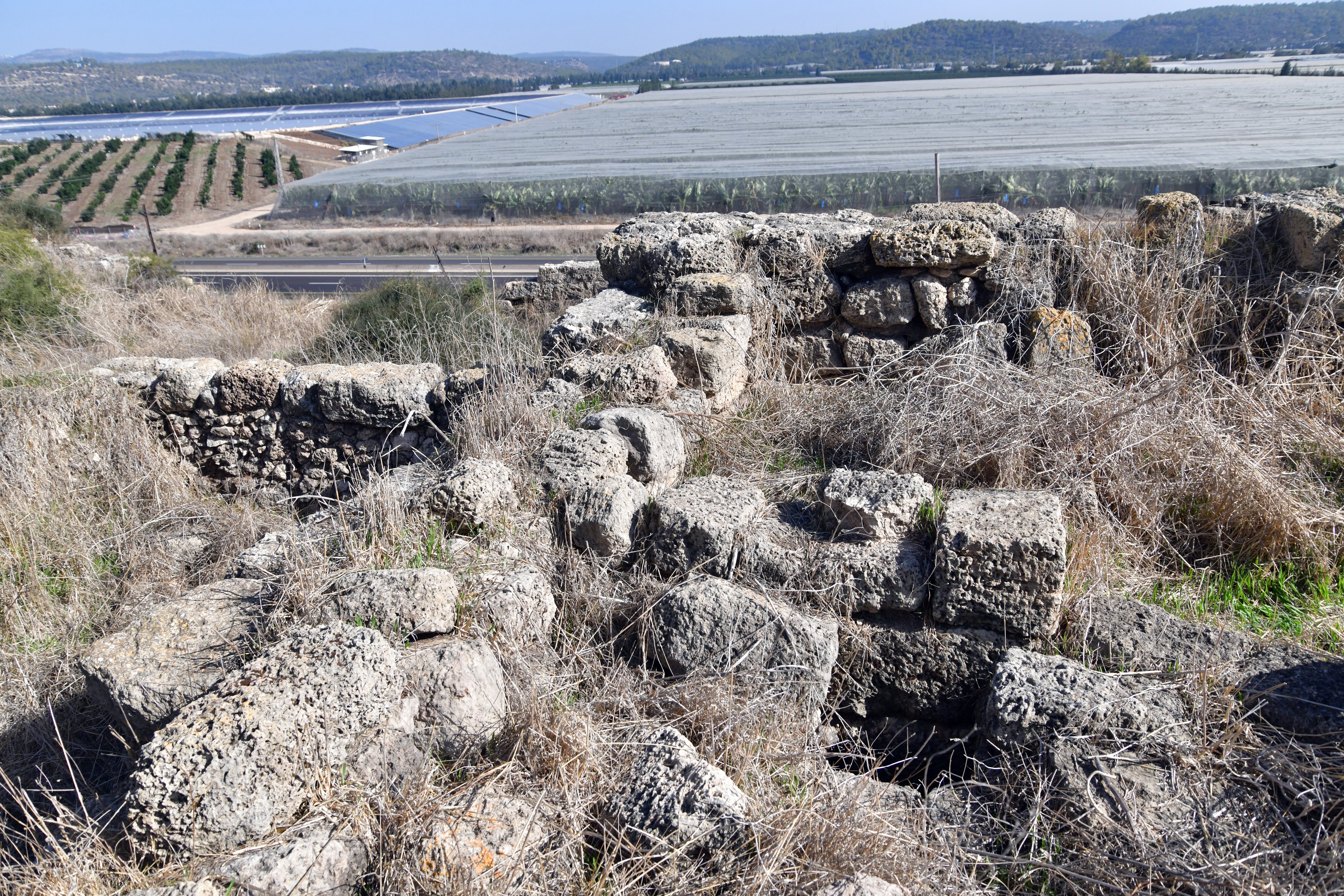
(f) Northern side
Along the northern wall are remains of the Arab houses of Kefar Lam, dated to the Ottoman and British mandate periods. It was not excavated yet.
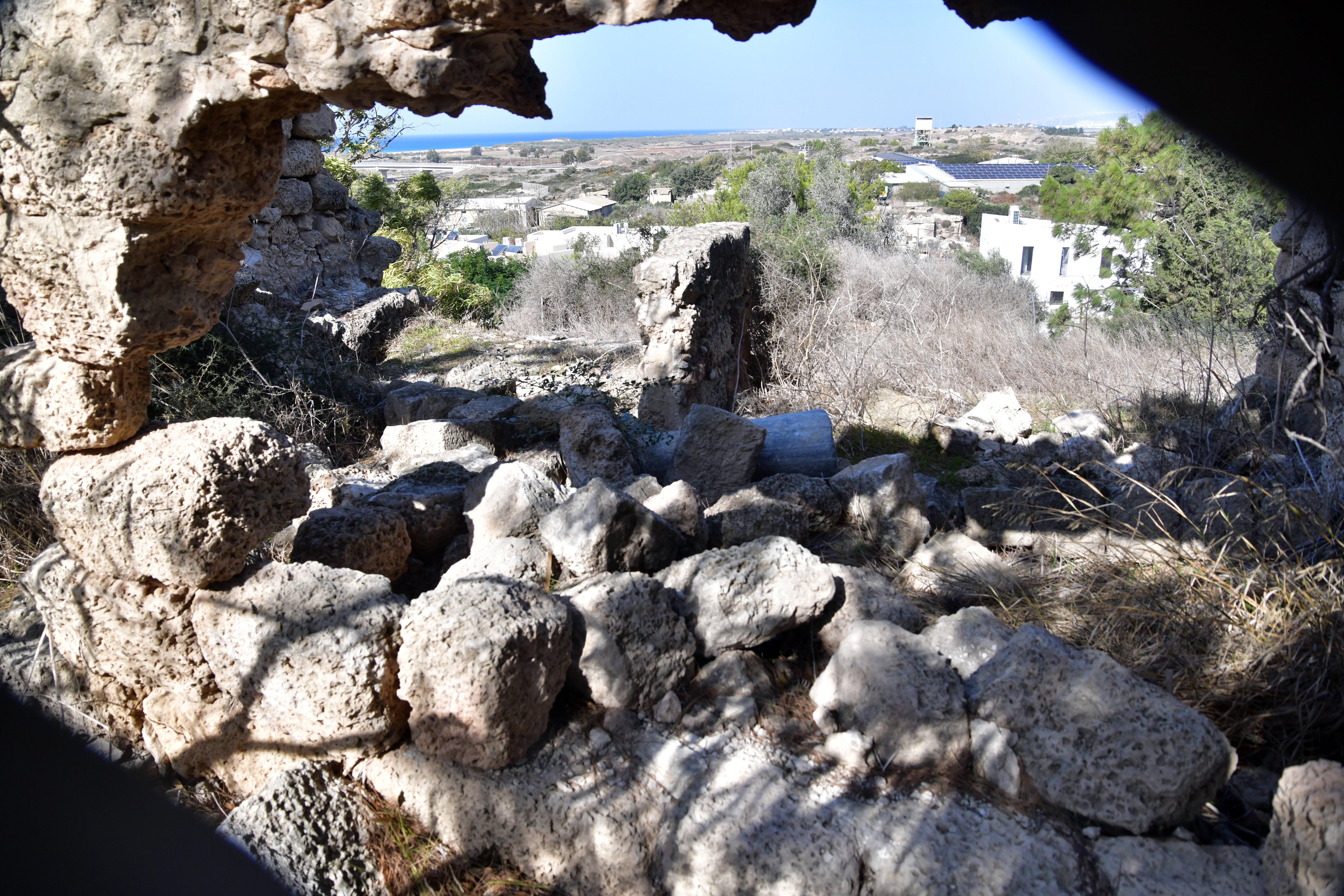
The conditions of these structures is dangerous as the walls are crumbeling and are not safe. They should be removed so the original Crusader wall and structures could be unearthed.
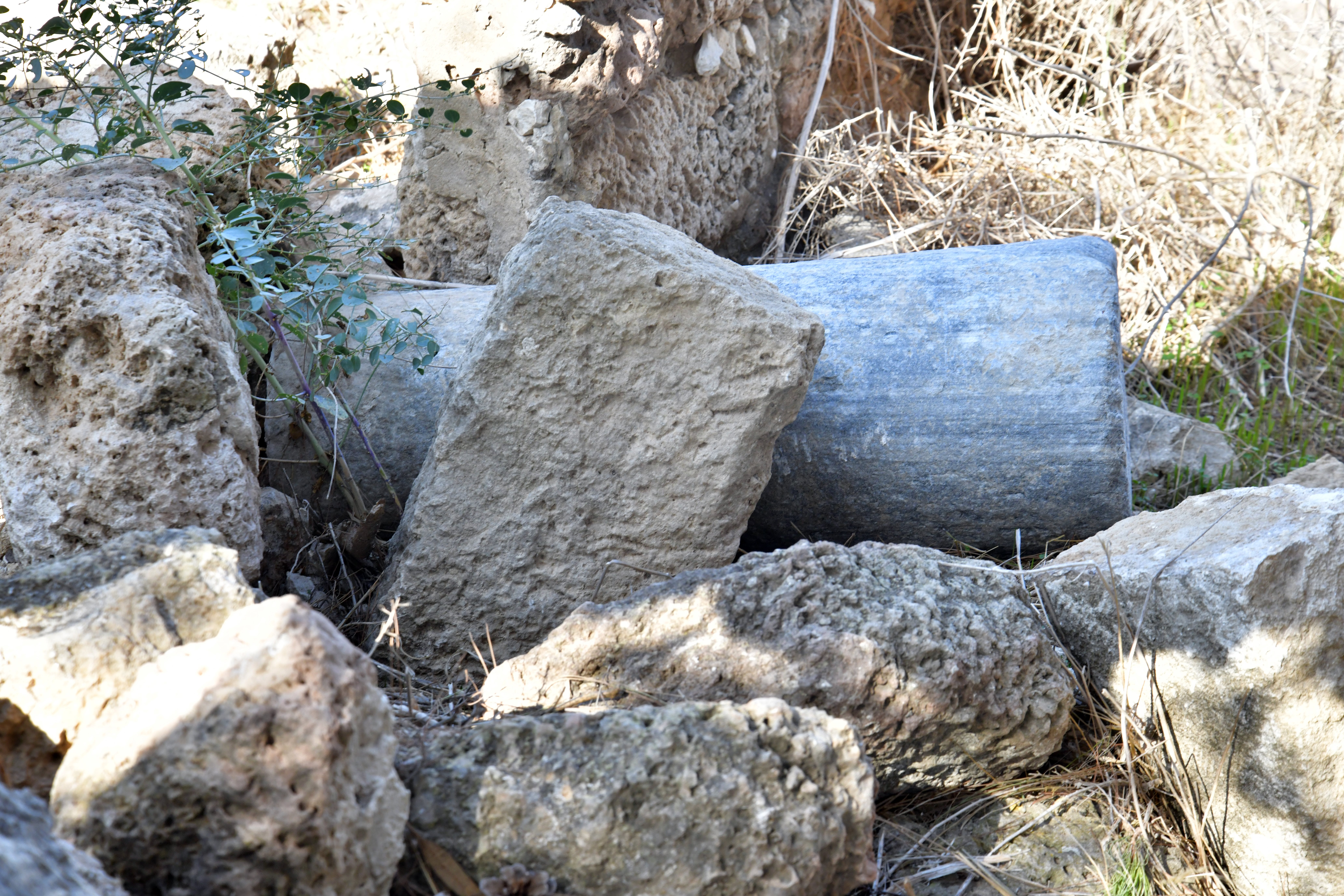
Among the rubble is a marbel pillar. It was probably reused from one of the Byzantine period structures that were found in the area.
(g) Eastern exterior
The area on the eastern exterior of the castle was excavated in 1999 and was designated as “Area 40”.
This is a view of the south east tower. The tower has a diameter of 5.2m.
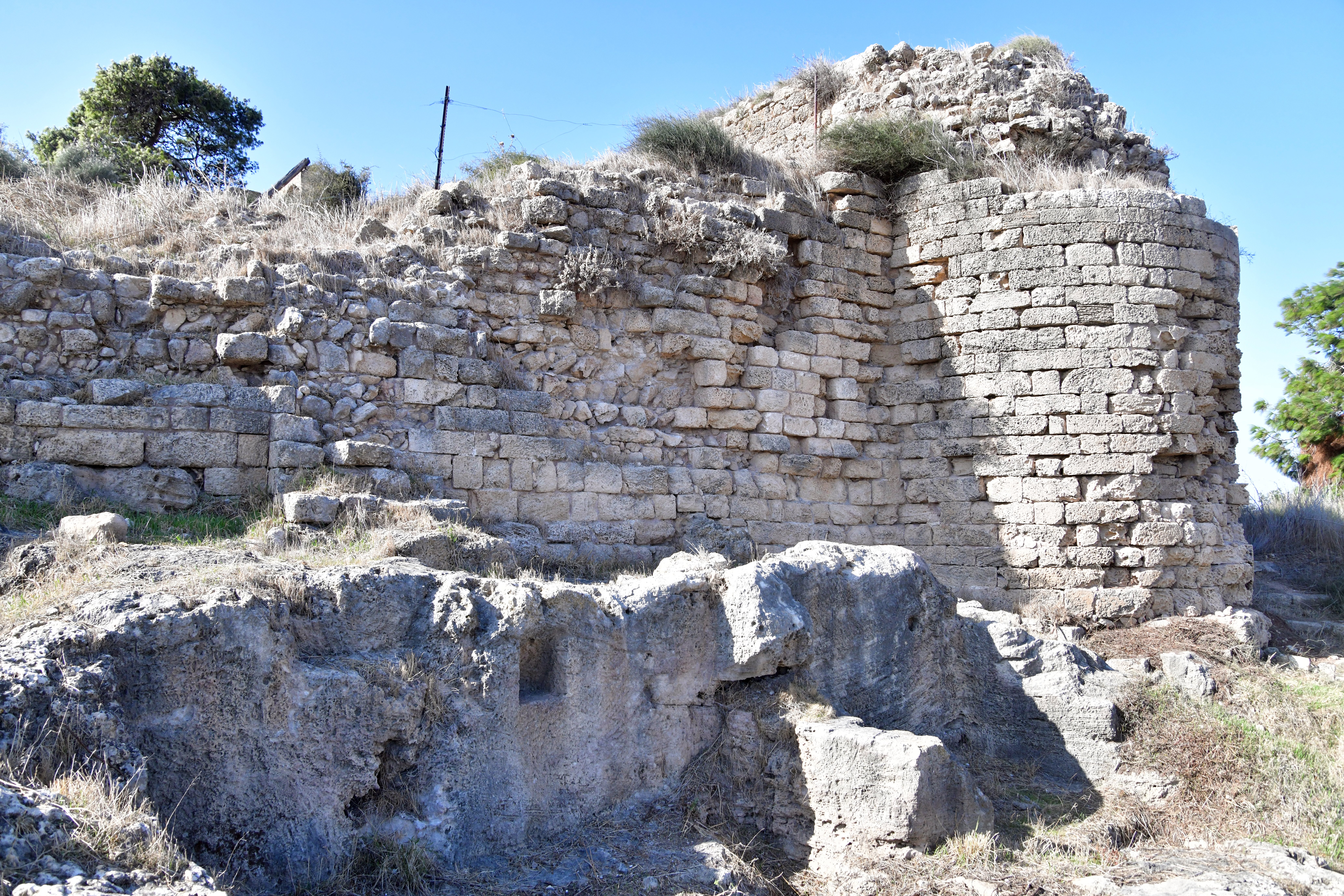
Along the eastern wall are several installations. They could have been constructed during the Byzantine period. Some of the rock cutting was also from the Muslim or Crusader period, as the builders of the fortress used the stones for both building material and also to creat a defense moat.
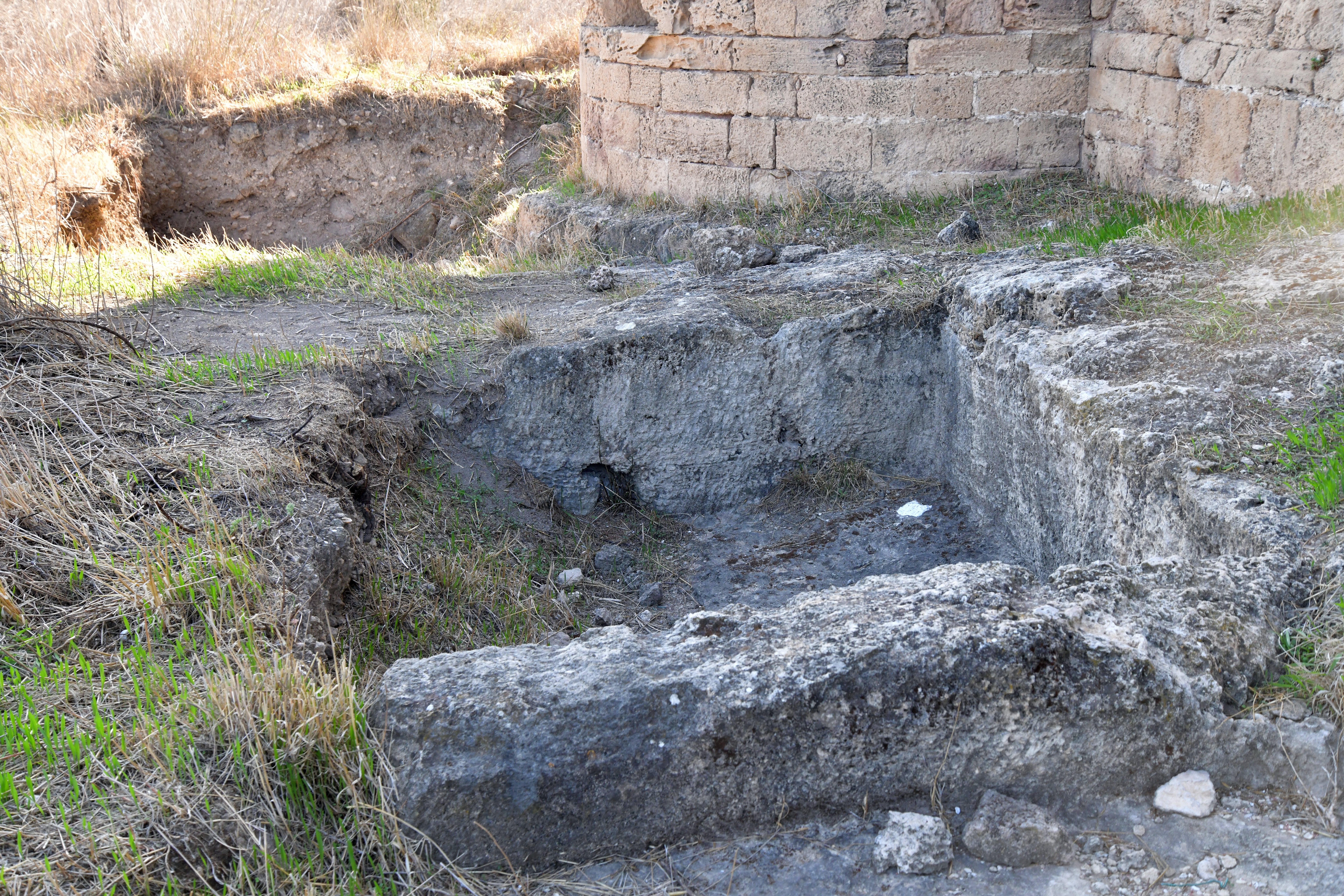
In the photo below is a view of the north east tower and a section of the eastern wall. Below the wall are rock cuttings and installations.
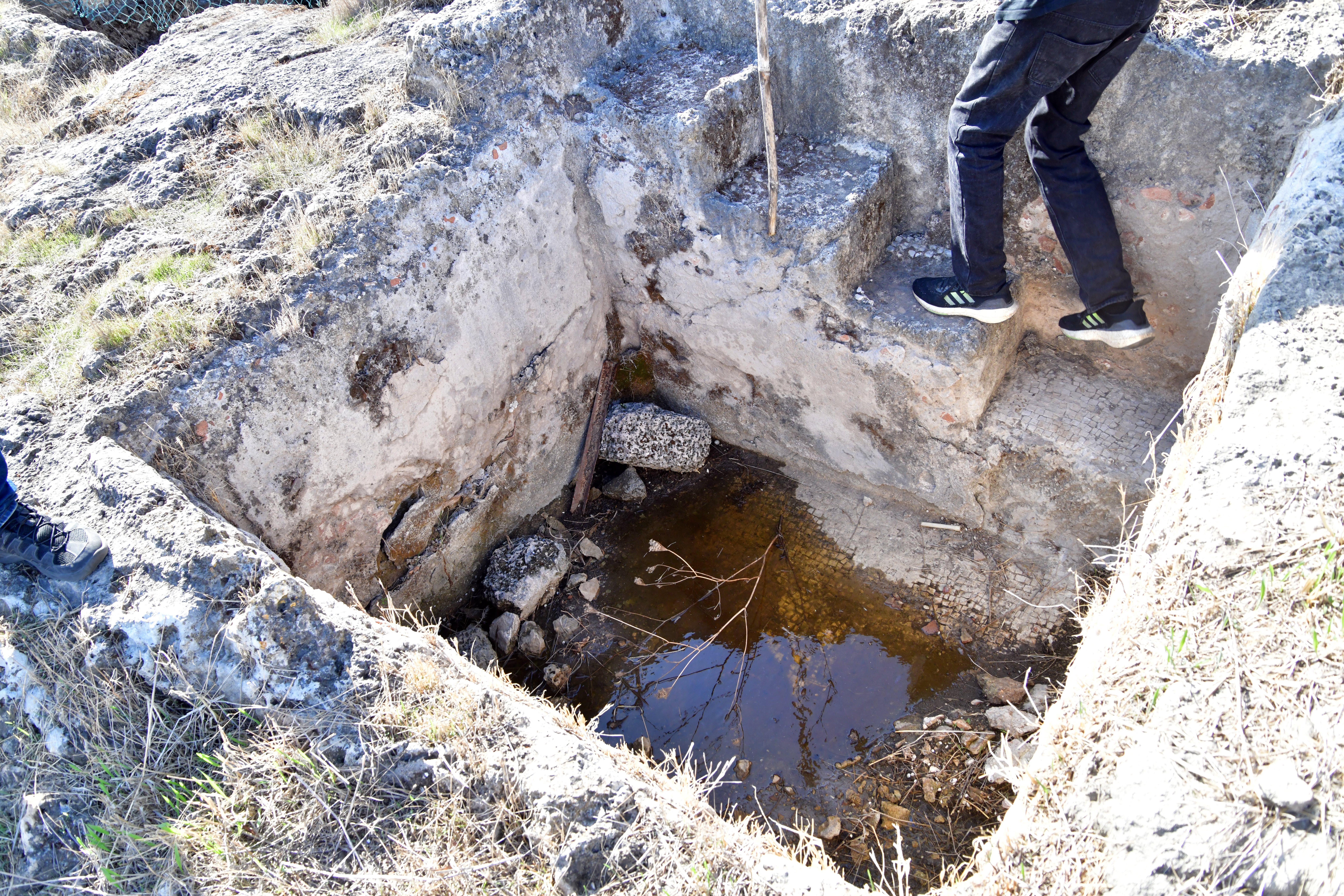
A winepress is also found here, with the same plan as the winepress that was found inside the fortress: square pool, staircase, plastered walls, mosic floor.
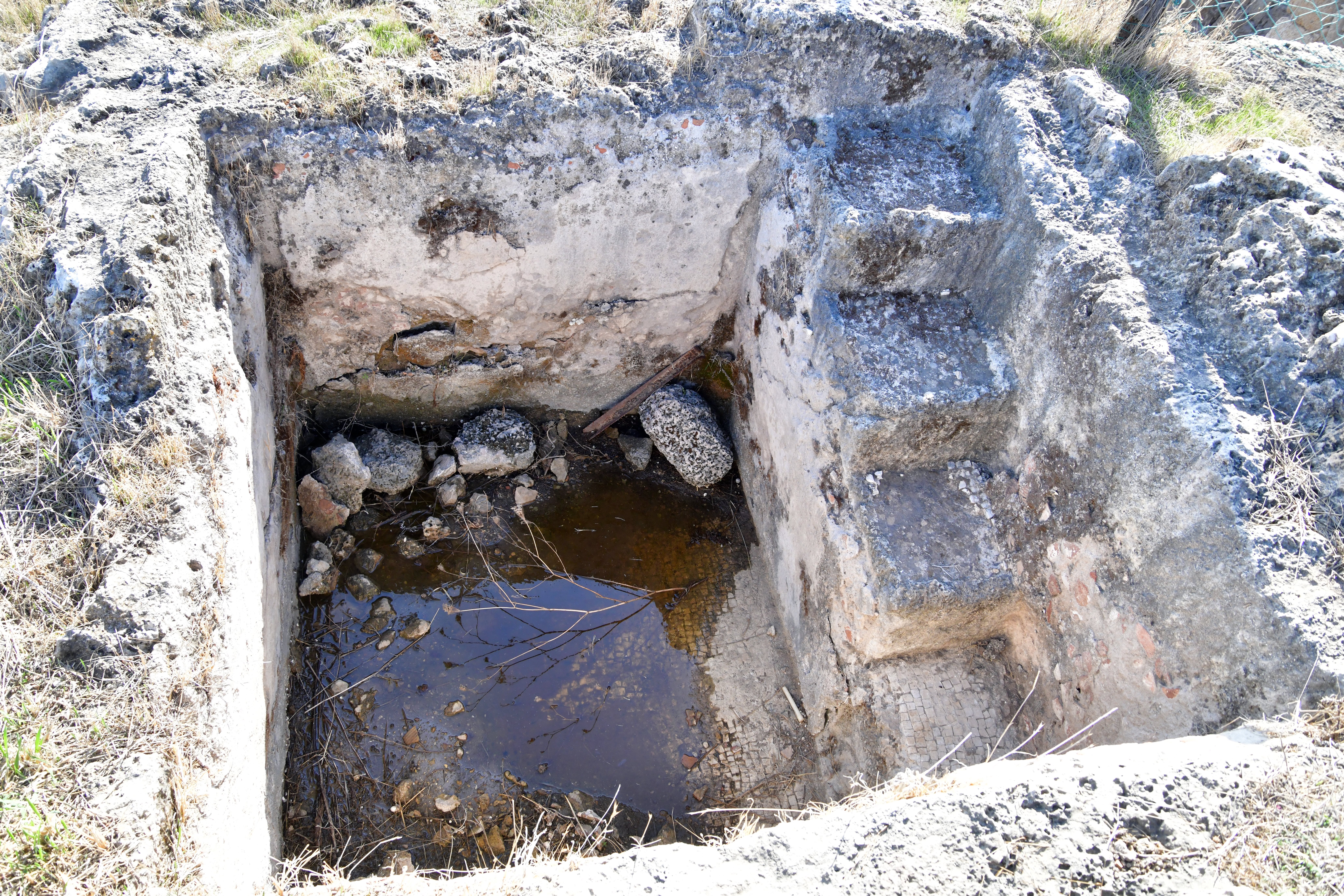
Another view of the winepress pool is below. Nearby is yet another winepress.
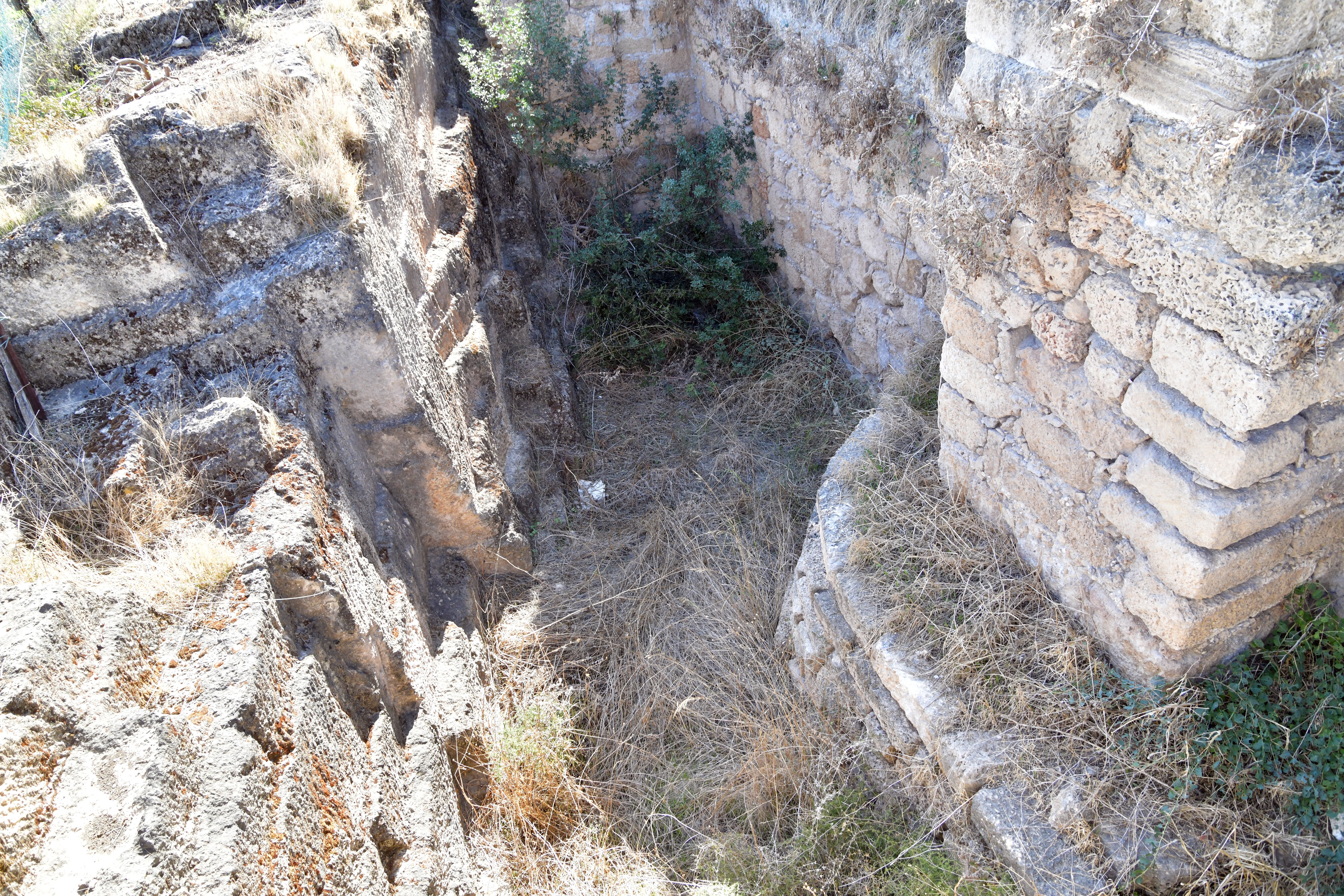
Below another section of the eastern wall is a deeper hole. It was probably used as a quarry for extracting building blocks, and then used as a wet moat by plastering the walls.
One of the buttresses that supported the walls is seen on the right side. It was reenforced with a structure that was built around it.
(h) Byzantine Burial cave
It had a rolling stone that stood on the hidden left side, but now its pieces lie on the floor before the burial cave.
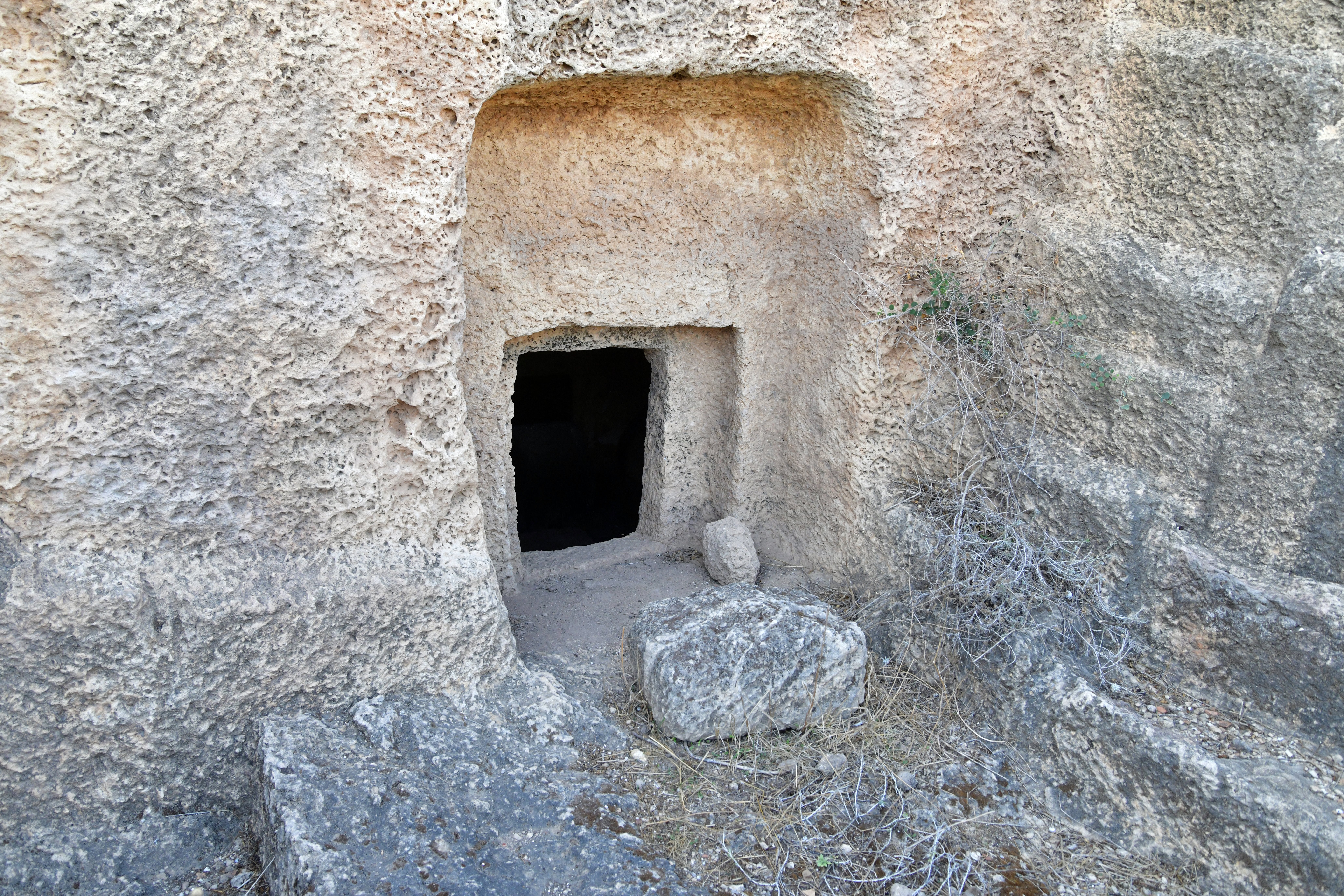
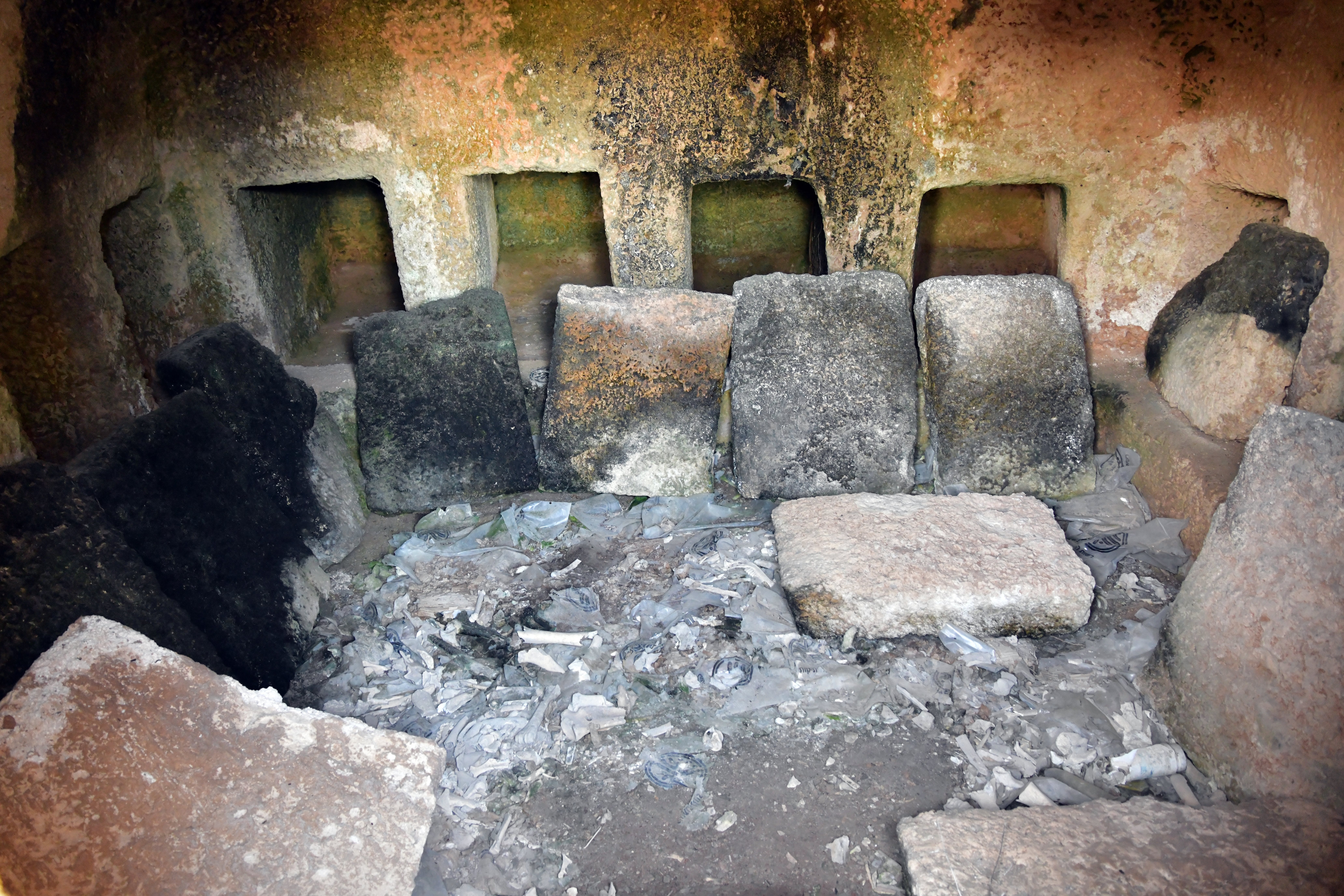
When explored, the interior contained ten hewn crypts (burial troughs) with their lids propped up. Inside the tombs the archaeologists found 55 skelatons, coins and jewlery dated to the Byzantine period.
Videos:
 This video summarizes a field survey of the Crusaders fortress by BibleWalks staff and Martin Telinius. It was conducted on Nov 2025.
Archaeological References:
- Pottery of the Crusader, Ayyubid and Mamluke periods in Israel – Miriam Avissar, Edna J. Stern (2005)
Historical References:
- May the Umayyad Coastal Ribāt Fortress of Kafr Lāb Have Been Built in Memory of Mujāhid ibn Jabr? Hassan S. Khalilieh, AL-MASĀQ 2022, VOL. 34, NO. 3, 292–313
- Habonim-Kafr Lām: A Ribāt of the Levantine Coastal Defensive System in the First Centuries of Islam – Hervé Barbé and Itamar Taxel – The Art of Siege Warfare and Military Architecture from the Classical World to the Middle Ages, pp 153-163
- Laurence Oliphant “Haifa, or Life in Modern Palestine” [1884]
His article was published on Dec 13 1884 in the New York “Sun”, with the title “Identifying ancient sites”, where he tells his readers about his trip to the ruins of Kefar Lam and his exploration of the fortress.
|
He calls the village “Kefar Nahum (Capernaum) of the Crusaders”. This tradition was adapted by the Crusaders, who substituted the real site on the shore of the Sea of Galilee with this place for practical reasons (of access and security). He wrote about two vaults, each 40 feet long, 12feet wide and 7 feet high. The roofs are supported on 5 arches. He also tells about a 35 ft deep well that the villagers discovered near the fortress, with steps descnding to the water level. As a reporter, his articles ignited the imagination and curiosity of the World… Indeed, a pioneer of Bible Walks! “Haifa” by Laurence Oliphant is a recommended book for the period of rediscovering the Holy Land. |
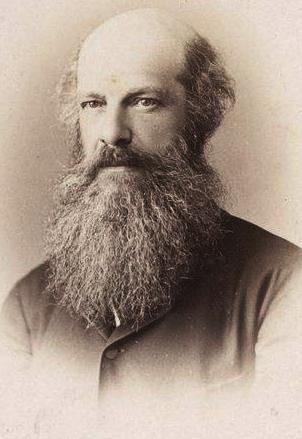
Laurence_Oliphant (1829-1888) Public domain photo |
BibleWalks Links:
- HaBonim – other antiquities south of the fortress
- Winepresses – BibleWalks info page
Etymology – behind the name:
-
HaBonim – Hebrew: the Builders. This was a Zionist youth organization that was established in 1933, helped the Jewish immigration, and built 25 settlements (all of them Kibbutz, and a single Moshav – named after the organization). It merged with “HaNoar Ha-Oved” in 1959.
- Moshav HaBonim – founded in 1949 on the ridge west of the modern highway.
-
Kfar Lam:
The original name was the Arab village Kafr Lam (كفر لام). “Kafr” (or “Kfar”) means village in Aramaic and Arabic. Meaning of “Lam”: The second part, Lam, is believed to refer to a person or family name, essentially meaning the “Village of Lam” or “Kafar Lab” (Village of Lab). Some historical accounts attribute its establishment to the Umayyad caliph Hisham ibn ‘Abd al-Malik (ruled 724-743 AD). Crusader Name: During the Crusader period, the site, which included an ancient fortress, was known as Cafarlet or Capharleth, which appears to be a derivative or transliteration of the original Arabic name.
-
A ribāt (Arabic: رِبَاط) is an Arabic term for a fortified building that served a dual purpose in the early Islamic period, functioning as both a fortress and a religious center.
Originally established along frontiers and coastal areas, particularly during the Muslim conquest of North Africa (the Maghreb), the ribāṭ housed military volunteers known as murābiṭūn (or murabitun), who were dedicated to the defense of Islam (jihād) and border patrol.
- Cafarlet or Capharlet – The Crusader name is a hybrid name derived from the Arabic Kafar Lam. The name was formed by combining the existing Arabic prefix Kafr (meaning “village”) with the French diminutive suffix -let, which means “small.” Thus, the name essentially translates to “Small Kafar” or “Small Village of Lam.”
BibleWalks.com – walk with us through the sites of the Holy Land
Habonim <<<—previous Carmel site —-<<<All Sites>>>—next Carmel site—> >> Tel Dor
This page was last updated on Nov 30, 2025 (minor updates)
Sponsored Links: