
The gate is located on the east side of the old city, leading to the temple, and regarded as the Holiest gate for all faiths. The gate was built in the 6th/7th century AD over the ruins of an ancient gate, and was sealed since the 16th century.
Home > Sites > Jerusalem > Golden Gate (Gate of the Mercy)
Contents:
Overview
Location
History
Photos
Biblical
Etymology
Links
Overview:
The Golden Gate, also known as the Gate of Mercy or the Eastern Gate, is a historic entrance to the Old City of Jerusalem. The gate is located on the eastern side of the city walls, facing the Mount of Olives. It is regarded as a Holy site for all faiths – Jewish (arrival of the Messiah) and Christian (entrance of Jesus on Palm Sunday) and Muslim (site of future resurrection).
The gate was built in the 6th/7th century AD over the ruins of the second temple gate. It is sealed shut and has been blocked off since the 16th century. The reason for its closure is a matter of historical debate. According to Jewish tradition, the Messiah will enter the city through the Golden Gate when he arrives. To prevent the Messiah from coming, the gate was blocked off by Muslim conquerors in the 8th century. Others believe that the gate was closed as a military measure to prevent invaders from entering the city.
Ezekiel 44 2: “This gate shall be shut, it shall not be opened, and no man shall enter in by it; because the LORD, the God of Israel, hath entered in by it, therefore it shall be shut”.
The current gate structure dates back to the Ottoman period in the 16th century. It is a magnificent example of Islamic architecture, featuring a large central arch and smaller side arches. The gate is made of stone and decorated with intricate carvings and Arabic inscriptions.
Visitors can view the exterior of the Golden Gate from outside the city walls or from the Mount of Olives. The gate is not open for entry, but it remains an important symbol of the rich history and diverse traditions of Jerusalem.
Location:
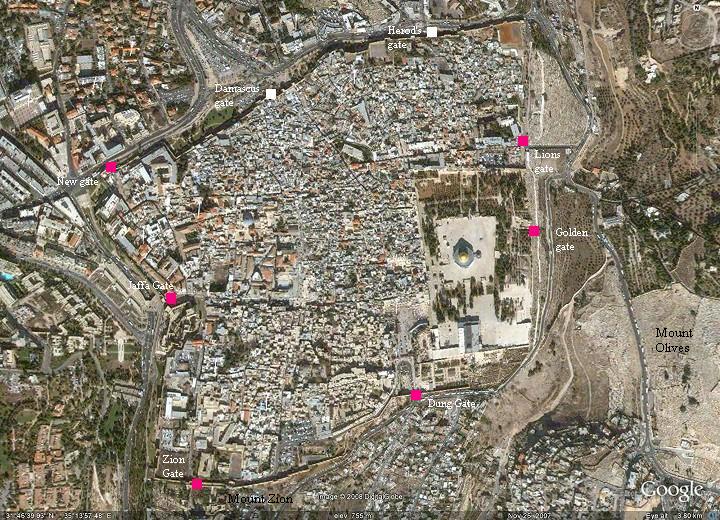
The aerial map shows the 8 gates of Jerusalem, with the Golden gate on the right (east side), facing the Kidron valley and Mount of Olives. These are the gates, listed clockwise starting from the west corner:
1. New gate
2. Damascus gate (on the north-western side)
3. Herod’s gate (on the north side)
4. Lions’ gate (near St. Anna)
5. Golden gate (this site; a closed gate)
6. Dung gate (on south side, near the western wall)
7. Zion gate (on the south-west side)
8. Jaffa gate (tower of David)
History of the place:
- First temple
A gate was located on the eastern side of King Solomon’s temple (10th century BC), and called the “east gate” (“Kadim” in the Hebrew Bible). Its location was probably at the vicinity of the Golden gate, inside the temple.
- Second temple
The second temple was first built in the 5th century BC by the returnees from the Babylonian exile. The gate, located on its eastern side, was called Shushan (or Susa), named after the ancient Persian capital. The remaining community in Persia paid for the construction of this gate.
The temple was renovated during the Herodian reconstruction (1st century BC). A reconstruction is illustrated on the right, and the gate is circled by a yellow line.

The Shushan gate was destroyed by the Romans during the destruction of the temple in 70AD.
According to Jewish tradition, the Messiah will enter through the gate riding on a white donkey. Ever since the destruction of the temple the Jews pray here to rebuild the gate and allow the spirit of God to return to the city, and the Messiah to pass the gate, asking for mercy and revival of the gate (hence the Jewish name of the gate: Sha’ar Harachamim – Gate of the Mercy).
According to Christian religion, Jesus is the Messiah; according to tradition, he entered through the Golden gate on the Sunday before Passover (“Palm Sunday”) riding on a donkey, an event that further angered the Jewish leaders and eventually led to the crucifixion several days later.

East of the temple mount, with Golden gate in the center. (part of Jerusalem Museum’s model of the city of Herod)
- Byzantine
A new gate was built over the ruins of the ancient gate in the 6th by the Byzantines (or in the 7th century by the Arabs). This makes the Golden gate the oldest gate in the present walls.
After the defeat of the Persians (629-630 AD) the Byzantine emperor Heraclius entered, barefoot as a Christian pilgrim, through the gate with the remains of the true cross, which he recovered from the Persians and returned to the Church of Holy Sepulchre. This event is ever since celebrated as the Elevation of the Holy Cross celebration, in different dates (March 21, September 14, and other dates).
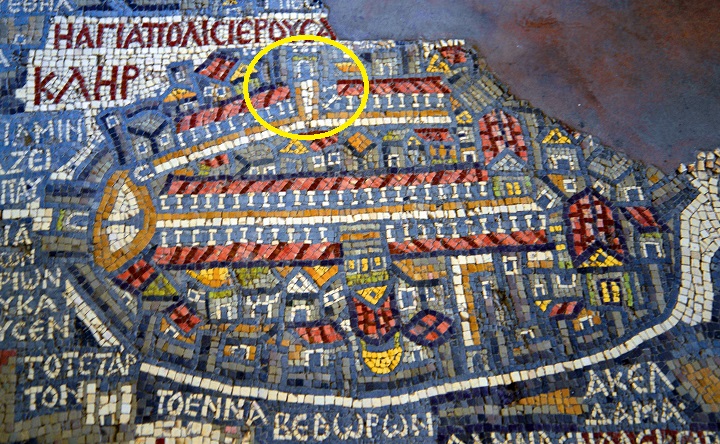
In the 6th/7th century Byzantine map from Madaba, the eastern gate is shown in the top center (eastern side in the ancient map), and is circled in yellow. It is seen connected by a street to the secondary Cardo.
- Crusaders
The Golden gate was opened twice a year – on Palm Sunday and on the Holy Cross celebration in March. After their defeat in 1187, the gate remained closed.
- Ottomans
The Ottomans built the present walls of Jerusalem in 1540. However, they sealed the Golden gate in 1541 AD in order to prevent the Messiah’s entrance, which according to the Jewish tradition will enter this gate. A cemetery was built in front of it, outside the walls, as part of the concept that the Messiah will not pass through a cemetery.
Photos:
Eastern (External) side:
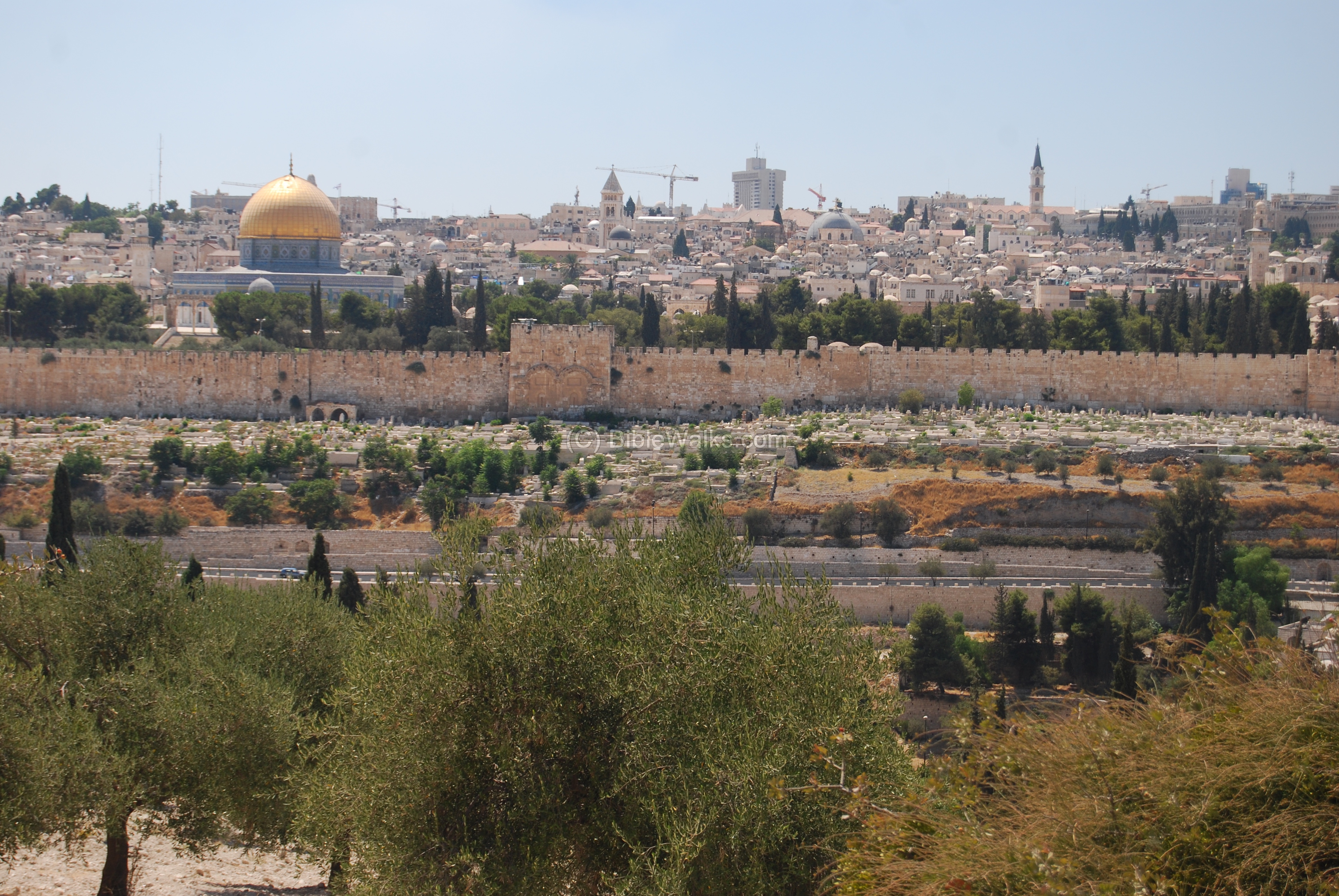
A view from the east is seen below, with the sealed Golden gate in its center, and the Golden Dome of the Rock to its left. This photo was taken from the foothills of Mount of Olives, across the Kidron valley.
Click on the photo to view it in higher resolution…
The Golden gate is shown in a closer view:
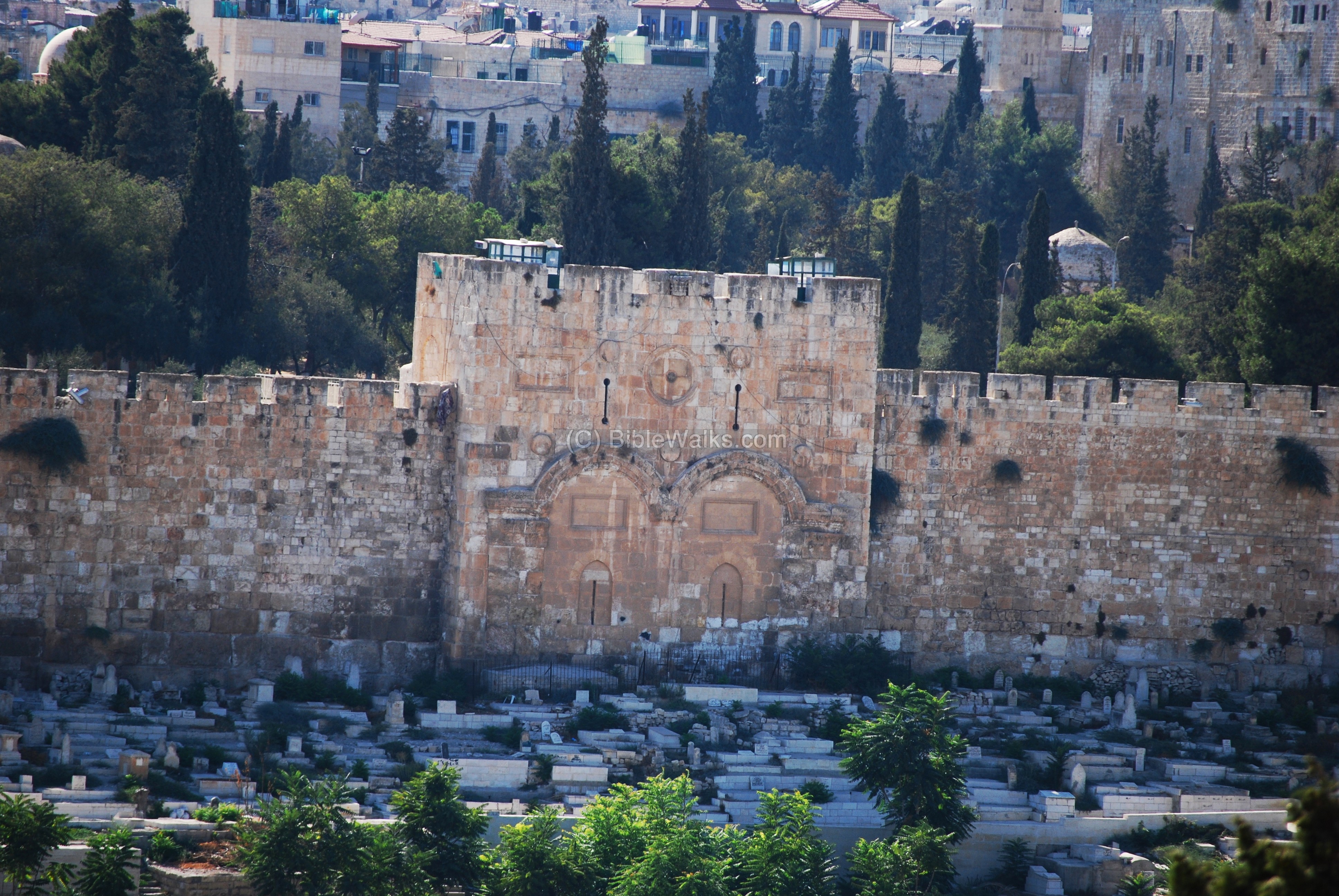
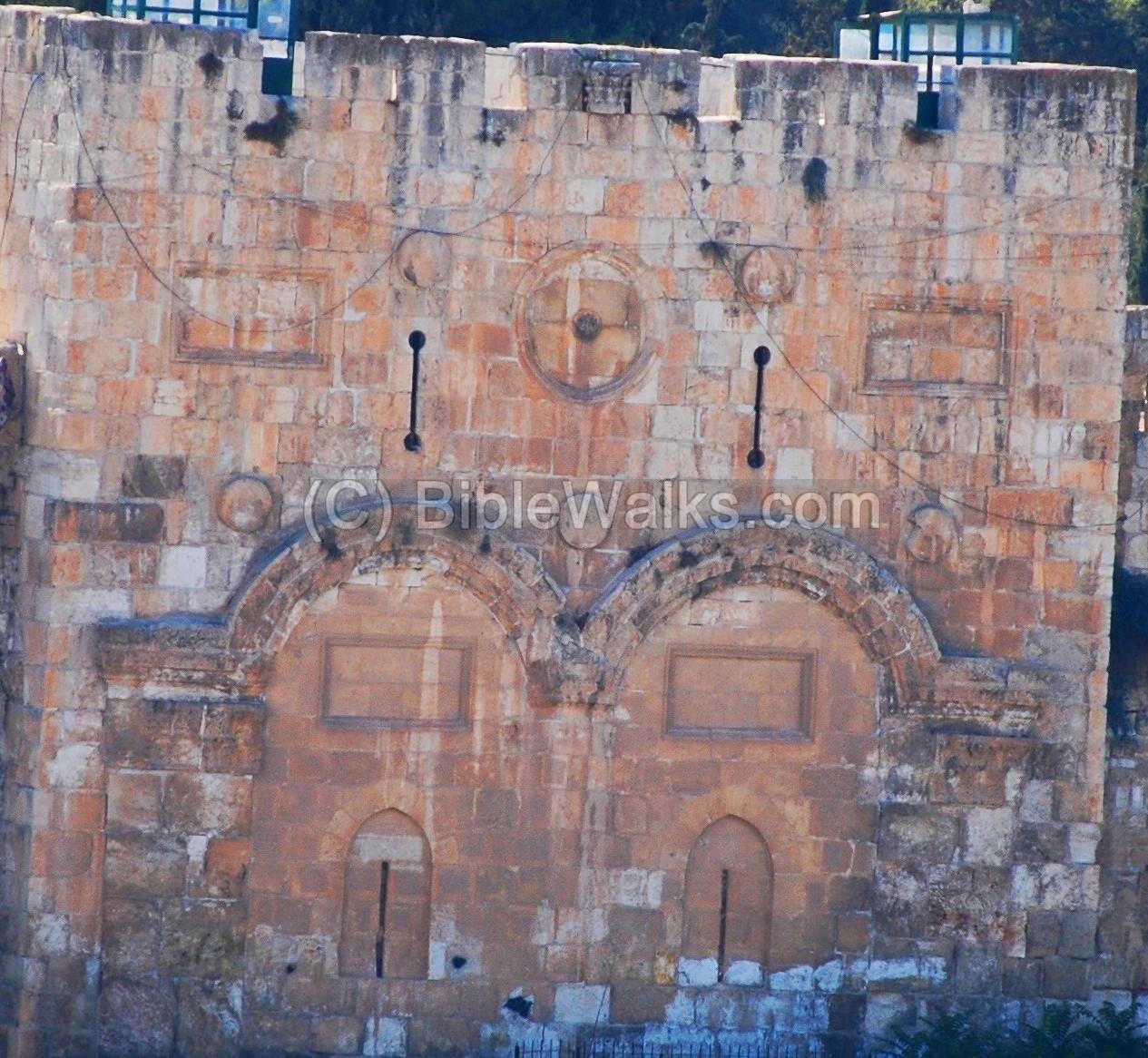
A detail of the sealed gate is seen below, with the double gates. The north side of the gate (on the left) is called the repentance entrance, while the southern side is called the mercy entrance. The sealed gate is dated to the 6th/7th century AD.
Behind that gate is a staircase is the gate house. After then is a staircase that leads to the higher platform of the temple mount. Inside the gate house is a set of ancient columns and decorated capitols.
Western side (Temple mount):
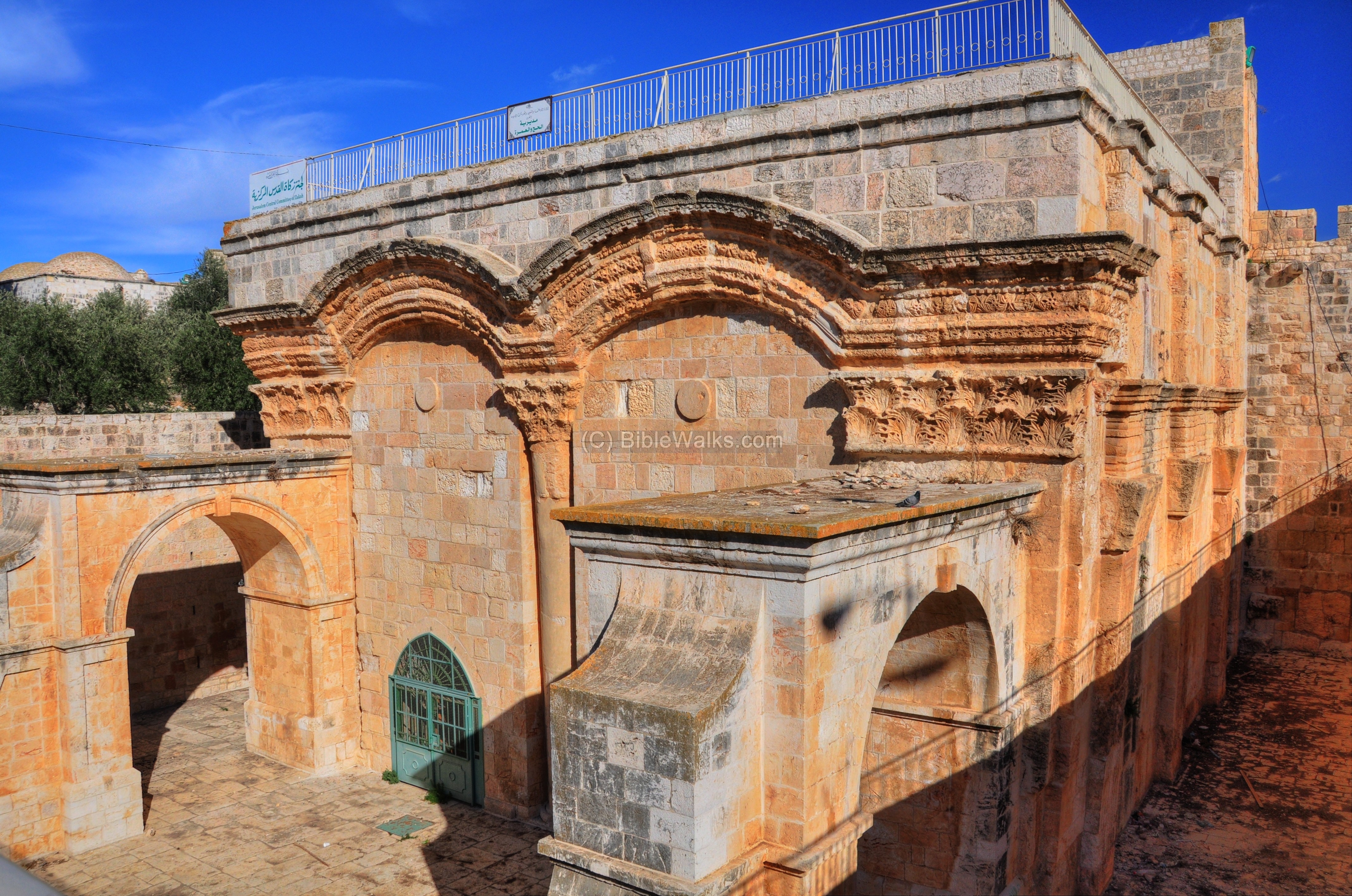
The western side of the gate is visible from the temple mount. A large gate house, dated to the end of the Byzantine period, protects the gate. The following picture is a view from the south-west side.
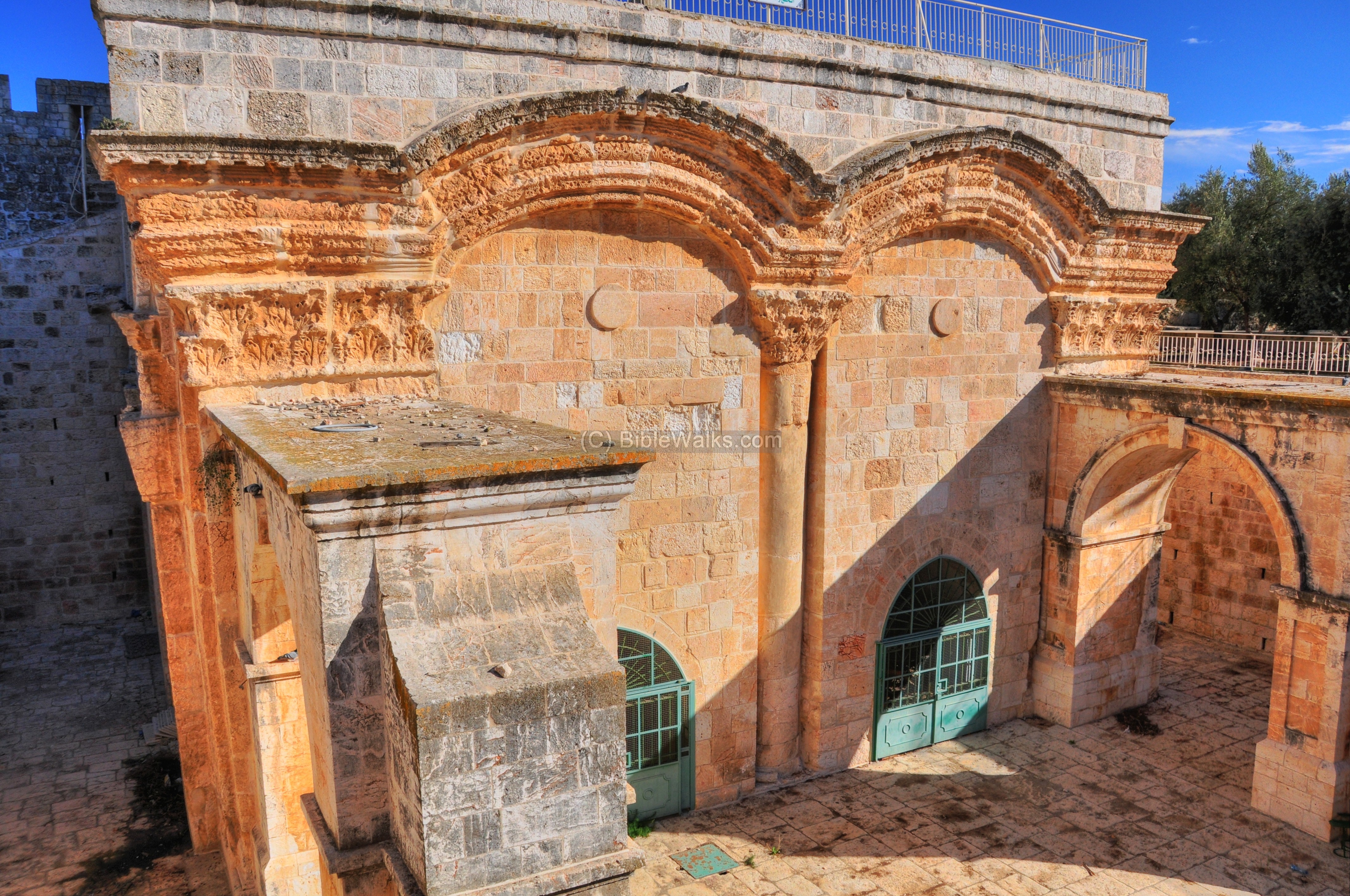
Another view below – from the north-west side.
Biblical References:
(a) Ezekiel 44 1-3:
This text refers to the ancient tradition of the gate in the second temple, dated to the 6th century BC exile in Babylon. According to Ezekiel, God’s spirit left the city through the gate, but will return after the Messiah will return through it.
“Then he brought me back the way of the gate of the outward sanctuary which looketh toward the east; and it was shut. Then said the LORD unto me; This gate shall be shut, it shall not be opened, and no man shall enter in by it; because the LORD, the God of Israel, hath entered in by it, therefore it shall be shut. It is for the prince; the prince, he shall sit in it to eat bread before the LORD; he shall enter by the way of the porch of that gate, and shall go out by the way of the same”.
(b) Mark 11 8-11:
Jesus entered to the temple through the Golden gate on Palm Sunday, chanting Psalms verses:
“…And many spread their garments in the way: and others cut down branches off the trees, and strawed them in the way. And they that went before, and they that followed, cried, saying, Hosanna; Blessed is he that cometh in the name of the Lord: Blessed be the kingdom of our father David, that cometh in the name of the Lord: Hosanna in the highest. And Jesus entered into Jerusalem, and into the temple:”
(c) John 12 12-15; Zechariah 9,9
Another text about Jesus’s entry:
“On the next day much people that were come to the feast, when they heard that Jesus was coming to Jerusalem, Took branches of palm trees, and went forth to meet him, and cried, Hosanna: Blessed is the King of Israel that cometh in the name of the Lord. And Jesus, when he had found a young ass, sat thereon; as it is written, Fear not, daughter of Sion: behold, thy King cometh, sitting on an ass’s colt”
Note that the belief of the Messiah’s return is described in Zechariah’s account of the Messiah (9,9):
“Rejoice greatly, O daughter of Zion; shout, O daughter of Jerusalem: behold, thy King cometh unto thee: he is just, and having salvation; lowly, and riding upon an ass, and upon a colt the foal of an ass”.
(d) Luke 19 35-38:
Another text of Jesus entering the city, chanting Psalms verses with his disciples:
“And they brought him to Jesus: and they cast their garments upon the colt, and they set Jesus thereon. And as he went, they spread their clothes in the way. And when he was come nigh, even now at the descent of the mount of Olives, the whole multitude of the disciples began to rejoice and praise God with a loud voice for all the mighty works that they had seen; Saying, Blessed be the King that cometh in the name of the Lord: peace in heaven, and glory in the highest.”.
(e) Psalms 118 24-26:
These are verses that Jesus and his disciples chanted while entering the temple thru the Golden Gate:
“This is the day which the LORD hath made; we will rejoice and be glad in it. Save now, I beseech thee, O LORD: O LORD, I beseech thee, send now prosperity. Blessed be he that cometh in the name of the LORD: we have blessed you out of the house of the LORD”.
Etymology (behind the name):
- Sha’ar – Hebrew: Gate
- Rachamim – Hebrew: Mercy
- Sha’ar Harachamim – Hebrew: Gate of the Mercy, the name of the gate by Jewish and Muslim traditions.
- Golden gate – The Christian name of the gate; named after the entry of Jesus and disciples to the temple, carrying palm leaves and chanting Psalms verses.
- Porte Dore’e – the name in French.
- Bab al-Rachma (Rahma) – the name in Arabic of Gate of the Mercy (bab – gate, Rachma- mercy).
- Bab al-Zahabi – Arabic: Golden Gate.
- Ezekiel – Hebrew: “God will strengthen”; Based on: Yechezek – will strengthen; El -God. Biblical Reference: Ezekiel 1 3: “The word of the LORD came expressly unto Ezekiel the priest, the son of Buzi, in the land of the Chaldeans by the river Chebar; and the hand of the LORD was there upon him”.
-
Zechariah – Hebrew: “God remembers him”, based on Zachar – remember. Zachariah was a prophet in the days of the return from exile in Babylon (6th C BC). Biblical reference: Zechariah 1,1: “In the eighth month, in the second year of Darius, came the word of the LORD unto Zechariah, the son of Berechiah, the son of Iddo the prophet, saying,”.
Links:
-
Golden gate and the Madaba map – this article by Dan Bahat suggests that the Golden gate was located over an arch on the north-eastern corner of the second temple, not over the ruins of the ancient pre-Herodian gate. Furthermore, the article suggests a later date for the mosaic map (7th-8th century) based on the gate featured on the map.
BibleWalks.com – enter the gates of Jerusalem
Zion Gate<—previous Jerusalem site–<<< All Sites >>>—next site–> Dung Gate
This page was last updated on Apr 7, 2023 (new overview)
Sponsored links: