
Tower of David is Jerusalem’s citadel, located near Jaffa gate on the western side of the old city wall. The walls and tower were repeatedly built and destroyed over the past 2,100 years, and protected the north-west corner of the “upper” city.
Psalms 48:12:”Walk about Zion, and go round about her: tell the towers thereof”.
Home > Sites > Jerusalem > Tower of David
Contents:
Overview
Location
History
Photos
Videos
Etymology
Biblical
Historical
Links
Overview:
The Tower of David, also known as the Citadel of Jerusalem, is an ancient fortress located near the Jaffa Gate in the Old City of Jerusalem. It has a rich history spanning over 2,000 years and has been a prominent landmark in the city.
The original construction of the Tower of David dates back to the second century BC, during the time of the Hasmonean dynasty. It was built to fortify the northern defenses of the city. However, the fortress has been destroyed and rebuilt several times throughout history.
The name “Tower of David” was given to the citadel during the Byzantine period, as a reference to King David of ancient Israel, who was believed to have ruled from that location. Despite its association with King David, there is no archaeological evidence linking him to the actual construction of the tower.
Over the centuries, the Tower of David served various purposes. It has been used as a military fortification, a royal palace, a prison, and even a residence for Ottoman governors. Today, it serves as a museum and cultural center known as the Tower of David Museum of the History of Jerusalem.
The museum showcases the history of Jerusalem through various exhibits, multimedia presentations, and archaeological artifacts. Visitors can explore the ancient ruins of the citadel, walk along its ramparts for panoramic views of the Old City, and learn about the city’s diverse and complex history.
The Tower of David Museum also hosts various events, concerts, and exhibitions, making it a popular destination for both locals and tourists. It provides an immersive experience that sheds light on Jerusalem’s past and its significance in different historical periods.
Location:
The Tower of David (Jerusalem citadel) is located on the western side of the old city (near Jaffa gate). It is the main entrance from the western section to the eastern (old city section).
At ancient times this section was the north-west corner of the “upper city”, and the tower and walls were built to protect this side.
History of the place:
- Hellenistic period
The walls in this site were first built by the Hasmonean kings in the 2nd century BC in the highest point in the old city (773m). This construction was in order to strengthen the new expanded western side, the “upper city”, which had no natural defenses -unlike the valley of Kidron on the east side. The site was located in the north-western corner of the Hasmonean defense walls.
- Roman period
Herod the Great, the great builder of Jerusalem and Israel, added here 3 mighty towers (37-34BC), naming them after Miriam (his wife, buried in a cave west to the tower), Hippicus (his friend), and Phatsael (Phasaelus, his brother). The western third tower still stands, and is the base of the current citadel. Herod built his palace in the adjacent area south to the towers. For a detailed description by Josephus Flavius, see below.
After Herod’s dynasty ended, Rome ruled Judea directly through governors (procurators), such as Pontius Pilate (26–36 AD). The fortress continued to serve as a military headquarters for Roman forces in Jerusalem. During the First Jewish Revolt (66–70 AD), Jewish rebels seized the citadel, but the Romans, led by Titus, recaptured and destroyed much of the city in 70 AD. The three Herodian towers survived the destruction and were left standing as a reminder of Rome’s power.
After Jerusalem was devastated, the Romans built a new city called Aelia Capitolina under Emperor Hadrian (117–138 AD). The citadel was incorporated into the new city’s defenses and remained a Roman garrison. During the Bar Kokhba Revolt (132–136 AD), the Jews attempted to take the city but failed. Hadrian then fortified Aelia Capitolina further and banned Jews from entering.
- Byzantine period (4th-7th century AD)
During the Byzantine period, the Tower of David (Jerusalem Citadel) remained an important fortification and administrative center, though its military role declined compared to the earlier Roman era. The Byzantines focused more on Jerusalem’s religious significance, transforming it into a Christian pilgrimage center.
The city walls and fortifications, including the citadel, were maintained but not heavily expanded. Jerusalem became an important pilgrimage destination, and the citadel likely served as a governor’s residence and administrative headquarters rather than a major military outpost.
- Early Muslim Rule (638–1099 AD)
In 638 AD, Caliph Umar ibn al-Khattab entered Jerusalem after its peaceful surrender by the Byzantine Patriarch Sophronius. The Byzantine fortifications, including the Tower of David, were maintained and continued to serve as a defensive stronghold.
The Umayyads (661–750), who ruled from Damascus, likely reinforced the citadel as part of their administration of Jerusalem. Under the Abbasids (750–969) and Fatimids (969–1099), the citadel remained an important military post but saw periods of neglect and rebuilding due to conflicts with the Byzantine Empire and internal struggles.
- Crusaders period (1099-1187)
The Crusaders, led by Godfrey of Bouillon, captured Jerusalem from the Fatimids after a bloody siege (1099). The Fatimid garrison surrendered at the citadel, marking one of the last points of resistance in the city. Godfrey of Bouillon took control of the citadel and used it as his headquarters, reinforcing its defensive role. During the Crusader period, the Tower of David served as a stronghold, palace, and final point of defense for the Latin rulers of Jerusalem.
The Crusaders rebuilt and reinforced the existing fortifications, making them thicker and more resistant to siege warfare. The citadel served as one of the strongest defensive positions in the city. The Crusaders converted the citadel into a royal palace for the Kings of Jerusalem, though it was also used as a military base. It housed a permanent garrison of knights and soldiers, ensuring the city’s western flank remained protected.
The main entrance was fortified, and a drawbridge may have been installed for additional security. The Crusaders built a church within the citadel, for the use of knights and the royal family.
The tower of David appears in the center of the royal seal of Baldwin III, Crusader King of Jerusalem (1143-1163). On the left is the dome of the rock, on the right is the icon of the Holy Sepulchre, and the walls of Jerusalem appear surrounding these sites.

Some of the Crusader-era fortifications have survived and can still be seen today at the Tower of David:
-
Sections of the walls and towers – Some parts of the citadel walls include Crusader construction.
-
The entrance gate – The Crusader entrance was later modified by the Mamluks, but elements of the Crusader design remain.
-
Vaulted halls inside the fortress – The Crusader knights likely used these halls for military and storage purposes.
-
Chapel remains – While altered over time, some remnants of the Crusader church can still be identified.
- Muslim capture under Saladin (1187-1229)
In 1187, Saladin besieged Jerusalem after his victory at the Battle of Hattin. The Crusaders, under Balian of Ibelin, held out in the citadel but eventually surrendered to Saladin. After retaking Jerusalem, Saladin partially dismantled sections of the fortifications to prevent another Crusader takeover.
- Brief Crusader Return (1229–1244)
During the Sixth Crusade (1229), Holy Roman Emperor Frederick II negotiated a treaty with the Ayyubids, temporarily regaining Jerusalem without conflict. The Crusaders controlled the city but were not allowed to refortify the citadel. In 1244, the Khwarezmian mercenaries, allied with the Ayyubids, stormed Jerusalem and permanently drove out the Crusaders.
- Mamluk Period (1260–1517) – Major Reconstruction
The Mamluks, who ruled from Egypt, saw Jerusalem as a religious and administrative center rather than a military one. Sultan Baybars (1260–1277) renovated the citadel and reinforced its defenses. Additional towers, gates, and a mosque were built inside the fortress. The citadel was also used as a prison and barracks for troops.
The Mamlukes destroyed the citadel (1239), but later rebuilt it after the Crusaders in Acre were defeated (1291). The Mamlukes added a mosque on its south-western side (in the years 1213 and 1310, according to inscriptions on its walls).
-
Ottoman Period (1517–1917) – Full-Scale Military Fortress
Sultan Suleiman the Magnificent (1535–1541) heavily restored and expanded the citadel as part of his grand fortification of Jerusalem. The Ottomans used the citadel as a garrison and administrative center for the city’s governor. A large minaret was added in the 17th century, often mistakenly called the “Tower of David” due to European misidentifications. It remained a military base throughout the Ottoman era, witnessing small skirmishes but no major battles.
- British, Jordanian, and Israeli Control (1917–Present)
The British captured Jerusalem in 1917, and the citadel ceased functioning as a military stronghold. Under Jordanian rule (1948–1967), it was part of East Jerusalem’s historical sites. After 1967, Israel restored the site, and today it houses the Tower of David Museum, showcasing Jerusalem’s history.
A museum of the history of Jerusalem is located inside the complex, opened in 1988. The museum was renovated in 2023. It is highly recommended to visit the exhibitions and witness the 4000 years of history of the city.
Tower of David Photos:
(a) Western side:
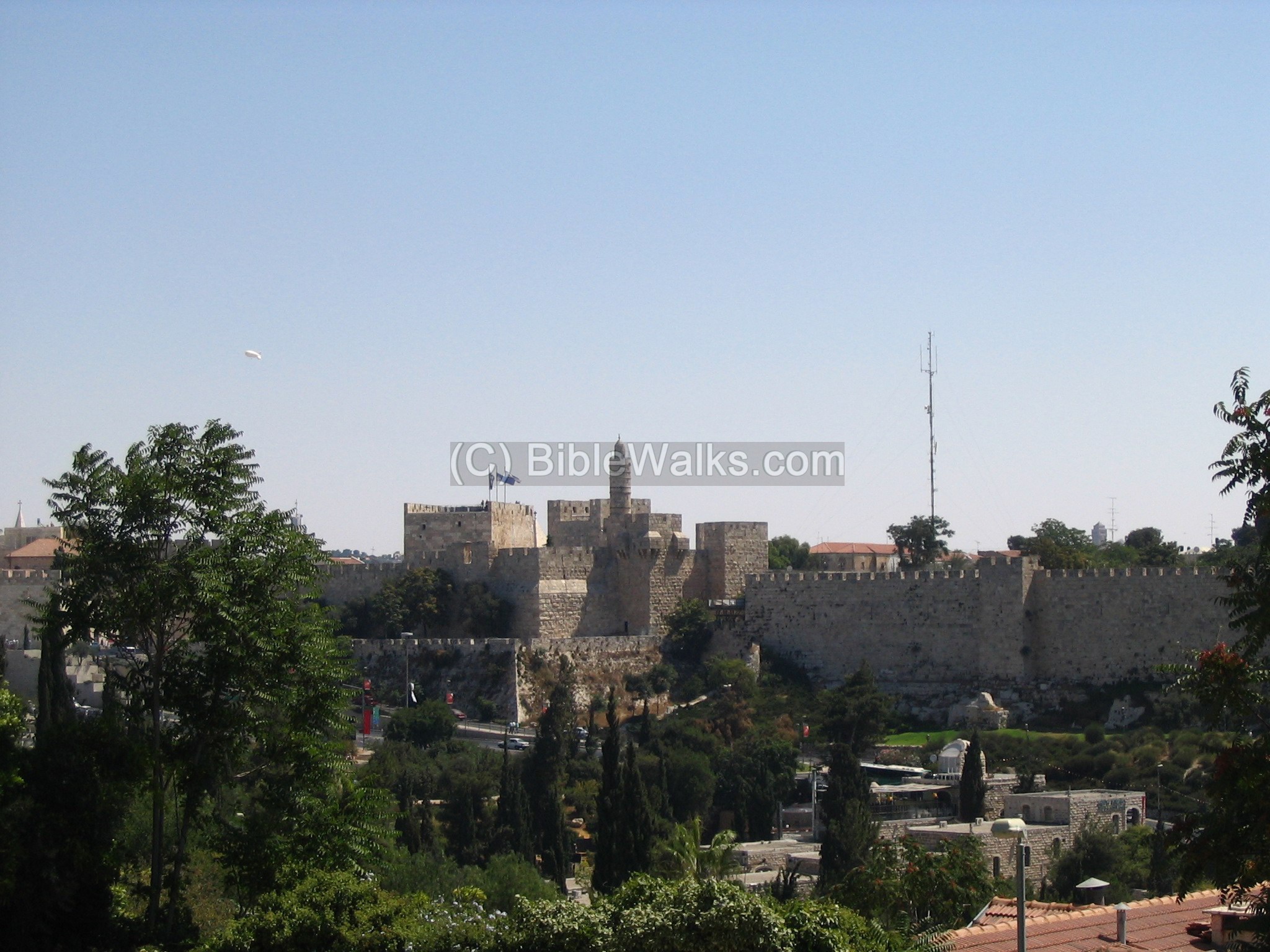
The photo below shows a view of the south-western side of Jerusalem, with the Tower of David on the left and the Dormition of Mount Zion on the right.
Click on the photos to view in higher resolution…
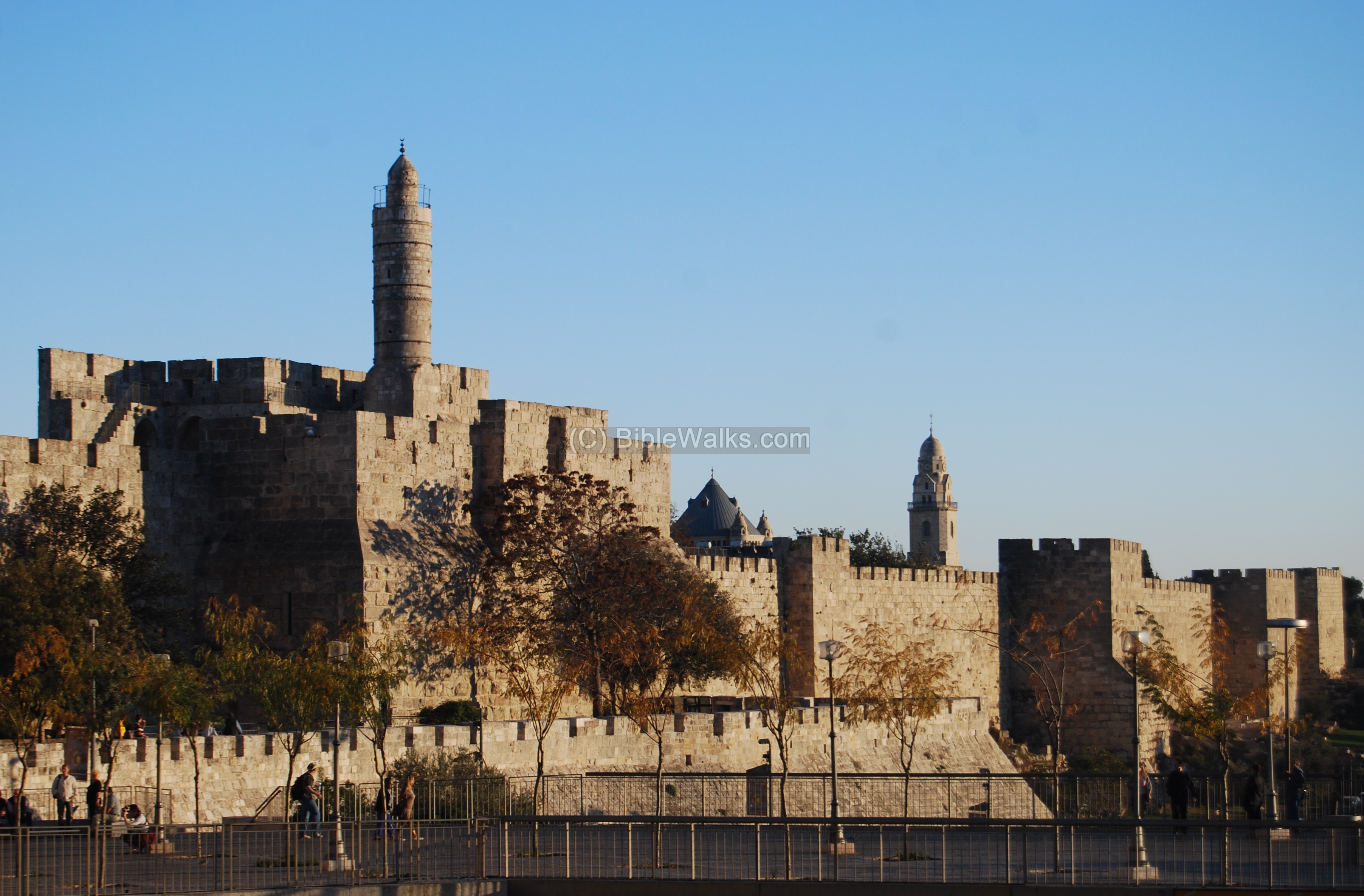
A view from the western neighborhoods is seen below. Note that a police surveillance balloon is seen in the sky above the old city, hovering over the area around the temple mount in order to alert on possible disturbances during the Friday worships.
(b) Western Walls:
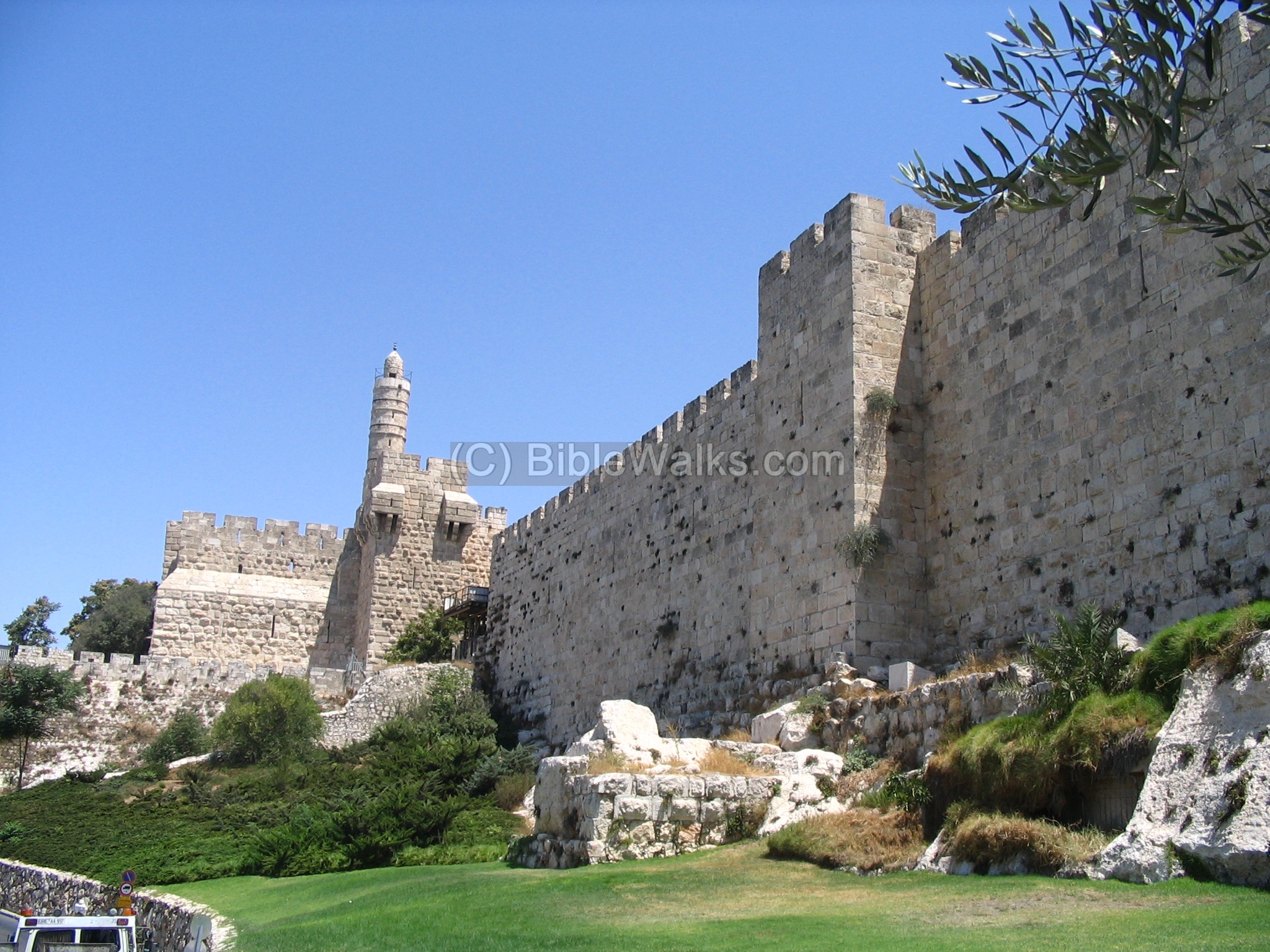
A closer view, below the old city’s walls, is seen in the following photo.
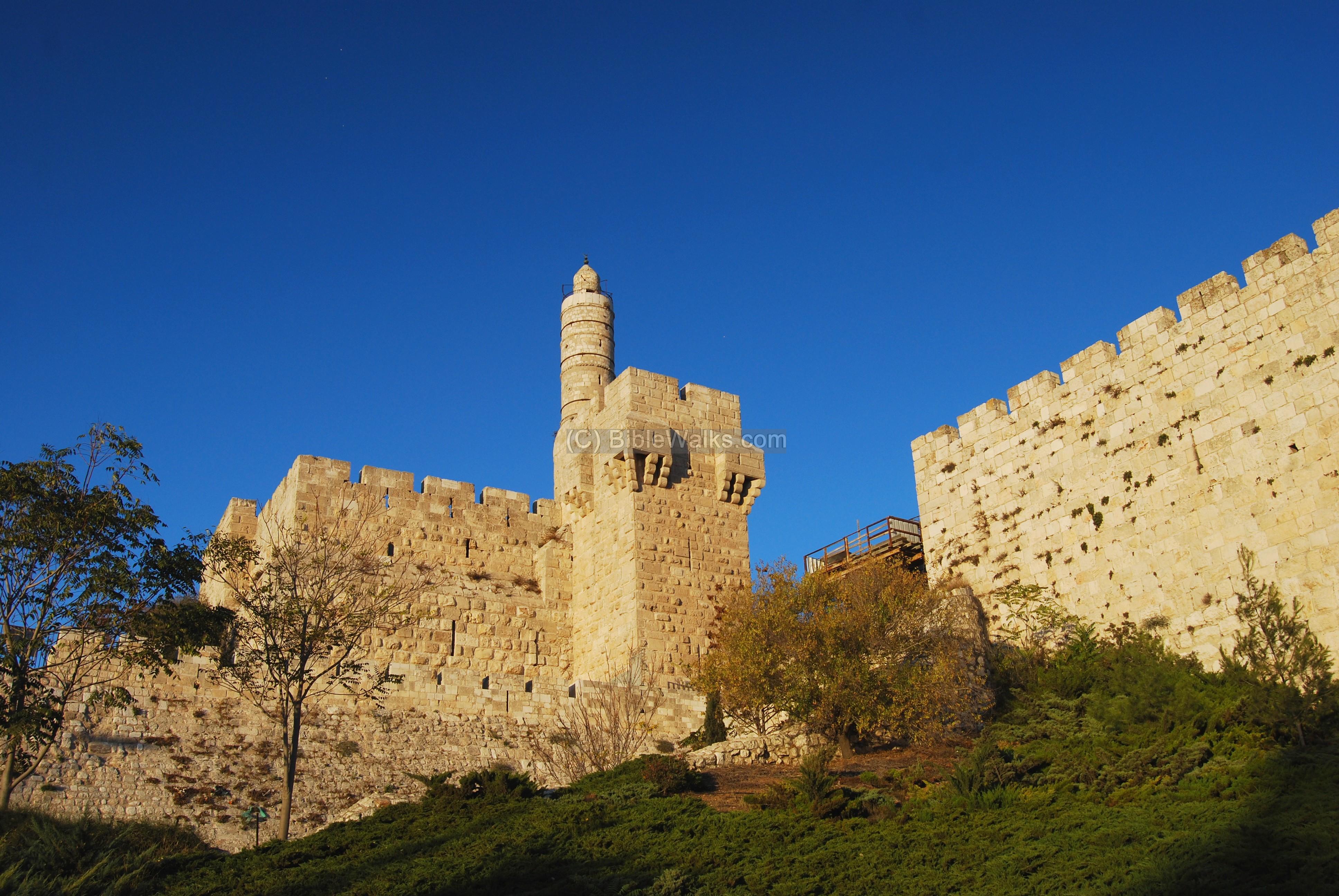
You can also take a walk on top of the walls and around the city. This walk starts from an entrance below the wall, behind the tree in the photo below. There are 3 available walks (90/150/180 minutes), the longer walks include additional sites.
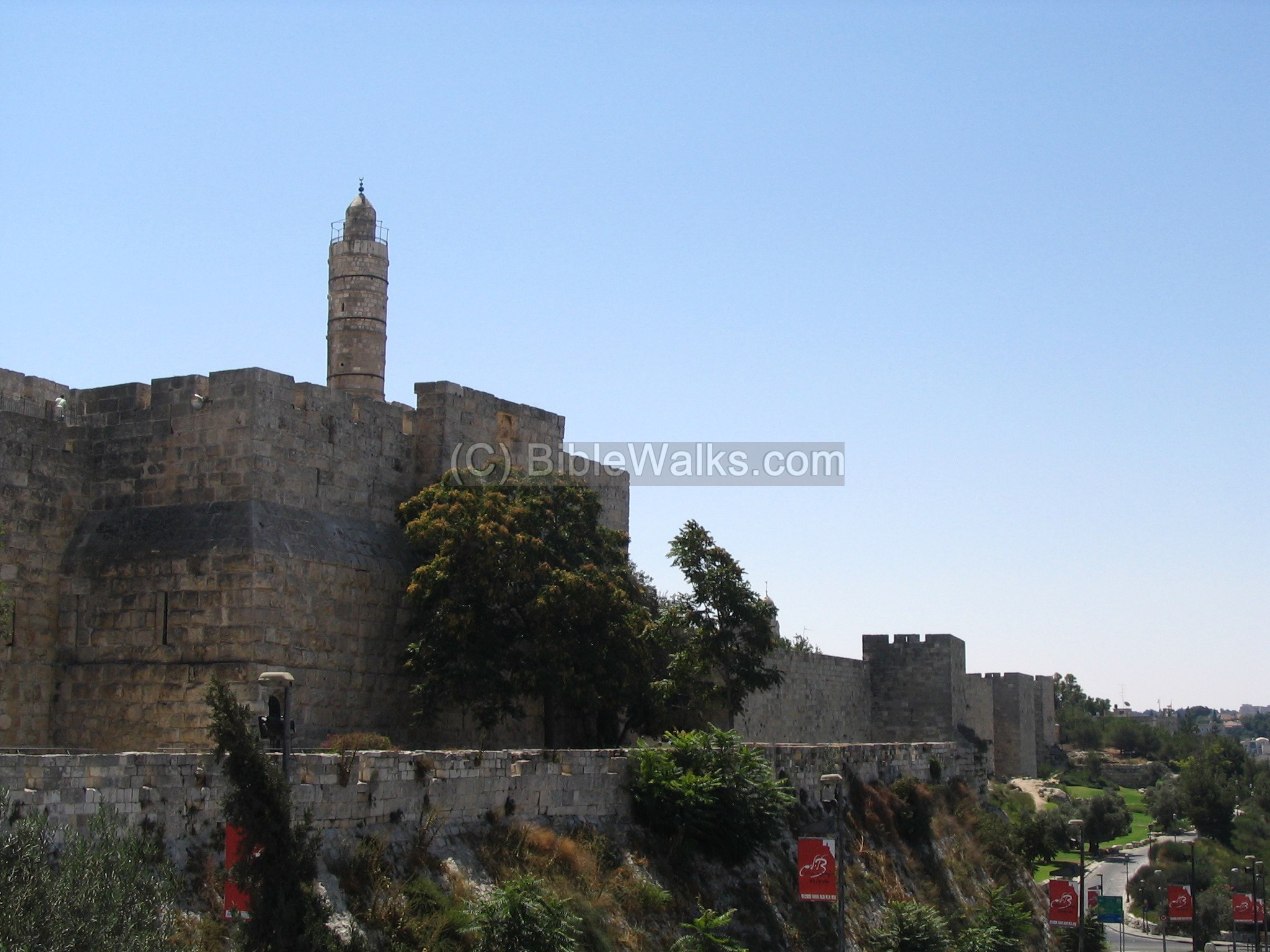
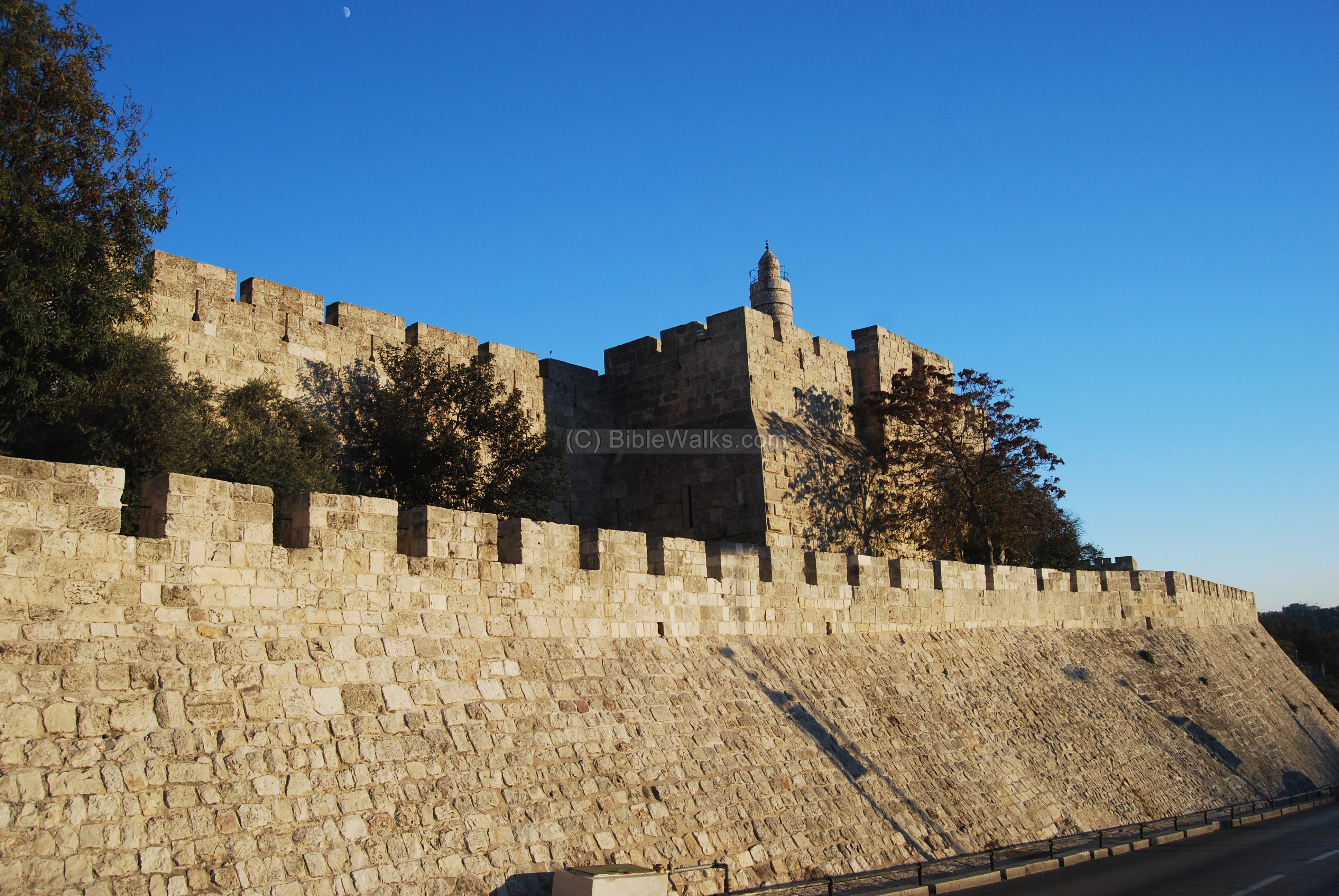
A late afternoon photo of the western walls is seen below.
Another late afternoon photo is seen below.
(c) North walls and moat:
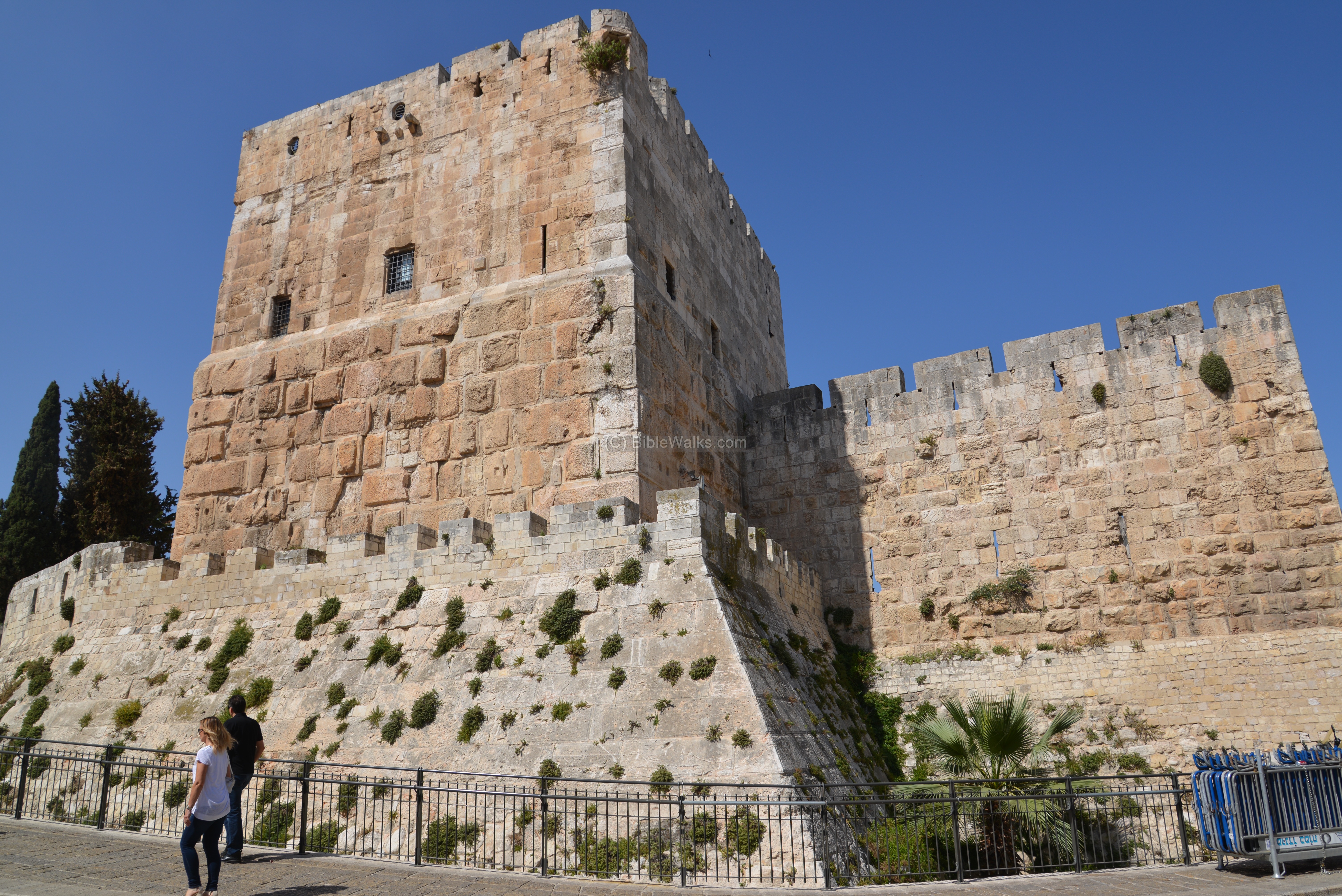
The photo below shows the north side of the tower, inside the old city.
This section was built by the Crusaders. The fortifications include a wide moat in front, an external wall above the moat, and an internal wall of the high tower.
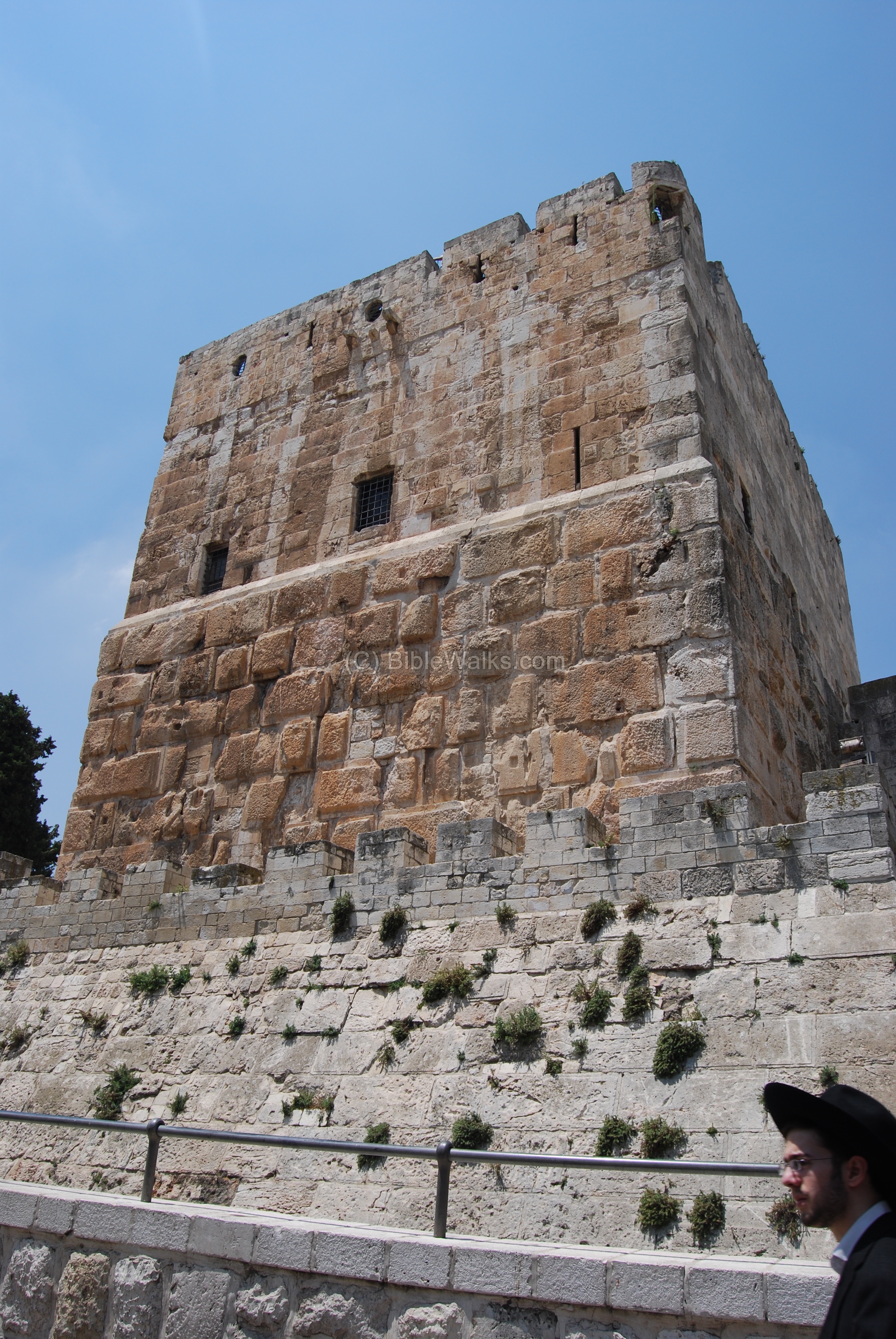
The next photo shows an orthodox Jew passing the tower on his way to the Western wall.
(d) Gate:
Another remain of the Crusader fortifications is the draw bridge on the north side.

(e) Inside the tower:
A museum of the history of Jerusalem is located inside the complex. The museum was recently renovated (June 2023). Here are the highlights, as reported by the place:
On June 1st, the Tower of David Jerusalem Museum opened after a decade of planning and three years of construction as the new gateway to the Old City of Jerusalem.
- New multi-level sunken entrance pavilion at the Jaffa Gate offers a new gateway to the Old City. The new visitor flow, integral to the museum’s concept, allows visitors to first better understand Jerusalem’s history through its new exhibition and provides food for thought to contemplate the complex reality of the Old City before entering its streets and alleyways.
10 completely new thematic galleries, telling Jerusalem’s 4,000-year story, and its centrality to Judaism, Christianity, and Islam with models of the Second Temple, the Church of the Holy Sepulcher and the Dome of the Rock.
Innovative and engaging content, including interactive, 12-meter multi-media wall (largest in Israel), 3-D digital modeling, video mapping, immersive 360 video installation, interactive sphere (first in Israel), 14 interactive maps, new animation films by Ari Folman and others
Authentic artifacts, some dating back to approx. 1500 years BCE and many displayed in-situ for the first time.
Citadel accessible to all visitors with an ambitious Accessibility Program and first-of-its-kind elevator in Israel, chair lifts and ramps.
Conservation of ancient citadel’s walls and minaret.
Museum area doubled to over 20,000 square meters.
Spectacular views of the whole of Jerusalem – east and west from the top of King Herod’s Phasael Tower built 2000 years ago.
We will show the new museum in the future.
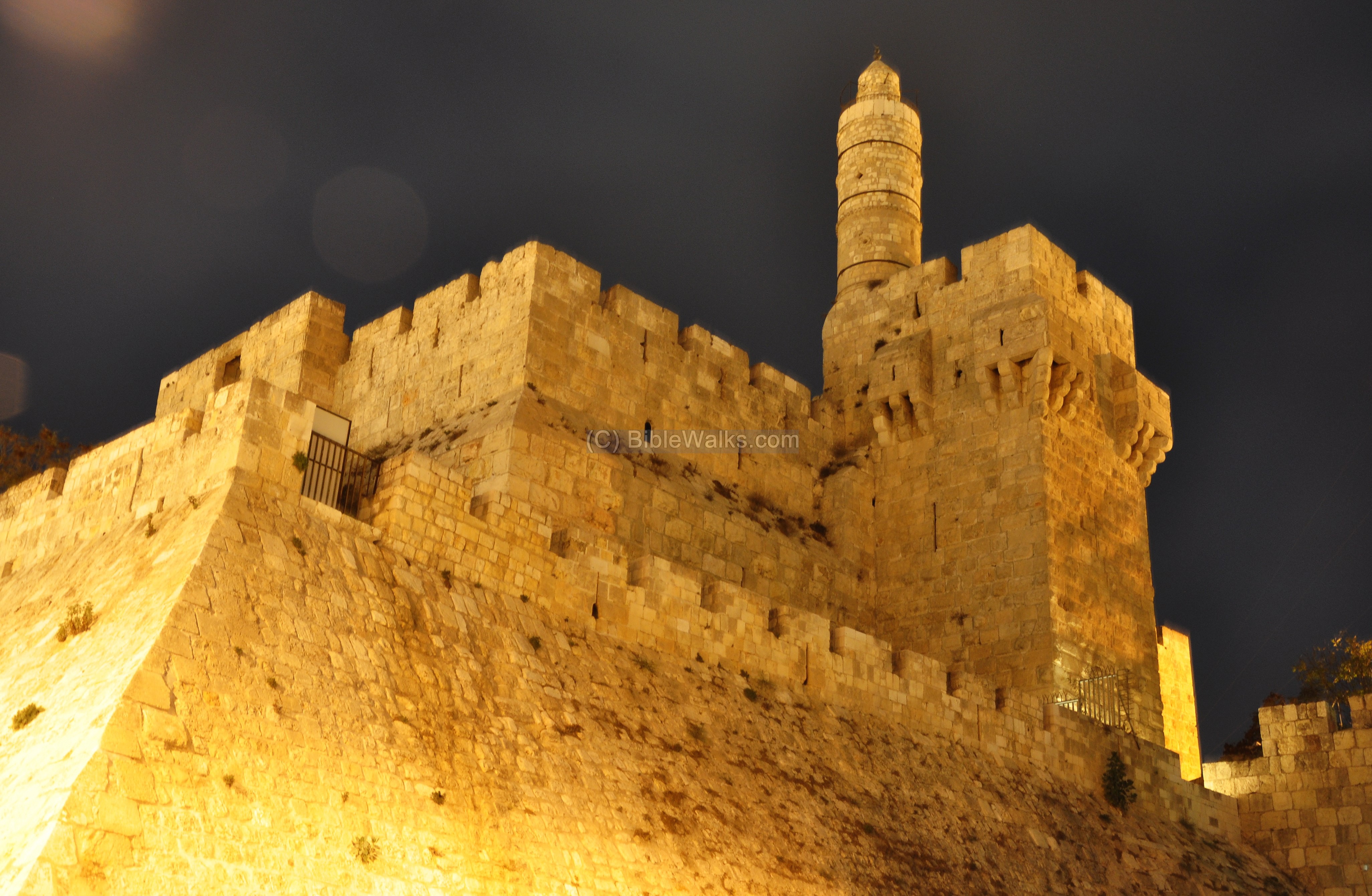
(f) At Night:
The city is extremely pretty at night, with the Tower of David as the jewel in its crown:
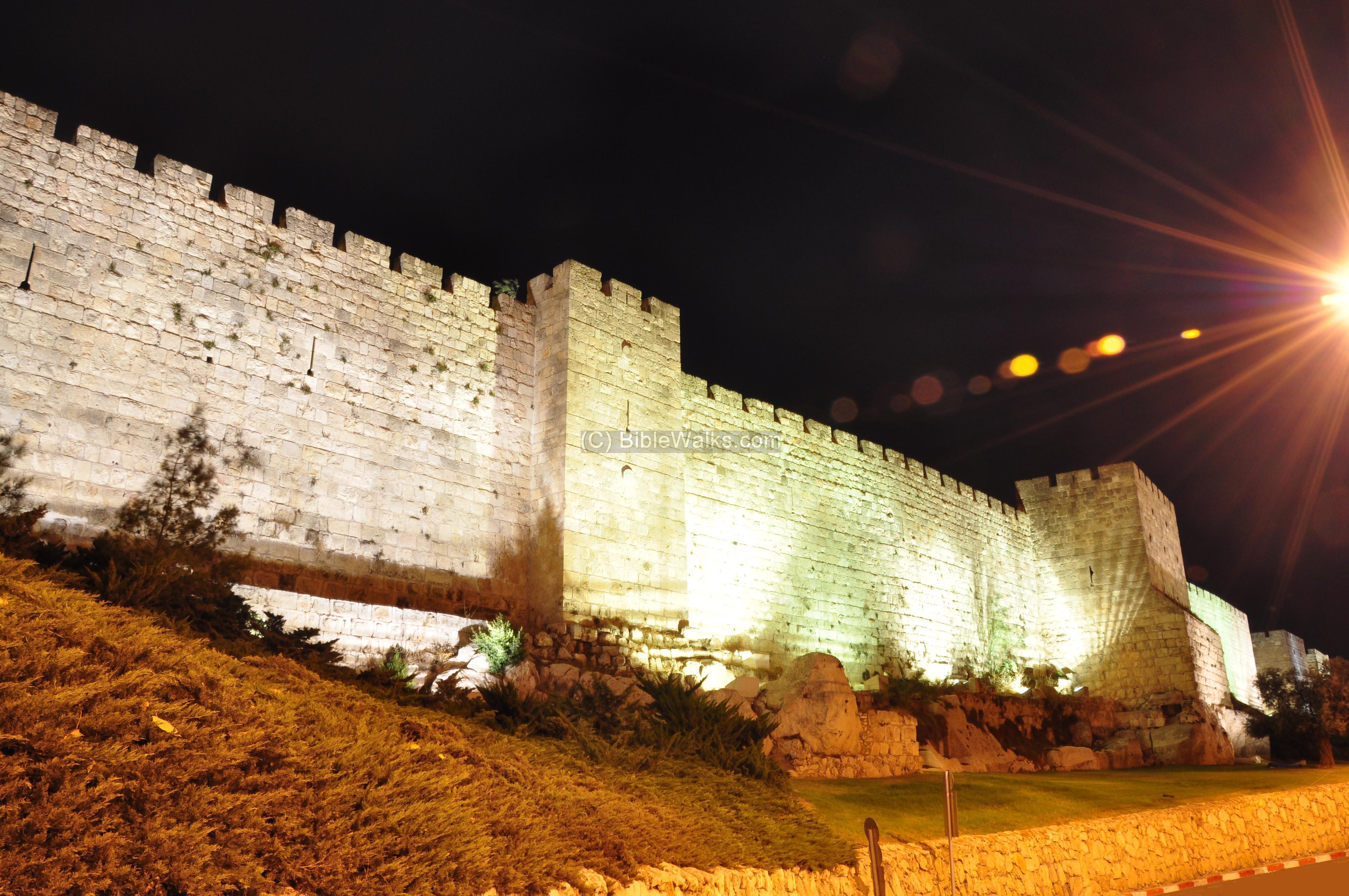
Another view of the walls, south of the tower, is seen in the next photograph:
Videos
 The following YouTube video summarizes a tour of the tower of David, as captured on March 2025.
Etymology (behind the name):
-
Migdal David (name in Hebrew) – Migdal is “tower”
-
Bab Al-Khalil – one of the Arabic names of Jaffa gate; means: Bab (gate) and Khalil (the friend – Abraham), named after Abraham’s city (Hebron).
Biblical:
Psalms 48:12:
“Walk about Zion, and go round about her: tell the towers thereof”.
Historical References:
Jozefus Flavius (“War of the Jews”, Book 5, Chapter 4):
The historian Josephus Flavius was the commander of the revolt, and fortified the site. He later wrote about it in his book, “War of the Jews“.
This text is a detailed description of the site and Herod’s construction of the 3 towers and palace. Note that cubit unit is about 44cm.
“1. The city of Jerusalem was fortified with three walls, on such parts as were not encompassed with unpassable valleys; for in such places it had but one wall. The city was built upon two hills, which are opposite to one another, and have a valley to divide them asunder; at which valley the corresponding rows of houses on both hills end. Of these hills, that which contains the upper city is much higher, and in length more direct. Accordingly, it was called the “Citadel,” by king David; he was the father of that Solomon who built this temple at the first; but it is by us called the “Upper Market-place.” But the other hill, which was called “Acra”, and sustains the lower city, is of the shape of a moon when she is horned; over against this there was a third hill, but naturally lower than Acra, and parted formerly from the other by a broad valley. However, in those times when the Hasmoneans reigned, they filled up that valley with earth, and had a mind to join the city to the temple. They then took off part of the height of Acra, and reduced it to be of less elevation than it was before, that the temple might be superior to it. Now the Valley of the Cheesemongers, as it was called, and was that which we told you before distinguished the hill of the upper city from that of the lower, extended as far as Siloam; for that is the name of a fountain which hath sweet water in it, and this in great plenty also. But on the outsides, these hills are surrounded by deep valleys, and by reason of the precipices to them belonging on both sides they are every where unpassable.
2. Now, of these three walls, the old one was hard to be taken, both by reason of the valleys, and of that hill on which it was built, and which was above them. But besides that great advantage, as to the place where they were situated, it was also built very strong; because David and Solomon, and the following kings, were very zealous about this work. Now that wall began on the north, at the tower called “Hippicus”, and extended as far as the “Xistus”, a place so called, and then, joining to the council-house, ended at the west cloister of the temple. But if we go the other way westward, it began at the same place, and extended through a place called “Bethso,” to the gate of the Essens; and after that it went southward, having its bending above the fountain Siloam, where it also bends again towards the east at Solomon’s pool, and reaches as far as a certain place which they called “Ophlas”, where it was joined to the eastern cloister of the temple. The second wall took its beginning from that gate which they called “Gennath”, which belonged to the first wall; it only encompassed the northern quarter of the city, and reached as far as the tower Antonia. The beginning of the third wall was at the tower Hippicus, whence it reached as far as the north quarter of the city, and the tower Psephinus, and then was so far extended till it came over against the monuments of Helena, which Helena was queen of Adiabene, the daughter of Izates; it then extended further to a great length, and passed by the sepulchral caverns of the kings, and bent again at the tower of the corner, at the monument which is called the “Monument of the Fuller,” and joined to the old wall at the valley called the “Valley of Cedron”. It was Agrippa who encompassed the parts added to the old city with this wall, which had been all naked before; for as the city grew more populous, it gradually crept beyond its old limits, and those parts of it that stood northward of the temple, and joined that hill to the city, made it considerably larger, and occasioned that hill, which is in number the fourth, and is called “Bezetha,” to be inhabited also. It lies over against the tower Antonia, but is divided from it by a deep valley, which was dug on purpose, and that in order to hinder the foundations of the tower of Antonia from joining to this hill, and thereby affording an opportunity for getting to it with ease, and hindering the security that arose from its superior elevation; for which reason also that depth of the ditch made the elevation of the towers more remarkable. This new-built part of the city was called “Bezetha”, in our language, which, if interpreted in the Grecian language, may be called “the New City.” Since, therefore, its inhabitants stood in need of a covering, the father of the present king, and of the same name with him, Agrippa, began that wall we spoke of; but he left off building it when he had only laid the foundations, out of the fear he was in of Claudius Caesar, lest he should suspect that so strong a wall was built in order to make some innovation in public affairs; for the city could no way have been taken if that wall had been finished in the manner it was begun; as its parts were connected together by stones twenty cubits long, and ten cubits broad, which could never have been either easily undermined by any iron tools, or shaken by any engines. The wall was, however, ten cubits wide, and it would probably have had a height greater than that, had not his zeal who began it been hindered from exerting itself. After this, it was erected with great diligence by the Jews, as high as twenty cubits, above which it had battlements of two cubits, and turrets of three cubits altitude, insomuch that the entire altitude extended as far as twenty-five cubits.
3. Now the towers that were upon it were twenty cubits in breadth, and twenty cubits in height; they were square and solid, as was the wall itself, wherein the niceness of the joints, and the beauty of the stones, were no way inferior to those of the holy house itself. Above this solid altitude of the towers, which was twenty cubits, there were rooms of great magnificence, and over them upper rooms, and cisterns to receive rain-water. They were many in number, and the steps by which you ascended up to them were every one broad: of these towers then the third wall had ninety, and the spaces between them were each two hundred cubits; but in the middle wall were forty towers, and the old wall was parted into sixty, while the whole compass of the city was thirty-three furlongs. Now the third wall was all of it wonderful; yet was the tower Psephinus elevated above it at the north-west corner, and there Titus pitched his own tent; for being seventy cubits high it both afforded a prospect of Arabia at sun-rising, as well as it did of the utmost limits of the Hebrew possessions at the sea westward. Moreover, it was an octagon, and over against it was the tower Hippicus, and hard by two others were erected by king Herod, in the old wall. These were for largeness, beauty, and strength beyond all that were in the habitable earth; for besides the magnanimity of his nature, and his magnificence towards the city on other occasions, he built these after such an extraordinary manner, to gratify his own private affections, and dedicated these towers to the memory of those three persons who had been the dearest to him, and from whom he named them. They were his brother, his friend, and his wife. This wife he had slain, out of his love [and jealousy], as we have already related; the other two he lost in war, as they were courageously fighting. Hippicus, so named from his friend, was square; its length and breadth were each twenty-five cubits, and its height thirty, and it had no vacuity in it. Over this solid building, which was composed of great stones united together, there was a reservoir twenty cubits deep, over which there was a house of two stories, whose height was twenty-five cubits, and divided into several parts; over which were battlements of two cubits, and turrets all round of three cubits high, insomuch that the entire height added together amounted to fourscore cubits. The second tower, which he named from his brother Phasaelus, had its breadth and its height equal, each of them forty cubits; over which was its solid height of forty cubits; over which a cloister went round about, whose height was ten cubits, and it was covered from enemies by breast-works and bulwarks. There was also built over that cloister another tower, parted into magnificent rooms, and a place for bathing; so that this tower wanted nothing that might make it appear to be a royal palace. It was also adorned with battlements and turrets, more than was the foregoing, and the entire altitude was about ninety cubits; the appearance of it resembled the tower of Pharus, which exhibited a fire to such as sailed to Alexandria, but was much larger than it in compass. This was now converted to a house, wherein Simon exercised his tyrannical authority. The third tower was Mariamne, for that was his queen’s name; it was solid as high as twenty cubits; its breadth and its length were twenty cubits, and were equal to each other; its upper buildings were more magnificent, and had greater variety, than the other towers had; for the king thought it most proper for him to adorn that which was denominated from his wife, better than those denominated from men, as those were built stronger than this that bore his wife’s name. The entire height of this tower was fifty cubits.
4. Now as these towers were so very tall, they appeared much taller by the place on which they stood; for that very old wall wherein they were was built on a high hill, and was itself a kind of elevation that was still thirty cubits taller; over which were the towers situated, and thereby were made much higher to appearance. The largeness also of the stones was wonderful; for they were not made of common small stones, nor of such large ones only as men could carry, but they were of white marble, cut out of the rock; each stone was twenty cubits in length, and ten in breadth, and five in depth. They were so exactly united to one another, that each tower looked like one entire rock of stone, so growing naturally, and afterward cut by the hand of the artificers into their present shape and corners; so little, or not at all, did their joints or connexion appear. low as these towers were themselves on the north side of the wall, the king had a palace inwardly thereto adjoined, which exceeds all my ability to describe it; for it was so very curious as to want no cost nor skill in its construction, but was entirely walled about to the height of thirty cubits, and was adorned with towers at equal distances, and with large bed-chambers, that would contain beds for a hundred guests a-piece, in which the variety of the stones is not to be expressed; for a large quantity of those that were rare of that kind was collected together. Their roofs were also wonderful, both for the length of the beams, and the splendor of their ornaments. The number of the rooms was also very great, and the variety of the figures that were about them was prodigious; their furniture was complete, and the greatest part of the vessels that were put in them was of silver and gold. There were besides many porticoes, one beyond another, round about, and in each of those porticoes curious pillars; yet were all the courts that were exposed to the air every where green. There were, moreover, several groves of trees, and long walks through them, with deep canals, and cisterns, that in several parts were filled with brazen statues, through which the water ran out. There were withal many dove-courts of tame pigeons about the canals. But indeed it is not possible to give a complete description of these palaces; and the very remembrance of them is a torment to one, as putting one in mind what vastly rich buildings that fire which was kindled by the robbers hath consumed; for these were not burnt by the Romans, but by these internal plotters, as we have already related, in the beginning of their rebellion. That fire began at the tower of Antonia, and went on to the palaces, and consumed the upper parts of the three towers themselves”.
Links:
External:
Internal:
- Jaffa Gate
- Roman streets – near David tower
BibleWalks.com – “Walk about Zion, and go round about her: tell the towers thereof”.
Overview<<<—previous site–<<< All Sites >>>—next Jerusalem site–>>>Jaffa Gate
This page was last updated on March 29, 2025 (rewrite history)
Sponsored links: