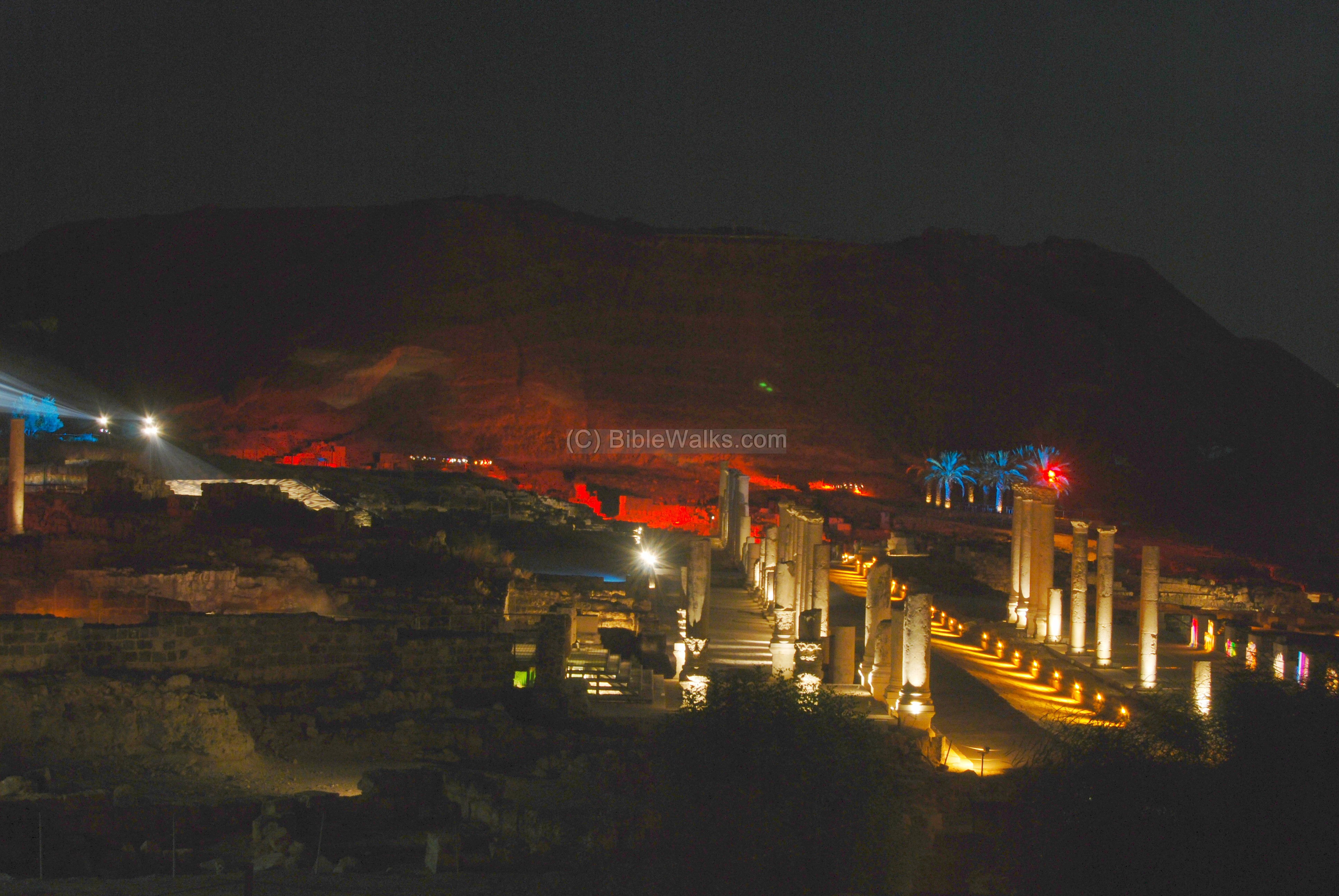
Beit Shean - at night
Beit Shean was a major Biblical city, located on the ancient trade route. Adjacent to the its ruins, the Hellenistic city, Scythopolis, was established and became a major city until its destruction in the 8th C. A new amazing multi-sensory night show has transformed the excavated site into a unique world class experience.
1 Kings 4 7-12: "And Solomon had twelve officers over all Israel... Baana the son of Ahilud; to him pertained ... all Bethshean, which is by Zartanah beneath Jezreel"
Home > Sites > Beit Shean Valley > Beit Shean - at night
|
|
Contents: |
Tell Beit Shean (Beth Shean) was a major Biblical city, located in the center of crossroads between the Jordan valley and the Jezreel valley. It later was expanded into a large Hellenistic, Roman and Byzantine city of Scythopolis. The large city was leveled by a massive earthquake in the 8th C AD.
An amazing multi-media multi-sensory night tour has been recently being launched in the national park of ancient Beit Shean. The 3M$ project is the first of its kind in the world in an archaeological site, and the 4th largest in the world.
The national park is located on the north side of the modern city of Beit Shean (Beth She'an), which is located on the south-east corner of the Galilee. It is located south to the Harod creek which flows from the foothills of the Gilboa mountain. The site is close to the Jordan river, which flows 5KM to the east of the site.
An aerial map of the ruins of Beit Shean is shown below, with the north side on the top of the photo, indicating the major points of interest. You can point on the purple points to navigate to the selected point.

Prehistory
Excavations dated the earlier findings in the area to the Calcolithic period (about 45C BC). The early man dwelt in the caves around the site.
According to the excavations, the city was established in the Early Bronze age (early 3rd Millenium). It extended to the hill east of the Tell, and became a large town. It is located on a prime location - in the center of major ancient crossroads (North-South connected Asia Minor to Egypt, and West-East connected the sea to Jordan and Arabia). The city is referenced in several Egyptian sources, starting in the 19th C Egyptian (12th Dynasty) enemy-curse clay tablets as "Aphkm".
After it was destroyed by fire, it declined into a small Middle Bronze age town (19th-15th C BC) .
Canaanite/Egyptian city
The city is listed as on of the cities that were conquered by Egyptian Pharaoh Thutmose III , just after the famous battle near Megiddo (1468 BC), which resulted in the Egyptian conquest of Canaan for 350 years. The excavations in the city unearthed findings from the period of Thutmose III.
During the late Bronze period and the beginning of the Iron age (15th C to 12th C) the city became as a center of the Egyptian imperial administration in northern Canaan, as did Megiddo.
A basalt tablet from Seti I (1318-1304 BC) was found in the city with the name of Beit-Shean. The name of the Holy Land in this tablet is "Retenu", which was the Egyptian name of the land of Israel before the Israelite conquest.
The city is also mentioned in the Amarna letters, a 14th century BC Egyptian archive of clay tablets.
Biblical times - Beit Shean
The mighty Canaanite city was not conquered by the Israelites (Judges 1: 27: "Neither did Manasseh drive out the inhabitants of Bethshean and her towns"). Later, in the 11th C BC, King Saul's body was displayed on its walls after his defeat by the Philistines (1 Samuel 31 10: "...and they fastened his body to the wall of Bethshan").
The Canaanite/Philistine city was burnt in the 10th C by King David. His son, King Solomon, rebuilt it and made it an important administration city (1 Kings 4 7-12: "And Solomon had twelve officers over all Israel... Baana the son of Ahilud; to him pertained Taanach and Megiddo, and all Bethshean, which is by Zartanah beneath Jezreel".
After Solomon's death, Egypt's Shishak invaded Israel in 924 BC (1 Kings 14: 25: "in the fifth year of King Rehoboam, Shishak king of Egypt attacked Jerusalem"). According to the Pharaoh's hieroglyphic inscriptions, Beit Shean is listed as one of the cities that he captured and Beit Shean's governor is illustrated as led to captivity in Egypt.
The Assyrians captured the Galilee (732 BC), and destroyed Beit Shean to its foundations.
Hellenistic period - Nisan-Scythopolis
During the 3rd C BC the city was rebuilt on the top of the Tell and to the north of it. The city was renamed Scythopolis and Scython-Polis, named after the veterans who resettled the Hellenistic city in 633 BC. According to Greek mythology the city was founded by the wine God Dionysos who lived in the city. According to the legend, his nursemaid Nysa who breast-fed him was buried in the city, so it was named Nysa-Scythopolis or Nisa.
The city was an important Greek Polis in the 2nd C BC, but destroyed by the Hasmonaens in about 100 BC. According to the Historian Josephus Flavius (Wars 1 2 3-7): "John, who was also called Hyrcanus ... marched with an army as far as Scythopolis, and made an incursion upon it, and laid waste all the country that lay within Mount Carmel". This description shows that the city was a key to the Galilee region, and after its conquest the whole area was under the control of the Jewish Kings.
Roman period - Skythopolis is a major city
During the Roman period, starting in the 1st C BC, the city became an administration center, and was part of the Decapolis - the league of the 10 cities which were located in a region east of the Jordan river and and north of the city.
A new well planned city was established to the south and east of the ancient Tell. The new urban design included wide colonnaded paved streets that crossed the civic center at the foothills of the ancient Tell. Large public structures, shopping areas and residential areas were constructed, and the city became one of the most important cities in the region.
|
The city is seen in the Peutinger map (Peutingeriana tabula) of the 4th C Imperial Roman roads as "Scytopoli", a major city which was connected via a road along the Jordan river to Jericho (on the left "Herichonte"), north to Tiberias (Tyberias" on the right) and south-west to Caperconti (Legion near Megiddo) and then to Caesarea Maritama ("Cesaria"). |
![]() |
After a major earthquake that affected most of the Galilee (363 AD), Scythopolis was damaged, but was reconstructed and rebuilt and continued to grow.
Byzantine period - prosperous Christian city
During the 4th-7th C the city continued to prosper, but the pagan structures were converted to other uses since the majority of the population was Christian. The size of the city grew to 400 Acres, expanding to all directions. Its population grew to 40,000 residents, and a 4.5KM long wall was added around the city.
Arab period - Decline and oblivion
The city was conquered in 635 AD and renamed Beisan, which preserved the ancient name. Thy city started a decline during this period. A major earthquake leveled the city in 749AD and the city remained in ruins until modern times.
Crusaders
In the 12th C the Crusaders built a fortress south of the Tell, reusing the stones from the ruins of the city. After their defeat, the city of Beisan declined further.
Ottoman/Mamlukes
During the middle ages Beisan was a small village with no importance. In 1308 a large hostel (Khan) was built on the north side, which served trade route from Egypt to Syria.
Beisan became a larger town after the railroad was laid out close to the village in the beginning of the 20th C.
The new city of Beth-Shean was established in 1949 in the deserted Arab village of Beisan.
The theater was excavated in the 1950s (Appelbaom), and major excavations continued in 1983 (Yadin/Geva) and 1989-1996 (A. Mazar). The Tell and the civic center were excavated by Mazor and Bar-Natan, Tsafrir and Foerster. Over 20 layers were excavated in the Tell, attesting to the successive construction of cities one on top of the ruins of the other, spanning more than 2,000 years. (see description of the Tell in our info page). Over 65M$ were invested in the excavations.
The light and sound show was opened in July 2008, with an investment of 3M$ by several government organizations. The show is open 300 nights per year, and requires advanced reservation. Every 20 minutes a group of 100 are entered to the park, view a 10-minute multimedia orientation presentation, then follow a guided tour of the enchanted ancient city.
|
A view towards the north is seen in the photo below. The ancient Biblical Tell is seen in the background, dominating the lower Roman city, and illuminated by the light show. In the center is the colonnaded Palladius street.
Click on the photos to view in higher resolution...
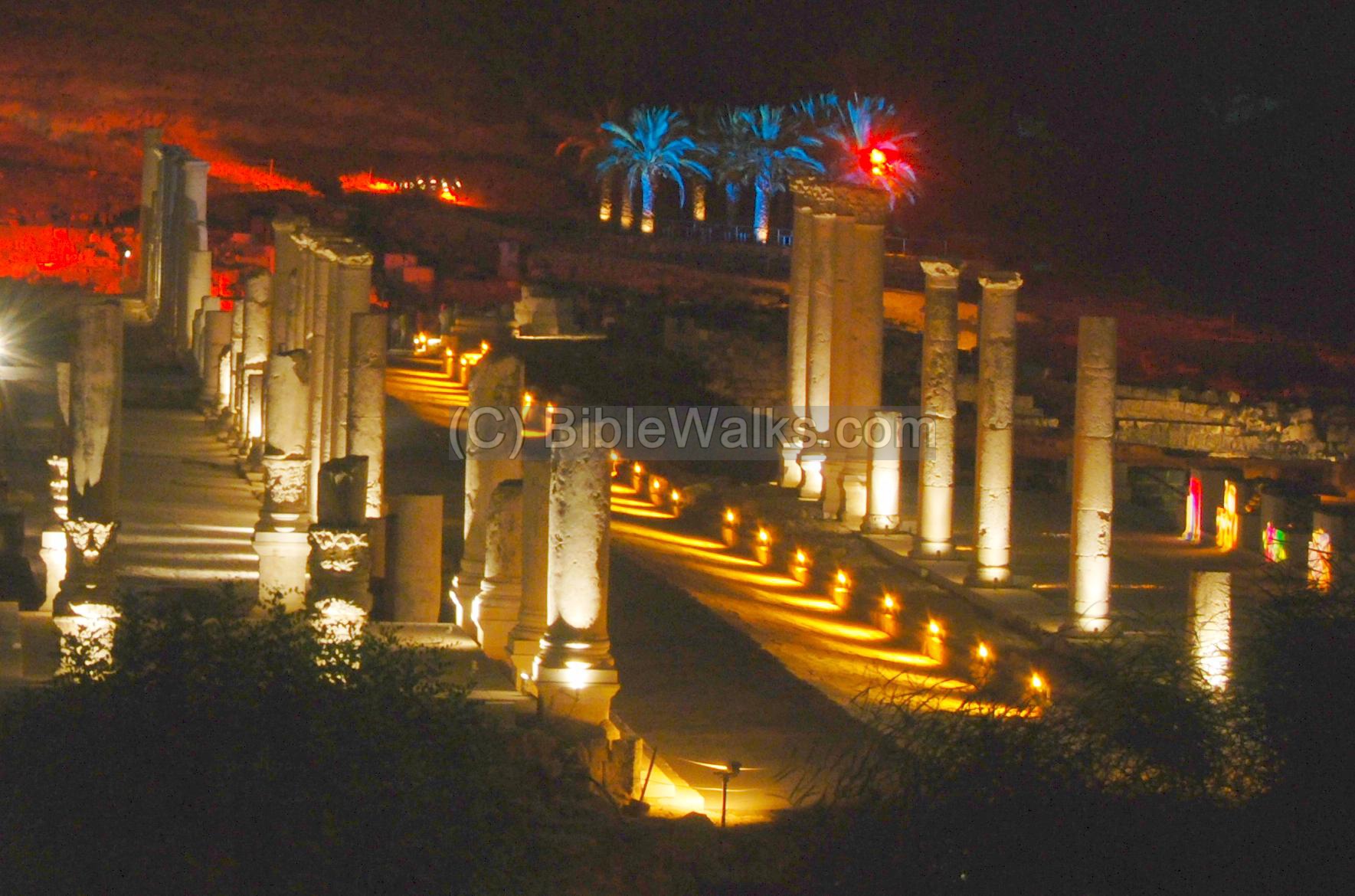
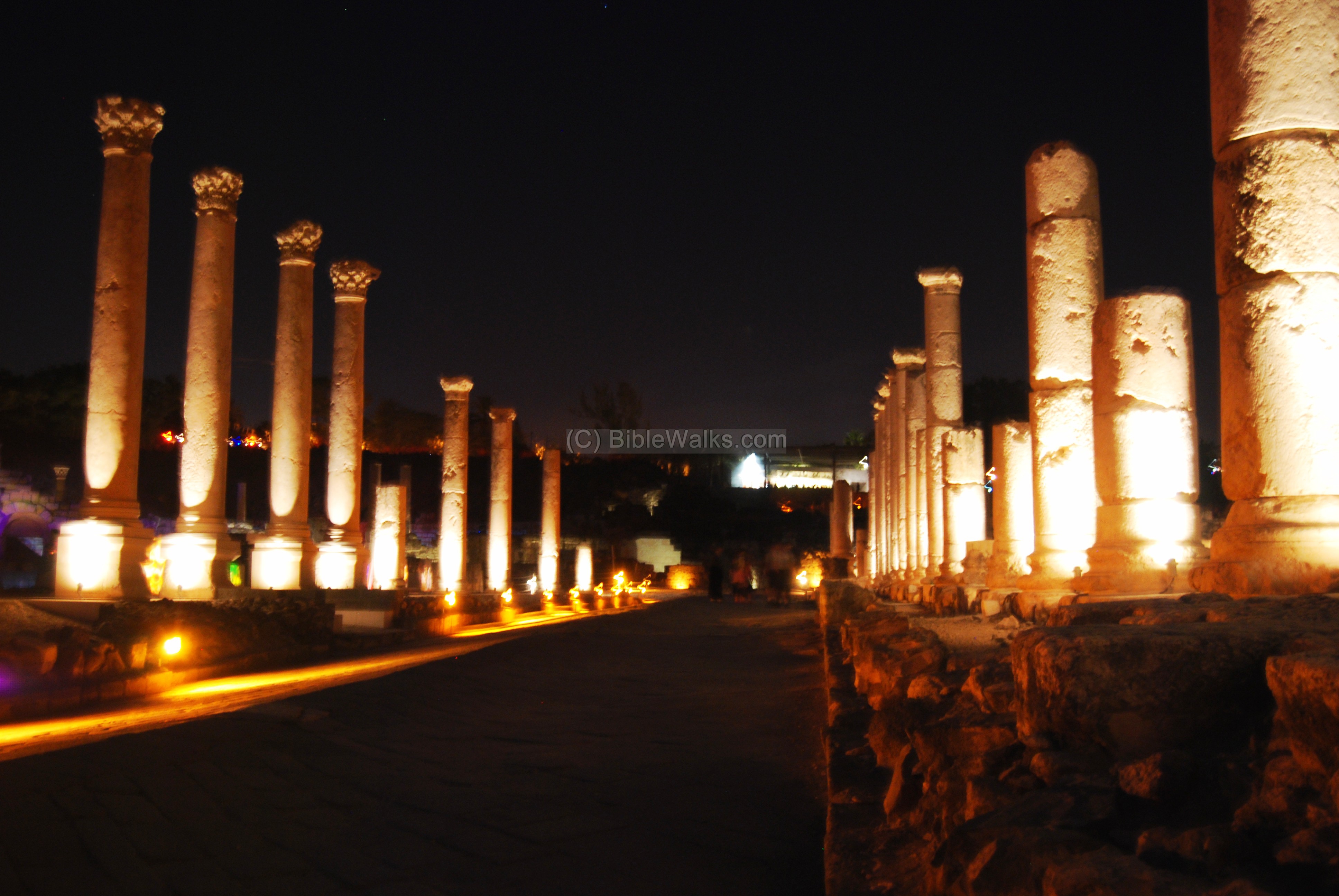
The colonnaded Palladius street extends from the theater to the foothills of the ancient Tell, 150M from south to north. The street was built in the Roman period, and restored during the Byzantine period. On both sides of the 24M paved street was a raised roofed sidewalk with shops and public houses.
The multi-media show along the street includes changing light patterns, sounds of carriages and horses, and projection of various images on the columns, structures and walls. This brings back the street to life as in a time machine, and the spectacular effects daze before your eyes. The vast size of the show, with the illuminated structures on the sides and in the background , make this an unforgettable experience.
Along the Palladius street, on the south-western side, is a large bathhouse.
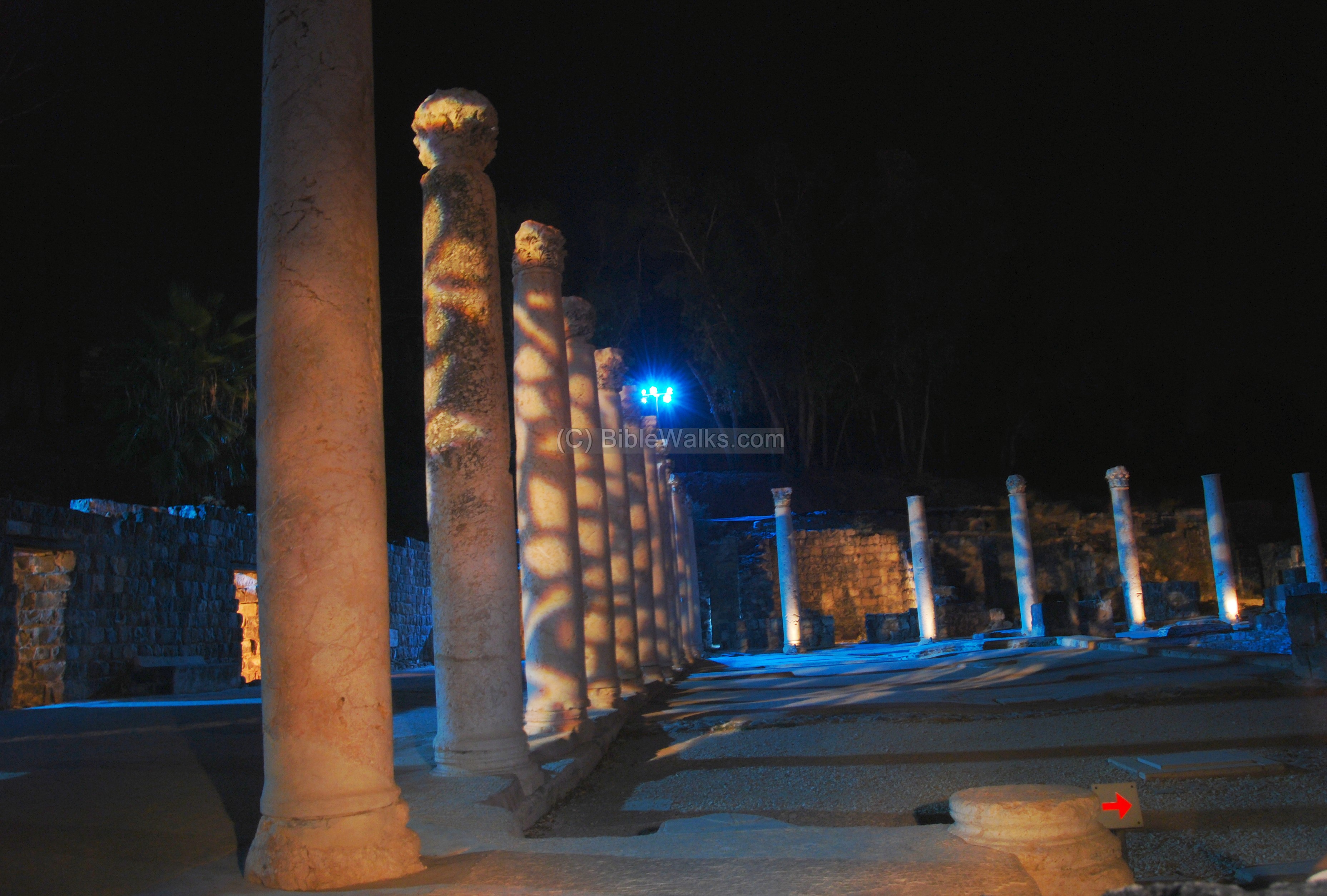
A view of the west bathhouse structure.
Tell Beit Shean is seen in the photo below, illuminated by the special effects. It is 106M under sea level, since the area is located in the Jordan valley depression. The steep hill is 80M above the Harod creek.
The Roman civic center is seen in the south foothills of the Tell.
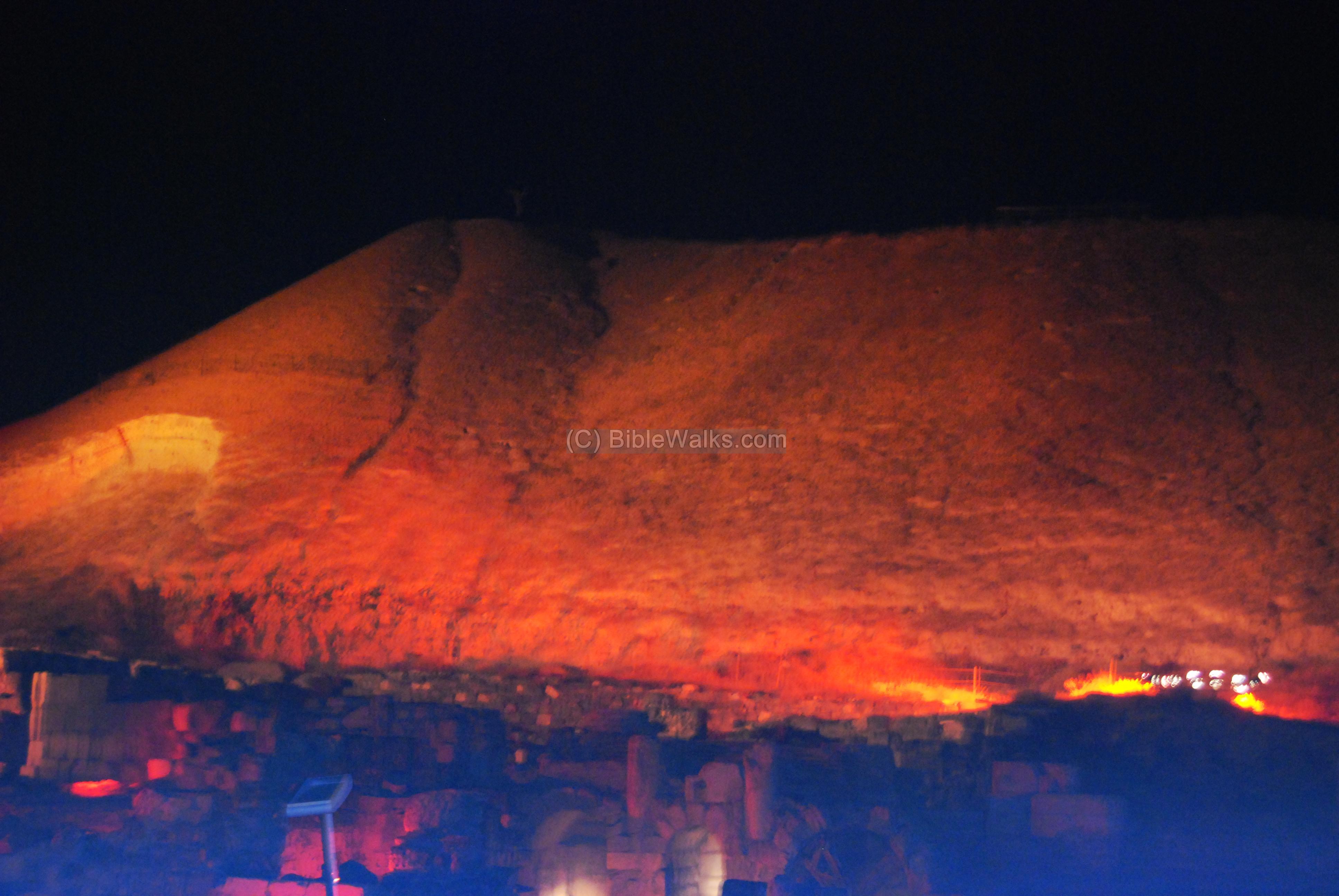
A closer view of the area below the Tell. This was the location of the nympheon, the 2nd C AD water fountain, and other public structures. Large columns lay fallen and broken over the paved street, attesting to the force of the massive earthquake that devastated the city.
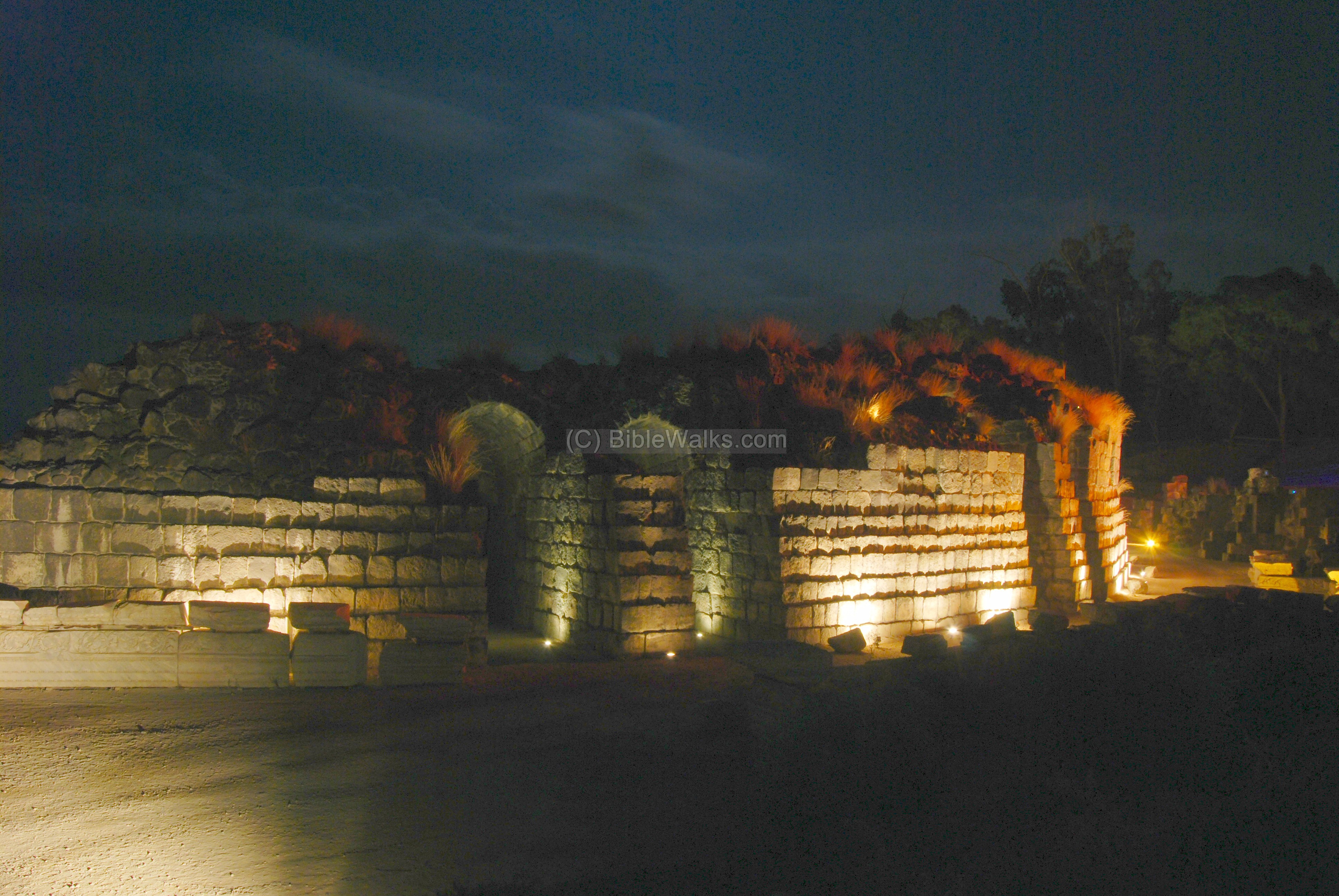
The theater was built in the 1st C AD. The structure seen today is from the end of the 2nd C, which was used until the 8th C. The spectators entered to the theater through the arched entrances. The theater set behind the stage was 20M high, and is facing the Tell.
The theater contained 7,000 seats, arranged in a 110M diameter structure which was cut into the hillside. Only the lower of the three levels of seats have survived, with 13 rows of limestone seats, as seen in the photo below from the direction of the stage.
The lights and slides projected over the seats change in conjunction with the sounds, and create a sensation of performing live on the ancient stage. At the end of the light and sound cycle, the projected spectators applaud to the visitors.
The Israelites did not conquer Beit Shean:
"And Manasseh had in Issachar and in Asher Bethshean and her towns, and Ibleam and her towns, and the inhabitants of Dor and her towns, and the inhabitants of Endor and her towns, and the inhabitants of Taanach and her towns, and the inhabitants of Megiddo and her towns, even three countries. Yet the children of Manasseh could not drive out the inhabitants of those cities; but the Canaanites would dwell in that land".
Neither did Manasseh drive out the inhabitants of Bethshean and her towns, nor Taanach and her towns, nor the inhabitants of Dor and her towns, nor the inhabitants of Ibleam and her towns, nor the inhabitants of Megiddo and her towns: but the Canaanites would dwell in that land. And it came to pass, when Israel was strong, that they put the Canaanites to tribute, and did not utterly drive them out".
King Saul's body was displayed on the walls of Beit Shean (here it is spelled BethShan) after his defeat to the Philistines:
"So Saul died, and his three sons, and his armourbearer, and
all his men, that same day together. And when the men of Israel that were on the
other side of the valley, and they that were on the other side Jordan, saw that
the men of Israel fled, and that Saul and his sons were dead, they forsook the
cities, and fled; and the Philistines came and dwelt in them.
And it came to pass on the morrow, when the Philistines came to strip the slain,
that they found Saul and his three sons fallen in mount Gilboa. And they cut off
his head, and stripped off his armor, and sent into the land of the Philistines
round about, to publish it in the house of their idols, and among the people.
And they put his armor in the house of Ashtaroth: and they fastened his body to
the wall of Bethshan. And when the inhabitants of Jabeshgilead heard of that
which the Philistines had done to Saul; All the valiant men arose, and went all
night, and took the body of Saul and the bodies of his sons from the wall of
Bethshan, and came to Jabesh, and burnt them there. And they took their bones,
and buried them under a tree at Jabesh, and fasted seven days".
King Solomon made BeitShean a major administrative city:
"And Solomon had twelve officers over all Israel, which provided victuals for the king and his household: each man his month in a year made provision...
Baana the son of Ahilud; to him pertained Taanach and
Megiddo, and all Bethshean, which is by Zartanah beneath Jezreel, from Bethshean
to Abelmeholah, even unto the place that is beyond Jokneam:".
The Assyrians captured the Galilee (732 BC), and destroyed Beit Shean.
" In the days of Pekah king of Israel came
Tiglathpileser king of Assyria, and took Ijon, and Abelbethmaachah, and Janoah,
and Kedesh, and Hazor, and Gilead, and Galilee, all the land of Naphtali, and
carried them captive to Assyria".
Links:
Etymology (behind the name):
|
|
Tell Yizreel <<<---previous site---<<< All Sites>>>---next site--->>> Balfouriya, Tell Yifar