
Impressive sandstone hills, located in the center of the Timna Valley . The ancient Egyptian copper miners erected here a temple in the times of Ramses III.
Home > Sites > Negev > Solomon’s Pillars (Timna)
Contents:
* Temple
Background:
An impressive set of high red sandstone hills, one of the most famous sites in the south of Israel, located in the center of the Timna Valley – today a nature & history park.
The area is one of the most ancient copper mines, dating to the end of the 5th Millennium BCE (about 6,000 years ago). An Egyptian temple and rock engraving are located in the site, and the miners’ camp is located nearby.
Zechariah 6,1: “… and the mountains were mountains of brass”.
The site and the entire park is a perfect place for hiking and combines remarkable nature scenes, historic sites and hiking tracks.
Location:
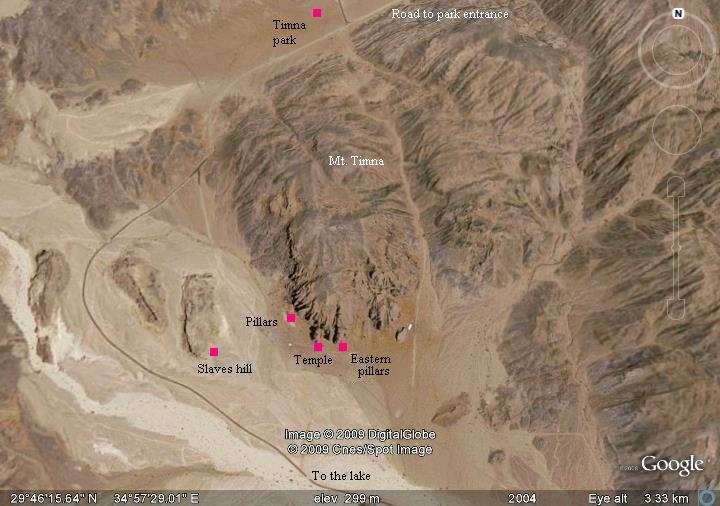
Solomon’s Pillars are located inside the Timna Park, 25KM north of the city of Eilat, on the southern tip of Israel.
Photos:
(a) General view:
The photo below shows a section of the Solomon’s pillars – a set of tall red sandstone hills in the south side of Mt. Timna. These cliffs, although called King Solomon’s mines, were carved naturally due to the soft sand stone.
Click on the photos to view in higher resolution…

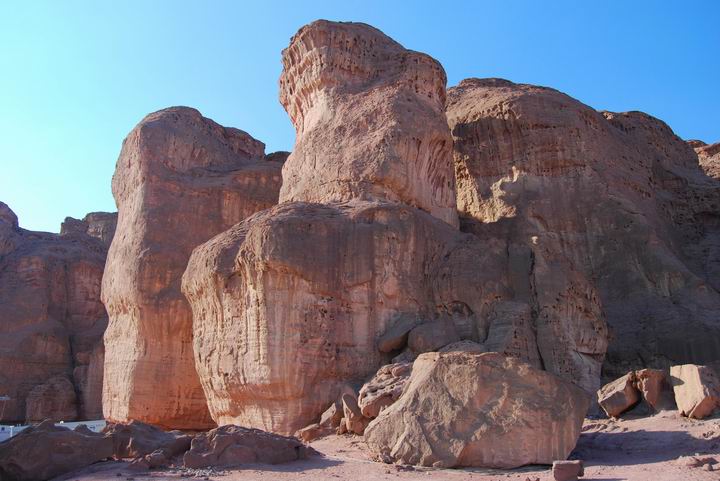
(b) The eastern pillars:
The following photos show a closer view of the cliffs on the east side.
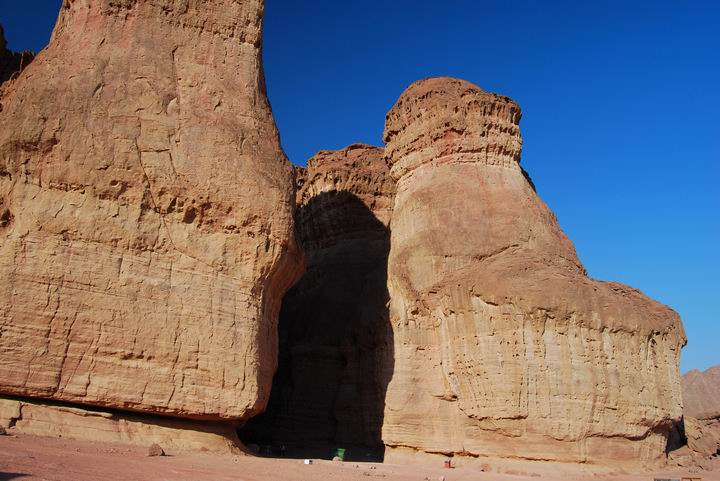
Another view from the eastern side of the cliffs.
(c) Egyptian mining temple:
In the center of the site is an Egyptian temple, dated to the 12-13th Century BC, dedicated to Hathor – the Egyptian goddess of mining. The shrine is seen in the center of the photo, behind the fence and under the great rock. Above and right to the temple, in the center of the cliff (seen with a partial shadow), is a rock carving of Egyptian King Ramses III.
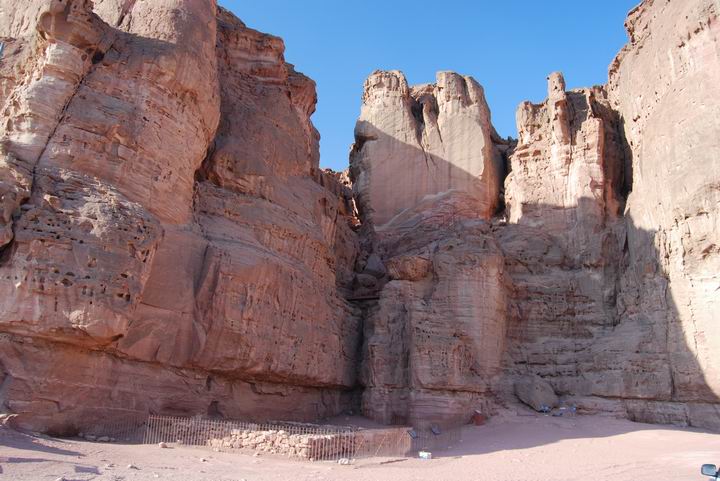
This is the view of the temple. It serviced the Egyptian miners who worked in the area. The altar is on the right side, just below the cliff.
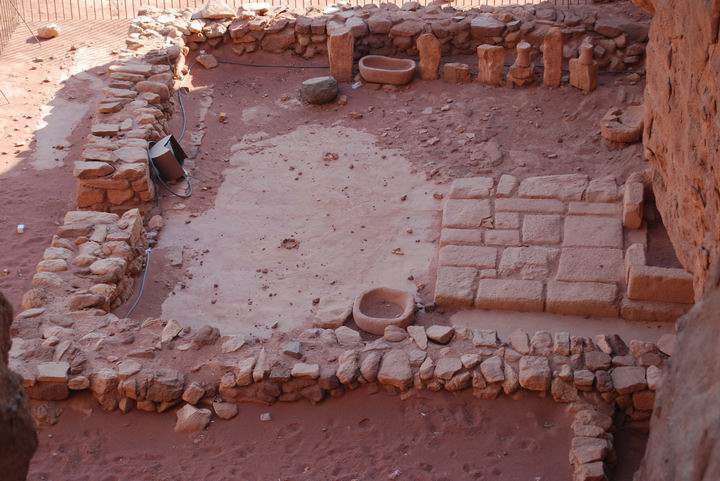
This following photo shows the altar, with three cultic recesses set into the rock face. A libation basin is also seen on the side of the paved platform.
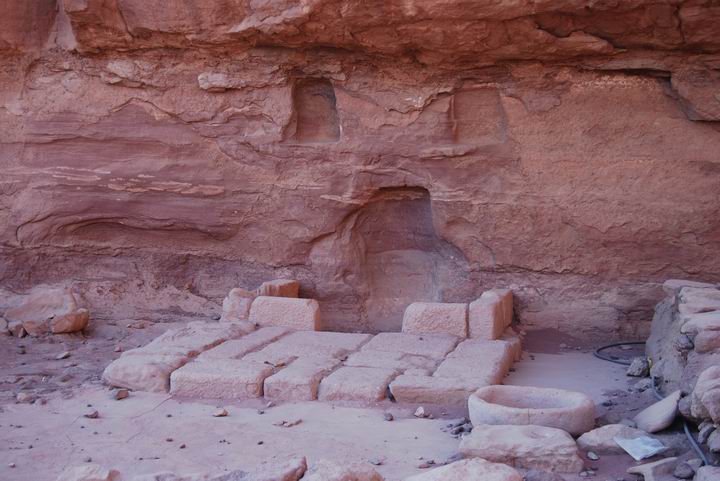
The photo below shows the south side of the temple, where standing stones, offering tables and deity images are aligned along the edge. At this area the excavators collected over 11,000 cultic offerings – figurines, pots, sacrificed animal bones. They dated the offerings to the 12-13th Century BC.
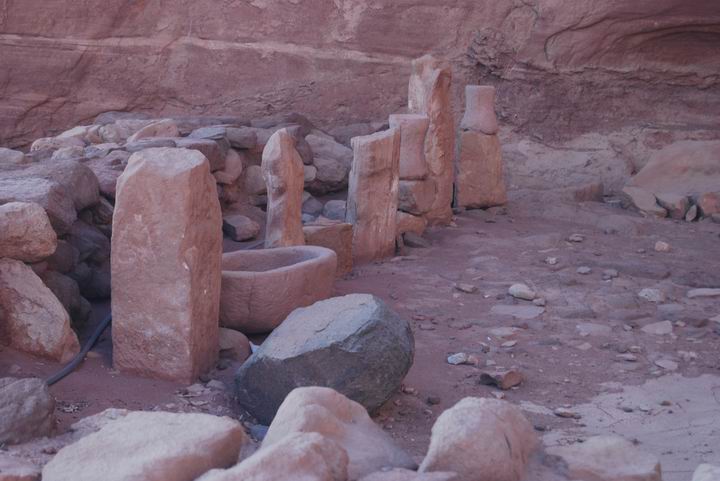
(d) Rock engraving:
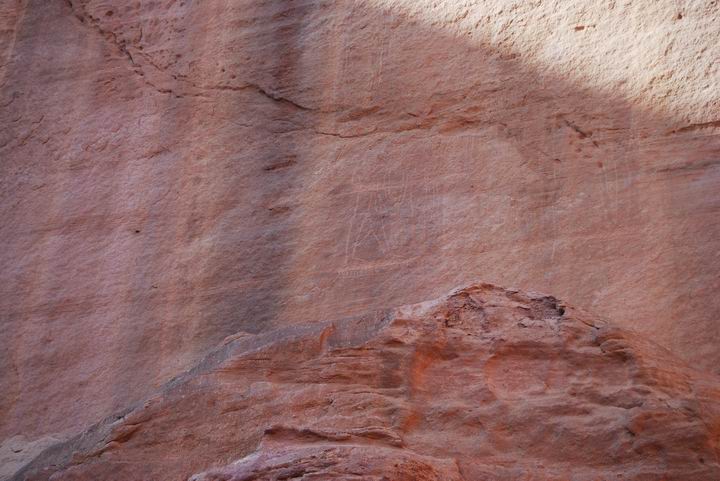
On the cliff, high above the temple, is a rock engraving dated to the days of King Ramses III (1st half of 12th Century BC).

The King is seen making offering to the goddess Hathor on the right. Between the two figures (80cm high) are double cartouches with the symbols of Ramses. The King has a crown of a snake – the symbol of the Kings. He is holding, with a raised arm, an offering to the Goddess. His other arm is holding a round object (fruit?). The Goddess Hathor is holding the symbol of eternity (a cross and a circle). On the bottom are hieroglyphs, which read “the arrival of the Royal butler Ramessesemperre”, the manager of the Egyptian copper mines in Timna.
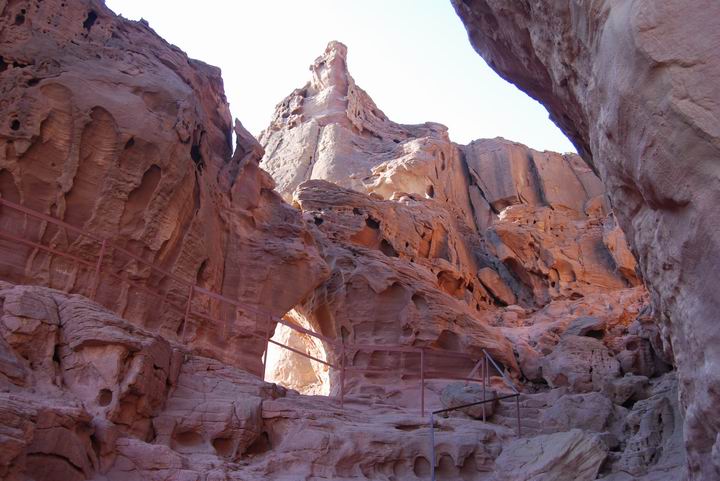
A path is used to climb up and closer to the rock carving and then farther to the top of the cliff. While walking high above the ground through these fantastic red rocks – it seems like walking through an enchanted palace, as you can see in the photo below.
(e) Slaves hill:
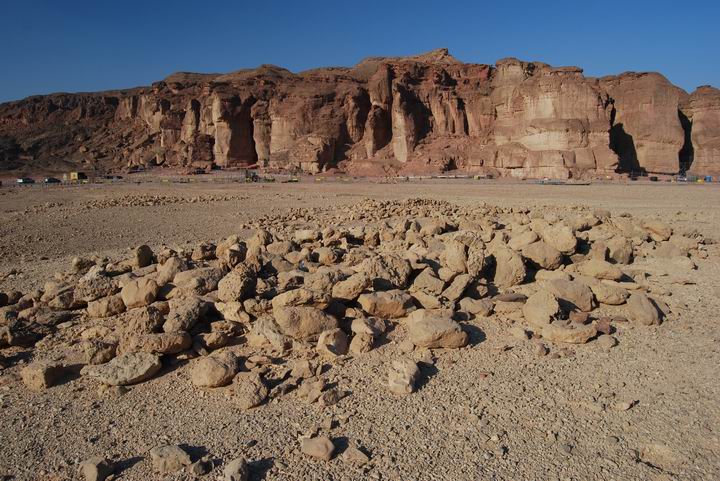
On the south side of Solomon’s pillars – seen on the background – is an area with ruins of the miners’ camp, called the slaves hill. In this area, as well as in other sites in the Timna valley, is a cluster of heaps of stones which once were the walls of the houses of the miners.
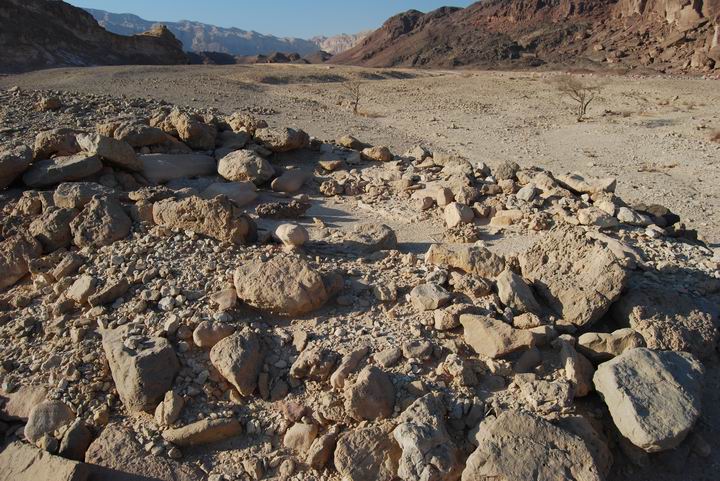
Another view of the ancient camp, with a view towards the Edom mountains on the Jordanian side of the Arava – which is seen in the far background.
Biblical sources:
Timna is one of Esau’s dukes in the land of Edom (which is located on the hills of Jordan facing the site).
Genesis 36, 22+40,
“And the children of Lotan were Hori and Hemam; and Lotan’s sister was Timna“. “And these are the names of the dukes that came of Esau, according to their families, after their places, by their names; duke Timnah, duke Alvah, duke Jetheth”.
1 Chronicles 1:51 :
“And the dukes of Edom were; duke Timnah, duke Aliah, duke Jetheth”,
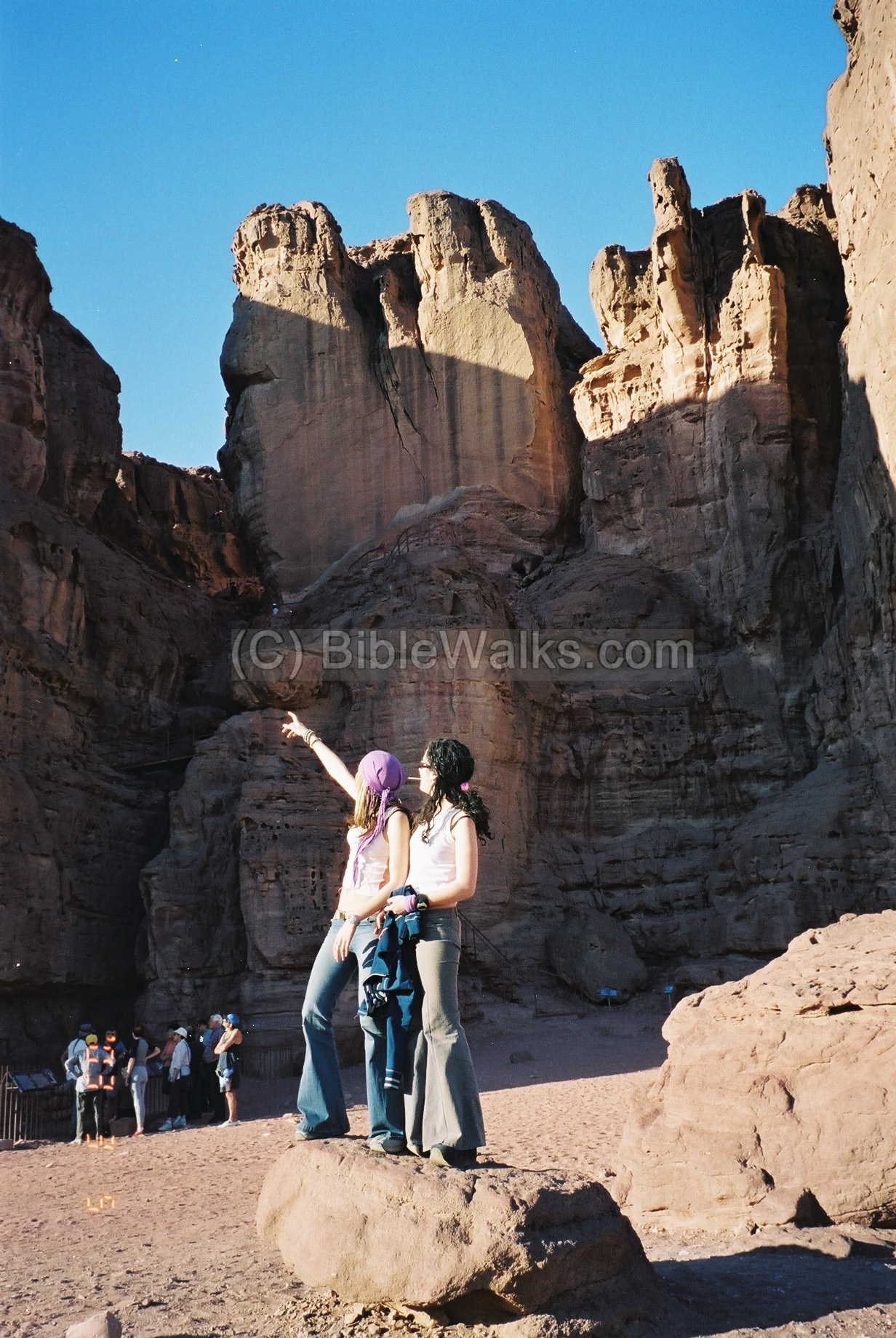
Webmaster Rotem pointing on the Solomon’s pillars
Etymology (behind the name):
-
Ammudei Shelomo – The name of the site in Hebrew: Ammud is Pillar, Shlomo is King Solomon. The name is based on the initial archaeological theories that these hills were mined at the times of King Solomon (hence also called “King Solomon’s mines”), a theory that was recently proven.
-
Timna – the name of the valley and the mountain. The name was based on the Biblical source (1 Chronicles 1:51: “And the dukes of Edom were; duke Timnah…”). Timna(h) is a royal Edomite family that descended from Esau, brother of Jacob. The name of the valley was selected on the fact it is near Edom and it sounds close to the Arabic name (Mene’iyeh).
-
Edom – the mountains east to Timna, across the Arava. In Hebrew Edom means “red” as the color of the rocks. Edom is mentioned many times in relation to Esau brother of Jacob and the geographic area. For example (Genesis 25:30): “And Esau said to Jacob, Feed me, I pray thee, with that same red pottage; for I am faint: therefore was his name called Edom”. and (Genesis 36:8): “Thus dwelt Esau in mount Seir: Esau is Edom”.
The Bible also calls it “Seir” (Genesis 32:3): “And Jacob sent messengers before him to Esau his brother unto the land of Seir, the country of Edom”.
-
Arava (Aravah, Arabah) – the name of the vast valley that divides Israel and Jordan, from the Dead sea to the Red sea, which is part of the Syrian-African fault line. In Hebrew it means a plain or a desert. Based on the Biblical source: Deuteronomy 1,1: “These be the words which Moses spoke unto all Israel on this side Jordan in the wilderness, in the plain over against the Red sea, …”
Links:
Internal links:
External links:
- Timna Park info
- Funon in the middle Araba valley – Eli Raz, Erez Ben Yosef (Hebrew, pdf)
-
King Solomon’s Dome – Reader Nanci Henderson wrote us that this is located in Canada, Yukon Territories, in the midst of the region noted for the Klondike Gold Rush (1896-1901), center of Dog Sled Races – the Yukon quest.
BibleWalks.com – walk with us through the sites of the Holy Land
Yotvata<—previous Negev site—<<<All Sites>>>—> Timna
This page was last updated on July 5, 2019 (text corrections)
Sponsored links: