
A 5th century AD monastery, the largest in the Judean desert. The walled complex is built on the southern cliffs of the Kidron creek. It was established by Saint Sabas, and named after him. The monastery started as a place of seclusion of few monks in the caves, led by Mar Saba.
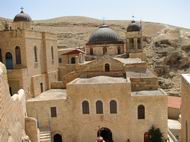
Home > Sites > Judea > Mar Saba Monastery, Kidron creek
Contents:
Background
Location
History
Photos
* General view
* Monastery
* Inner Yard
* Inner Tombs
* Church
* Art
* Cave of Saba
* Kidron Valley
Links
Overview:
Mar Saba Monastery, also known as St. Sabbas Monastery, is a historic Greek Orthodox monastery located in the Judean Desert, east of Bethlehem and south of Jerusalem in the West Bank. The monastery was founded in the 5th century by St. Sabbas the Sanctified, one of the most prominent figures in the history of Orthodox monasticism. Over the years it was built, expanded, and fortified. During the peak times it housed about 500 monks.
The monastery is situated on a steep cliff overlooking the Kidron Valley and has been an important center of Orthodox Christianity in the region for centuries. It contains a number of chapels, cells for monks, and a library with a valuable collection of manuscripts.
Today, Mar Saba Monastery is still an active monastery and is home to a small community of Greek Orthodox monks. It is considered one of the most important monasteries in the Orthodox Christian world and is a popular destination for pilgrims and tourists alike. However, access to the monastery is restricted due to its location in the West Bank and visitors must obtain permission from the Israeli authorities.
Location and Aerial map:
The site is located 10KM east of Bethlehem, near the desert road to Jerusalem. It is 250M above sea level, hanging over a steep cliff above the Kidron creek. The Kidron starts from the valley between the temple mount and Mount of olives in Jerusalem, and flows eastwards to the Dead sea.
The monastery is located on crossroads: up the creek towards Jerusalem, south-west to Bethlehem (10KM), and east towards Nebi-Musa (19KM) through the Horkania fortress.
An aerial photo of the area around the monastery is seen below.

History of the place:
- Sabas – Founding father
Sabas was born in Mutalaska, Cappadocia, in 439 AD. He was grown in the Coenobium of Cappadocia for 10 years, then at the age of 18 he came to Jerusalem. He moved to the Judean desert and stayed in the Coenobium of Euthymius for 12 years. At the age of 30 he was granted the permission to live in seclusion, and wandered for 5 years in the desert. Sabas lived about 10 years in a cave near the future location of the monastery. He found this remote site in Kidron creek, with its local spring, a perfect place for the seclusion. Sabas established, at the age of 45, a Laura in Mar Saba (483AD) – a cluster of caves or cells of hermits residing around the central monastery.
Sabas directed the Great Laura of Mar Saba for nearly 50 years. During the years the place was expanded in order to accommodate the hundreds of monks who resided here, and walls were constructed in order to provide protection.
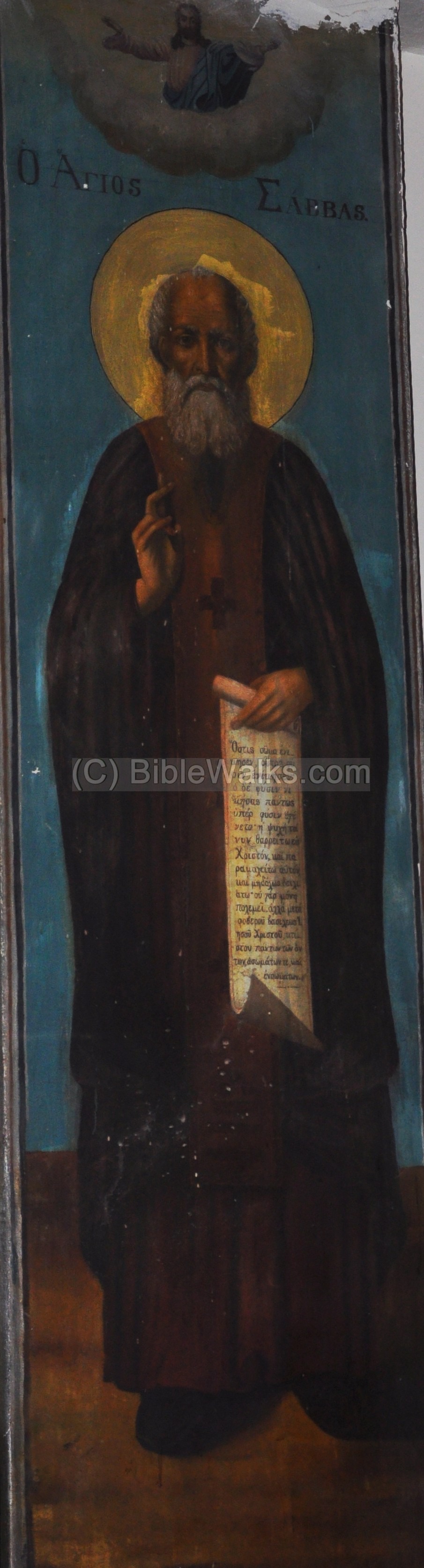
Sabbas – painting in St. Gerassimos
Sabas helped to establish more monasteries in the desert: He and his monks established during this time a total of 13 (!) monasteries in the Judean desert – 7 Lauras and 6 Coenobiums. Several older monasteries came under his management – including the famous Monasteries of Euthemius and Theoktistus. In his times the number of hermits grew from hundreds to thousands. The author of the “Life of Sabbas”, Kyrillos of Skythopolis, summarized his lifetime mission as “converted the desert to a city”.
His influence reshaped the customs and living habits of the monks. He was the first among the desert hermit fathers who formulated a set of written rules for the conduct and way of life for the desert monks in the Judean desert.
-
After Sabas
After his death in 532 at the age of 93, Sabas was buried in the yard of the monastery. By now, the Monastery was a small center for monks. This formed a Laura (Lavra) – a term in Orthodox Christianity meaning a cluster of caves or cells of hermits residing around a central monastery.
During the years the place was expanded in order to accommodate the hundreds of monks who resided here, and walls were constructed in order to provide protection.
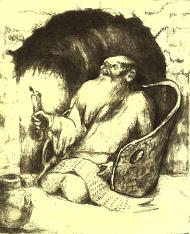
Hermit in a cave – drawing by Rina
-
After the Byzantine period
During the Persian invasion (614AD) the monastery was damaged, and restored in 629. After being robbed in 796 its was further fortified in the 9th century AD.
The Crusaders expanded the fortifications in the 12th century. When the Crusaders left the Holy Land they transferred Saba’s bones to Venice, which were returned here only in 1965.
A 19th century photo shows the monastery during the end of the Ottoman period.

Mar Saba– 1860-1880 – Photos of the Library of Congress
During the Turkish rule the monastery was raided several times by the local Bedouins. It was also damaged in a 19th century earthquake, but was restored in 1840 by the Russians.
Photos:
(a) General view
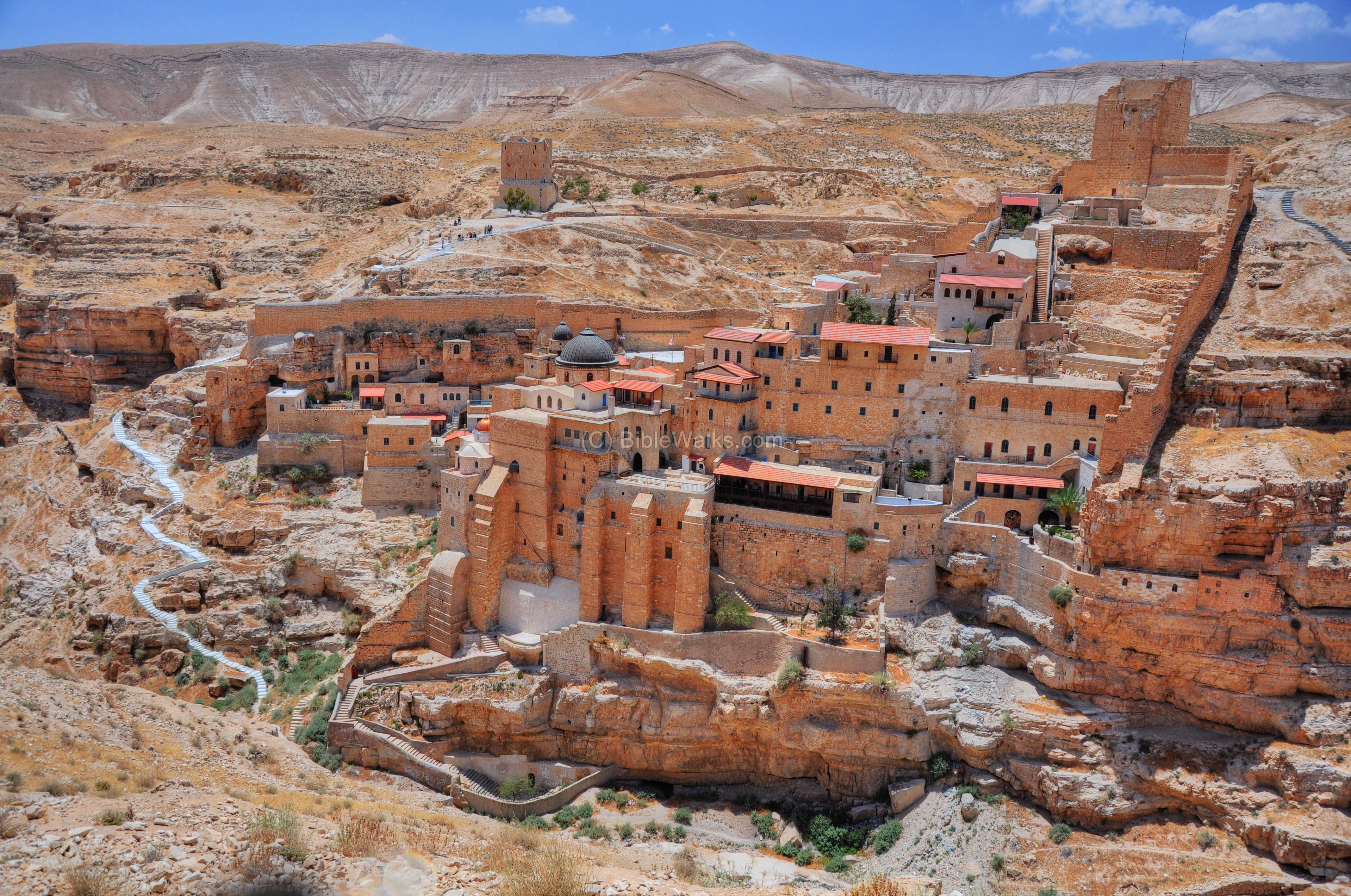
View of the monastery, as seen from the north-east. The Kidron creek flows through the Judean desert, from Jerusalem (located upstream in the back of this position) towards the Dead Sea (located downstream to the left of the photo).
Click on the photos to view in higher resolution…
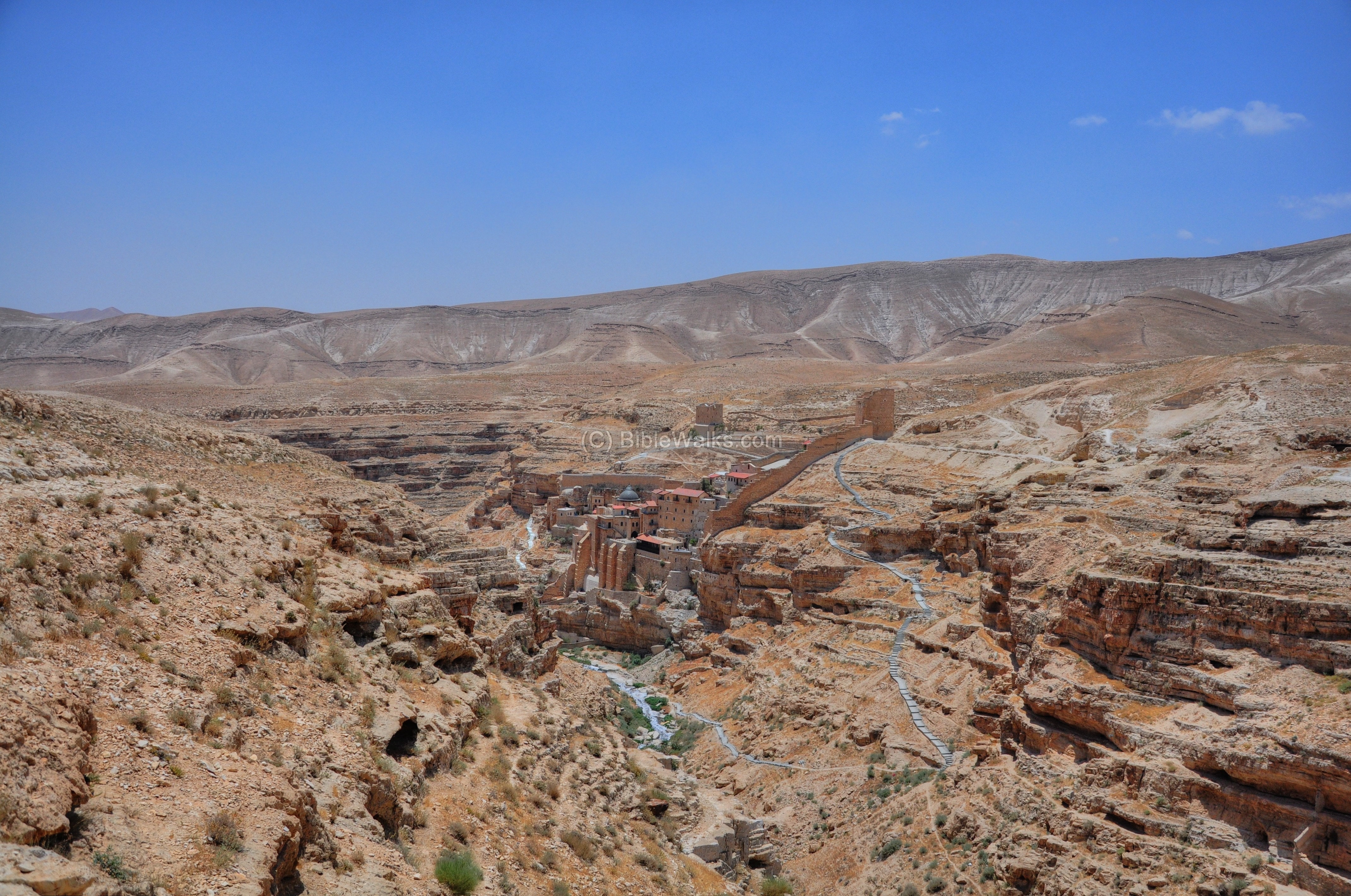
A closer view of the center of the monastery is shown below, with its high defense walls and two towers. The Kidron valley passes below the monastery on its way to the Dead Sea (downstream on the left side).
(b) Views of the monastery
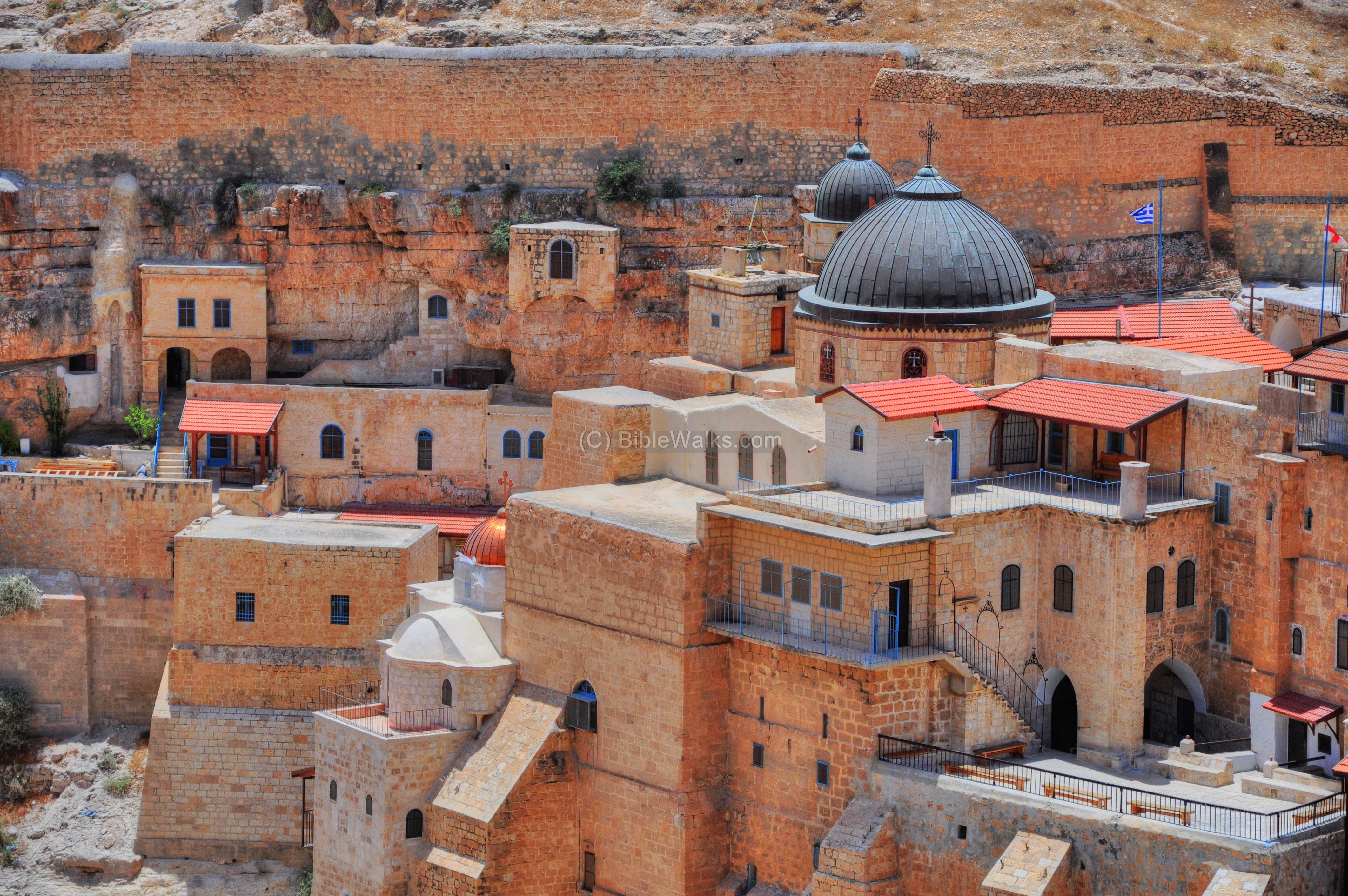
The following photos show details of the monastery complex, as viewed from the eastern side.
A view of the central side of the monastery is below. On the right is the dome of the church. The golden cap in the center was the original grave of Sabas.
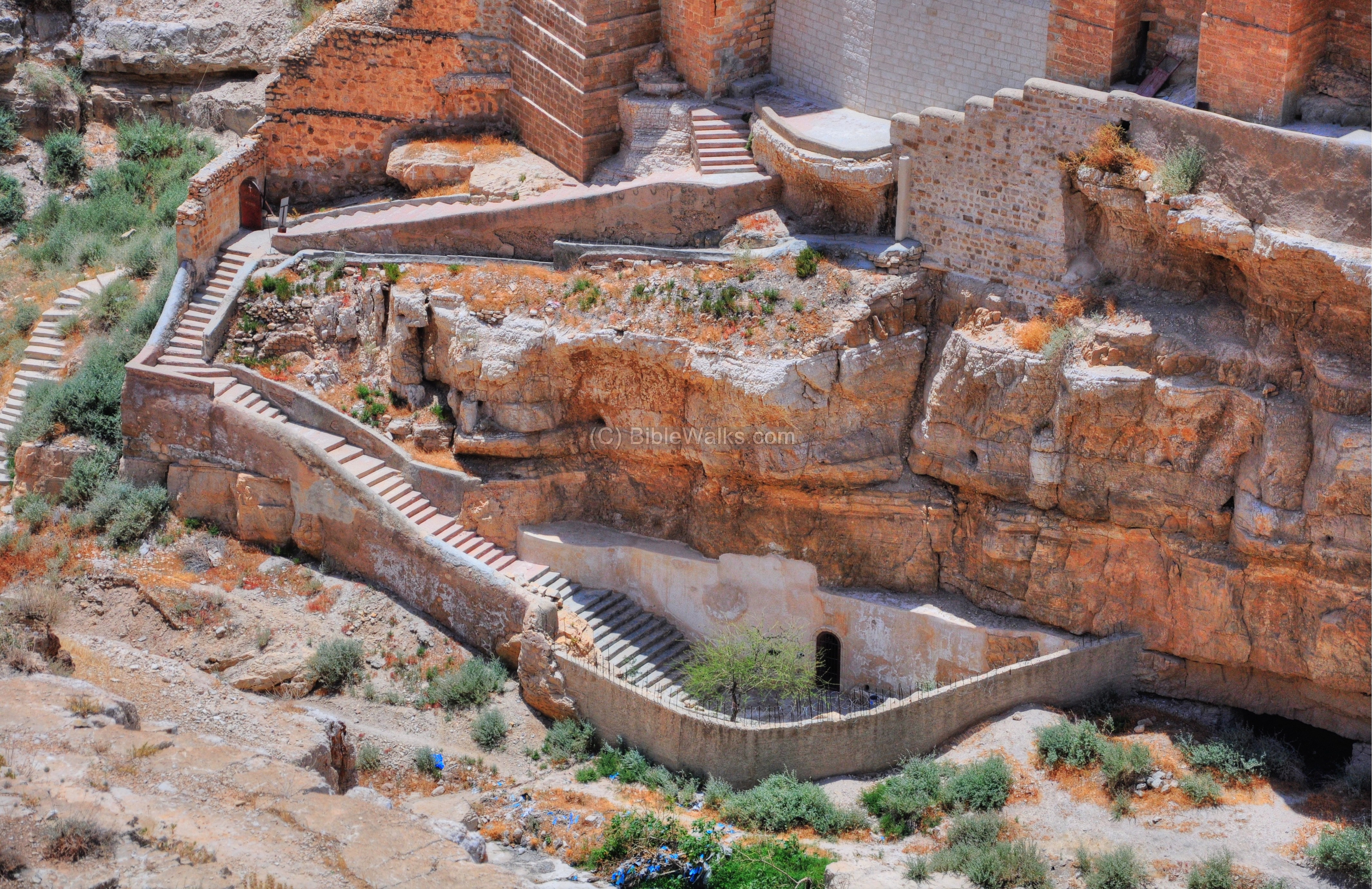
A view of the lower northern side of the monastery:

At the bottom of the monastery is the spring, which attracted Sabas to the site before the monastery was established.
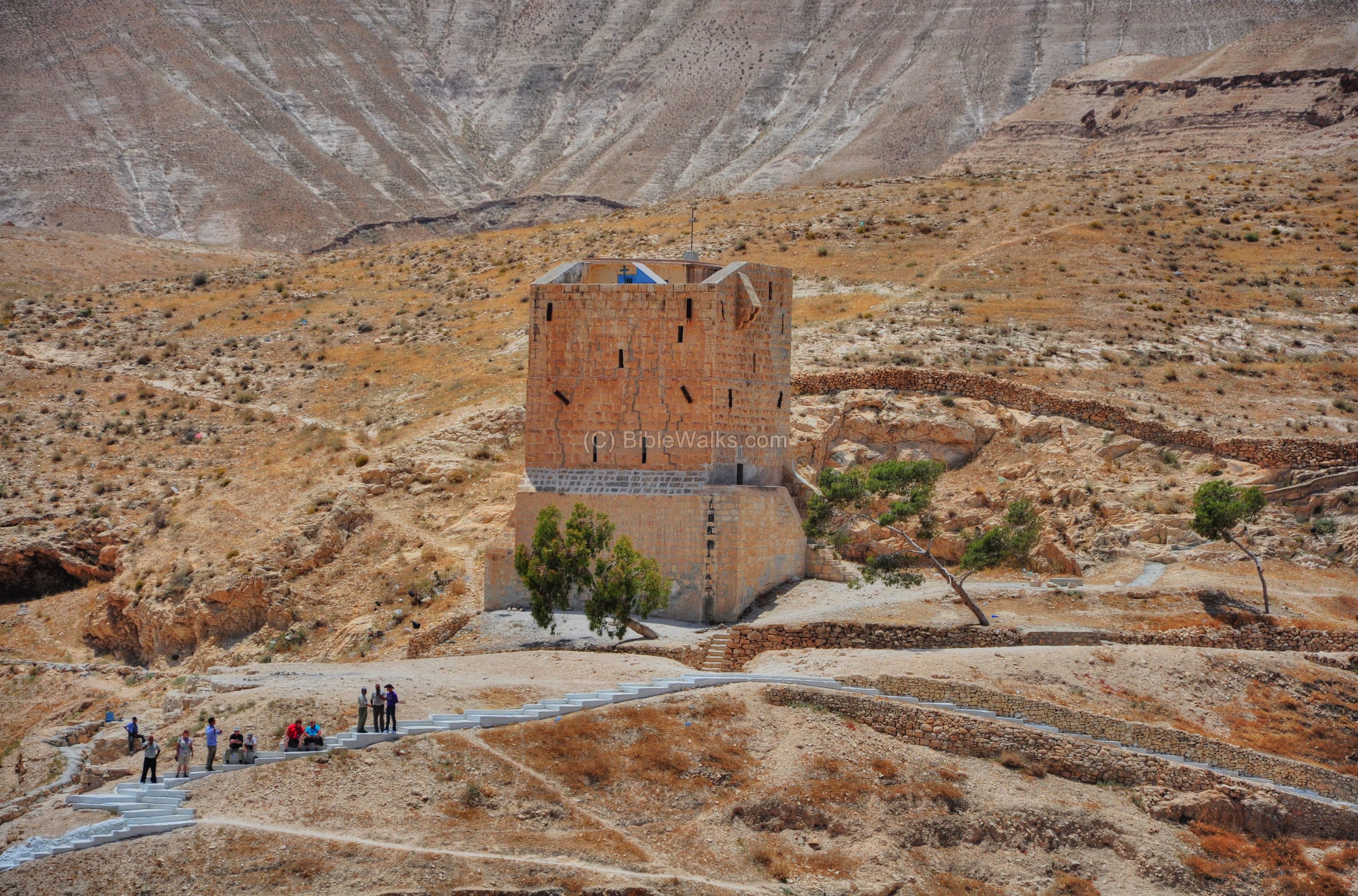
The southern tower, also called the Women’s tower, since they were excluded from other sections of the monastery:
The northern tower:

(c) Inside the yard of the monastery
All interior photos below by Shay Shtickgold – we thank Shay for his contribution of the wonderful photos.
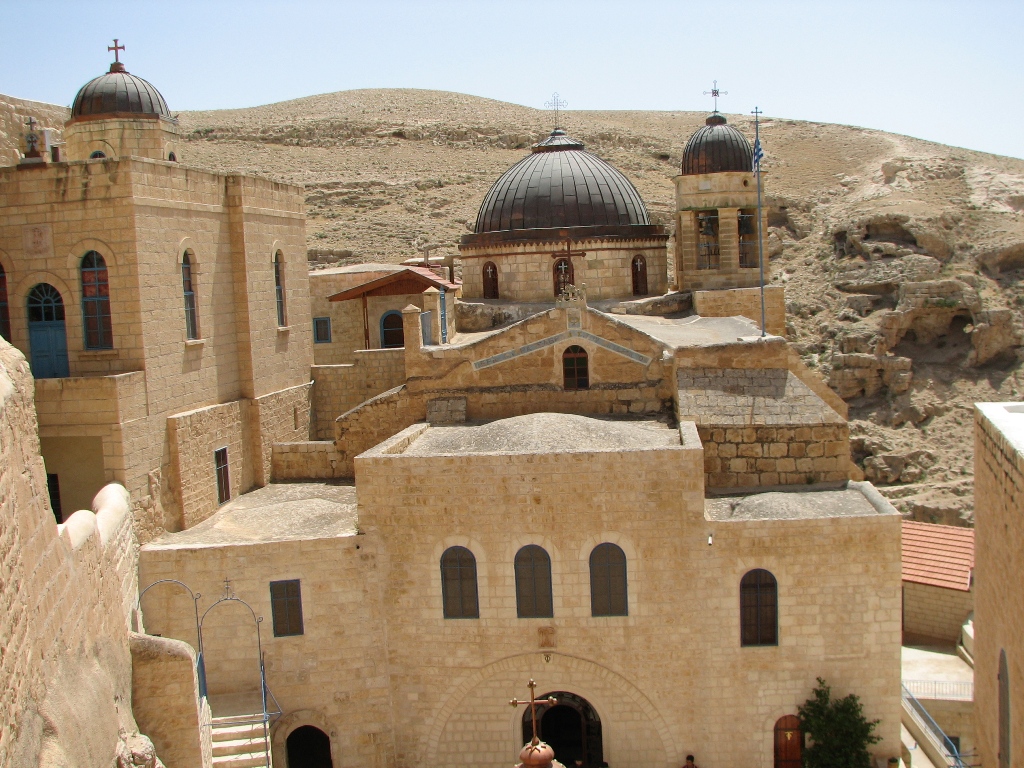
This is a closer view of the Monastery, inside the complex, as seen from the upper balcony. Women are forbidden to enter the complex, and can access only one of the exterior towers, built according to tradition by Saba’s mother (who was also forbidden to enter the holy grounds).
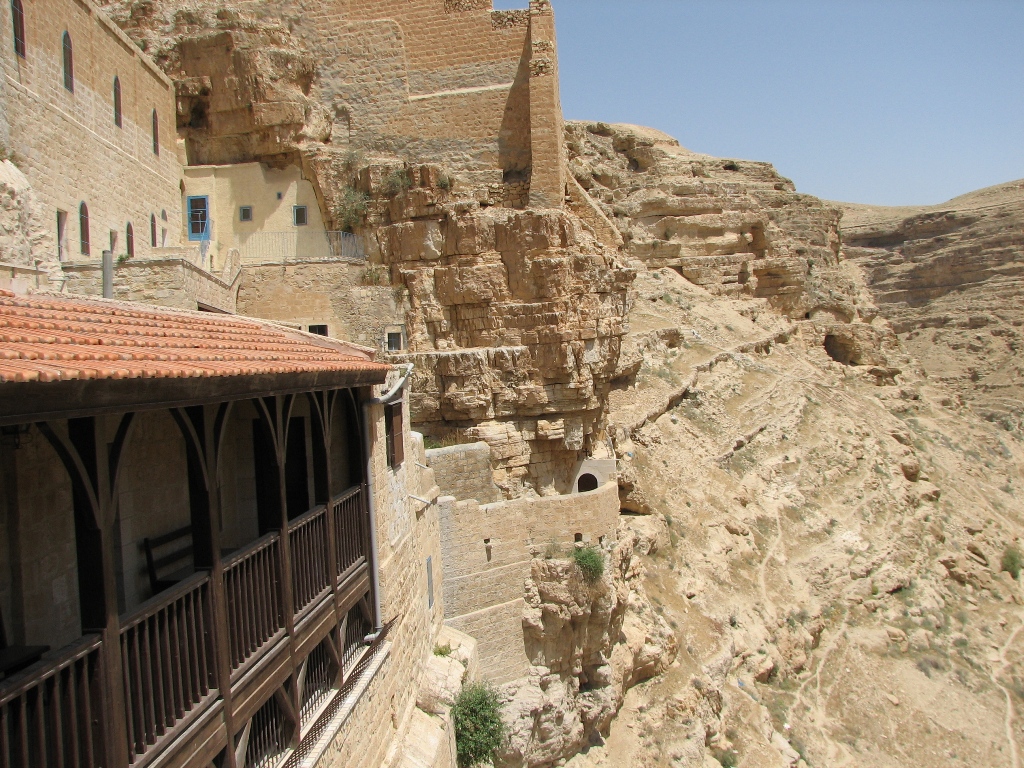
Some of the structure is built into the cliff. This is the west side of the walled complex. The structure seems to hang on the cliffs, and is embedded into it.
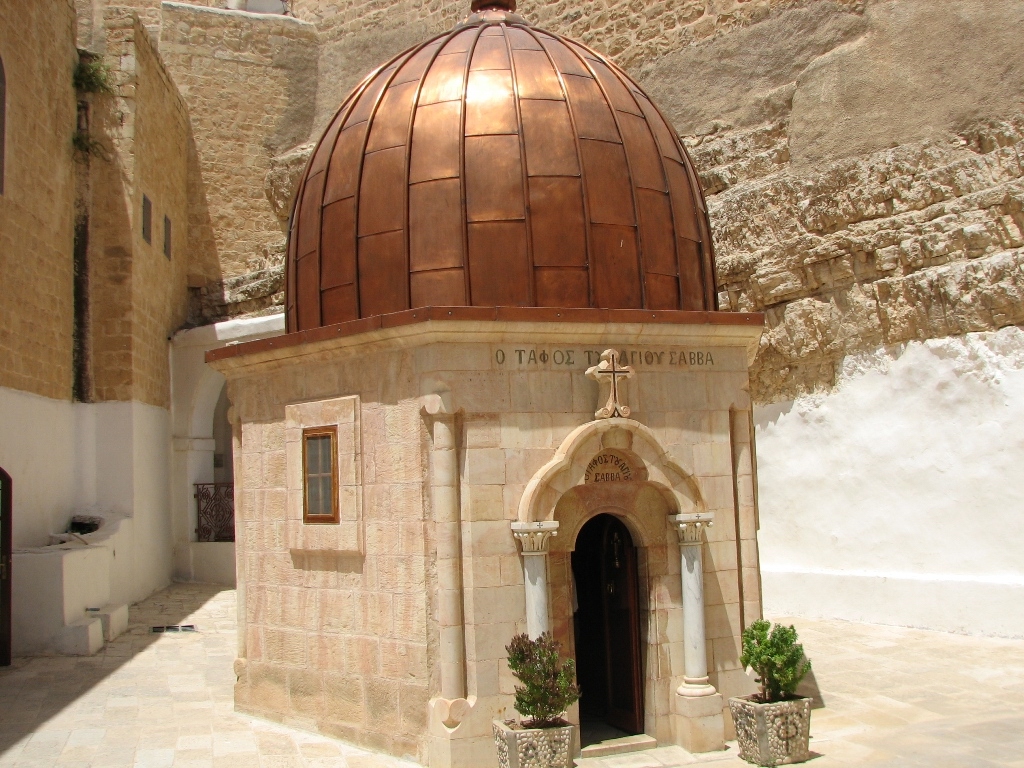
(d) Tomb inside the yard
Inside the yard is an hexagon shaped dome. It is the original grave of Sabas, but his bones were removed in the 12th C, returned in 1965, and are now on display in the main church hall.
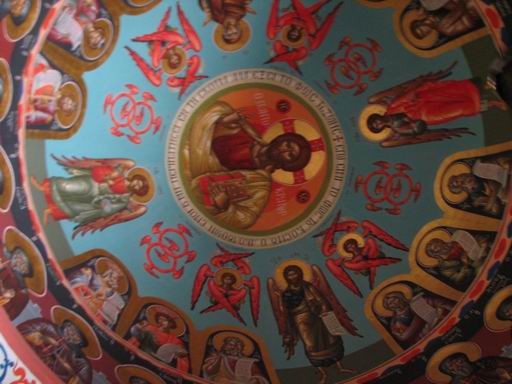
The ceiling of the dome is decorated inside with these colorful paintings.
Under the white roof, seen on the floor around the dome, is a room where the monks are buried.
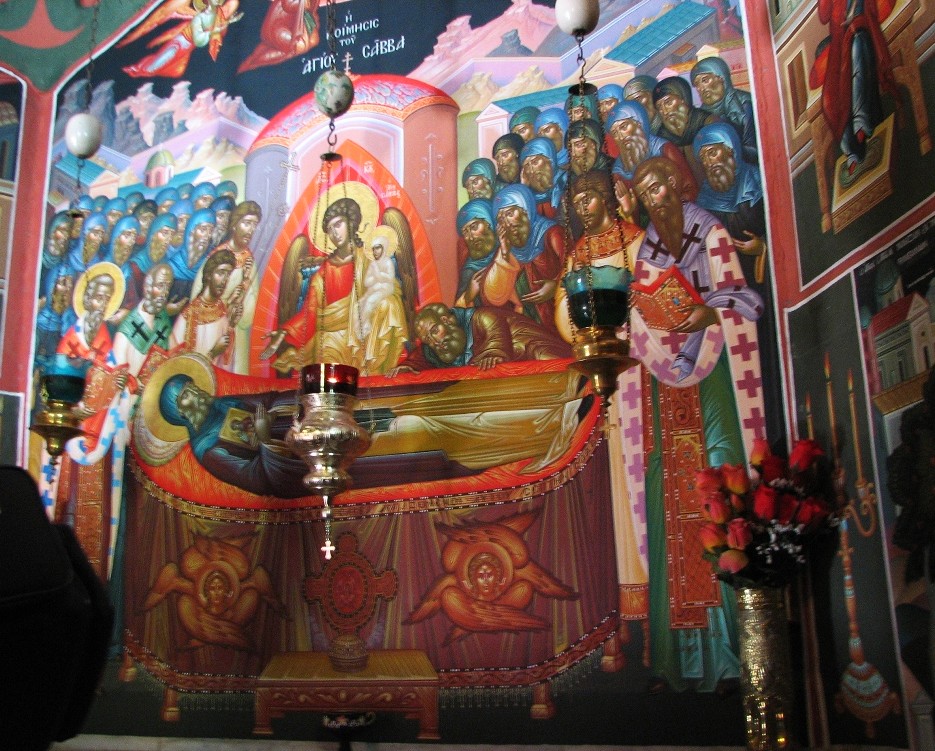
Inside the tomb, a painting of the deceased Sabas, with the monks gathered around and paying respect to the founder and leader.
(e) The Main Church
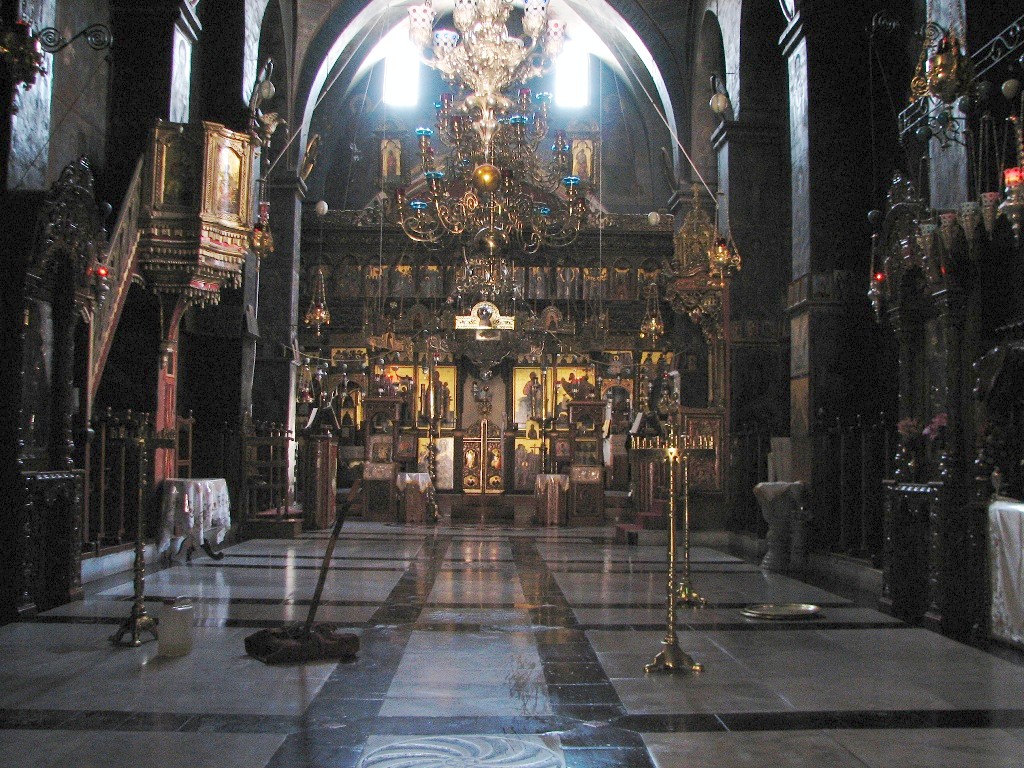
The interior of the main church is seen below, the most beautiful hall in the monastery. The floor is shining clean, and is polished with kerosene. On the right side, behind a glass closet, are the bones of the founder. Mar Saba, dressed with garments, continues to watch and dominate the daily life of the monastery.
The hall is dark, and is lit by the natural light that filters in from above. The entire setting of this hall casts a sense of holiness, and is a special experience, rewarding the long journey to the site.
(f) Greek-Orthodox Art
The Greek-Orthodox art and paintings inside the monastery provide a special atmosphere, as most of the Greek-orthodox churches in the Holy Land. You can’t miss the sensations radiated in these rooms.
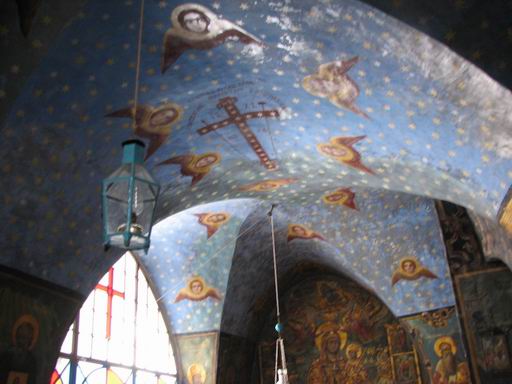
This painted ceiling (photo above) and wall (photo below) is in the entrance to the main prayer hall.
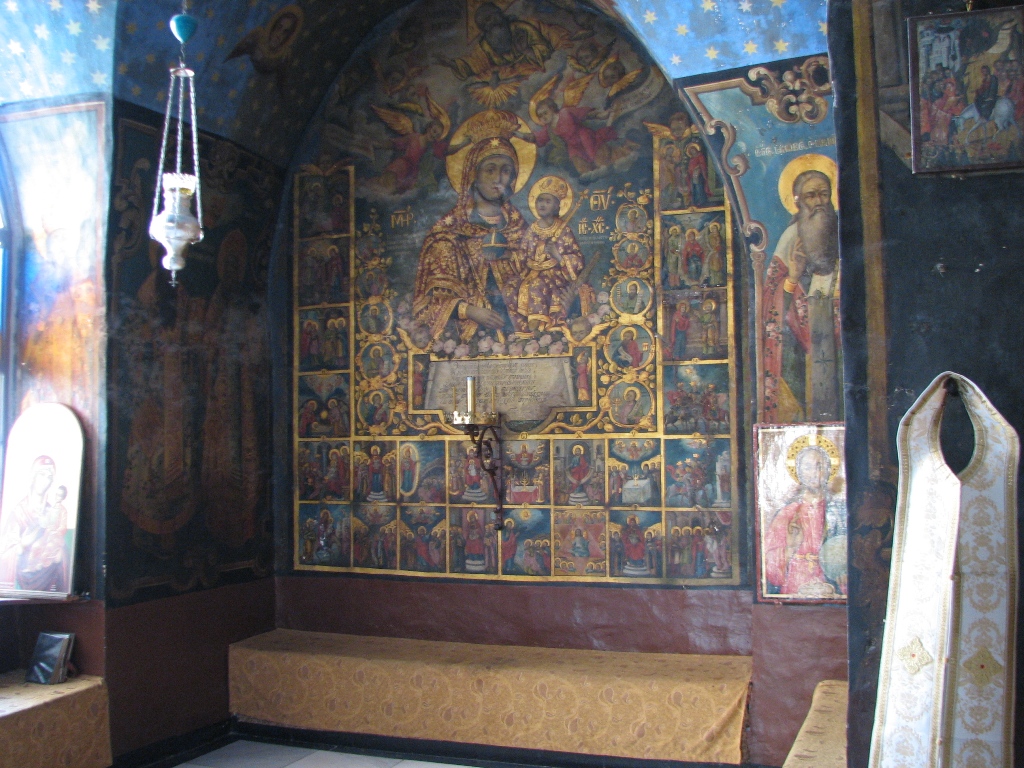
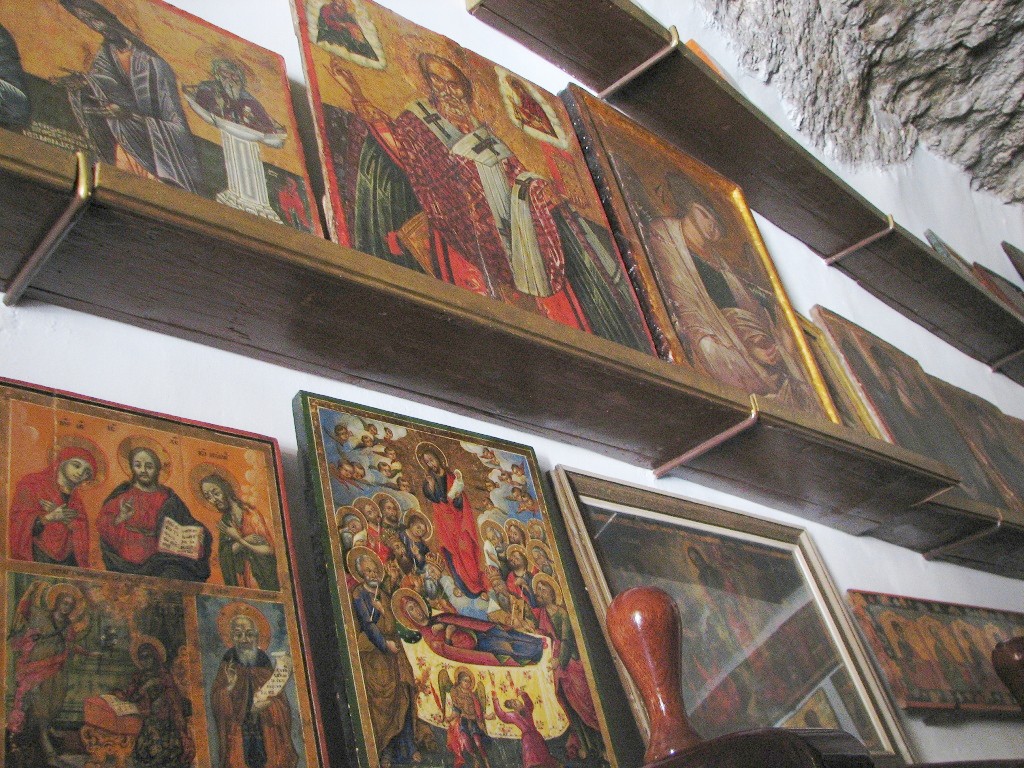
In the monastery there is a collection of many rare icons, books and paintings. Some of these treasures have been relocated to Jerusalem in order to provide them a better protection. The ancient paintings below are displayed in the holiest room.
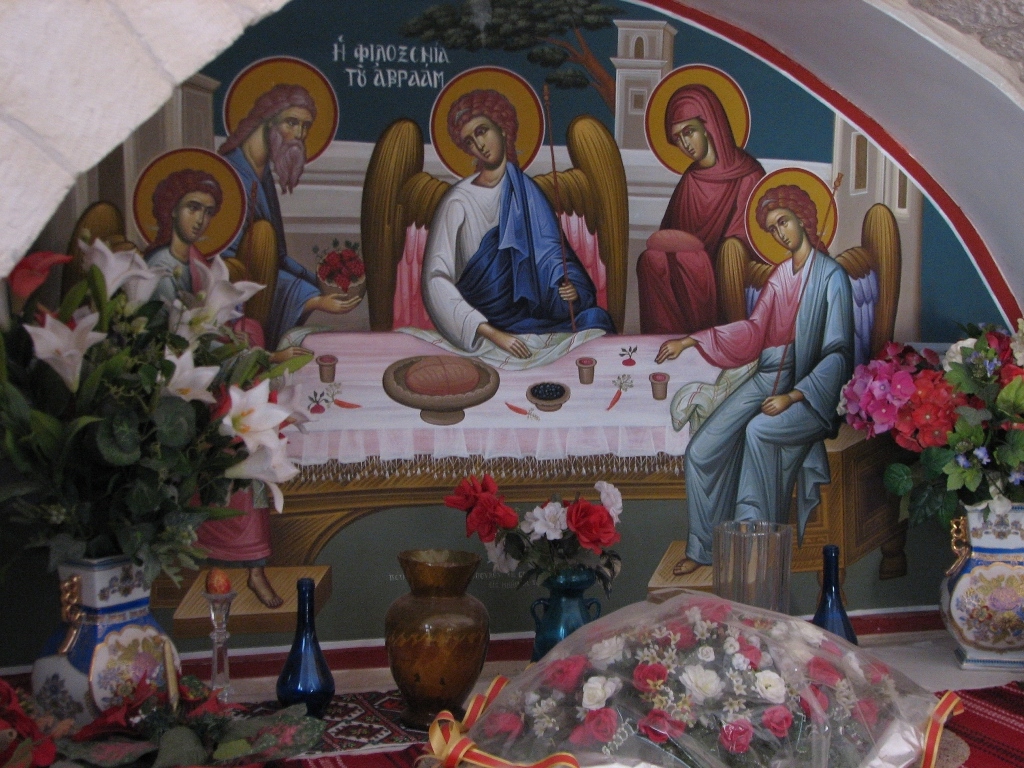
A view of the guest room where the visitors are greeted with traditional drink and food.
(g) Cave of Sabas
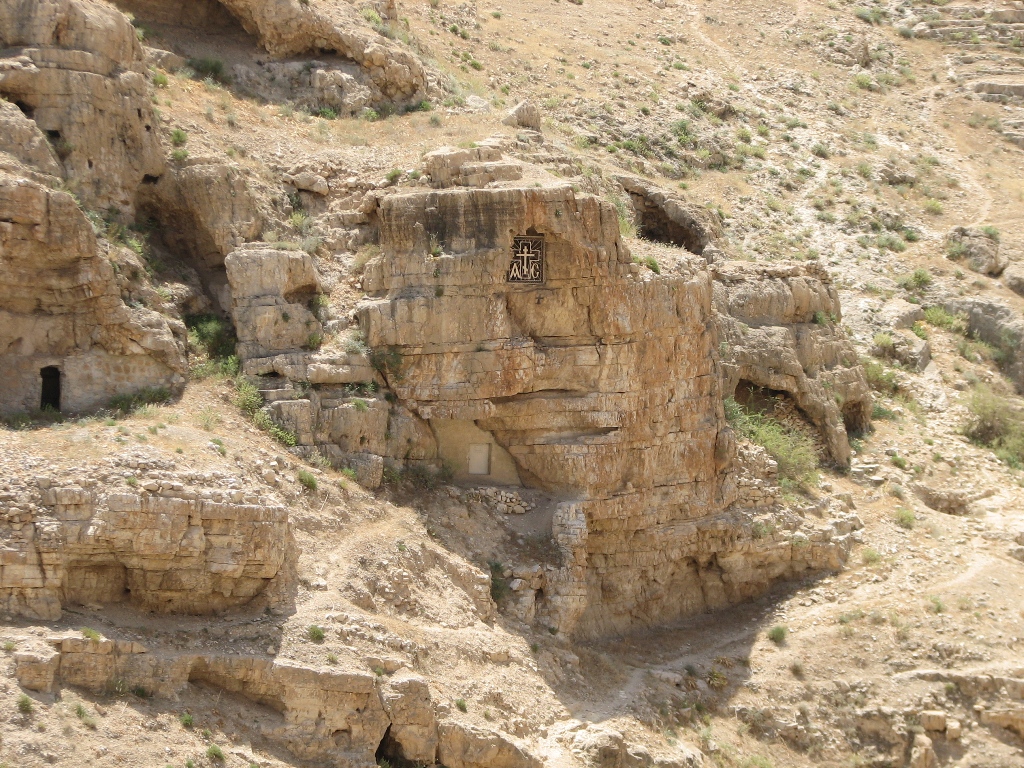
The cave of Sabas, marked by a cross, is on the facing wall of the creek. It is seen here from the main balcony. According to the tradition, Sabas secluded here for 5 years. Around it are more caves, where his assistants lived while building the monastery.
(h) Kidron Valley Hermits
There are dozens of hermit caves along the Kidron valley, close to the monastery. The photo below is a view towards the north-west side of the monastery.
Mar Saba used to host hundreds of hermits during the middle ages. Therefore, the hermits preferred to stay alone in their private corners most of the time, and gather in the monastery only on weekly basis or special occasions.

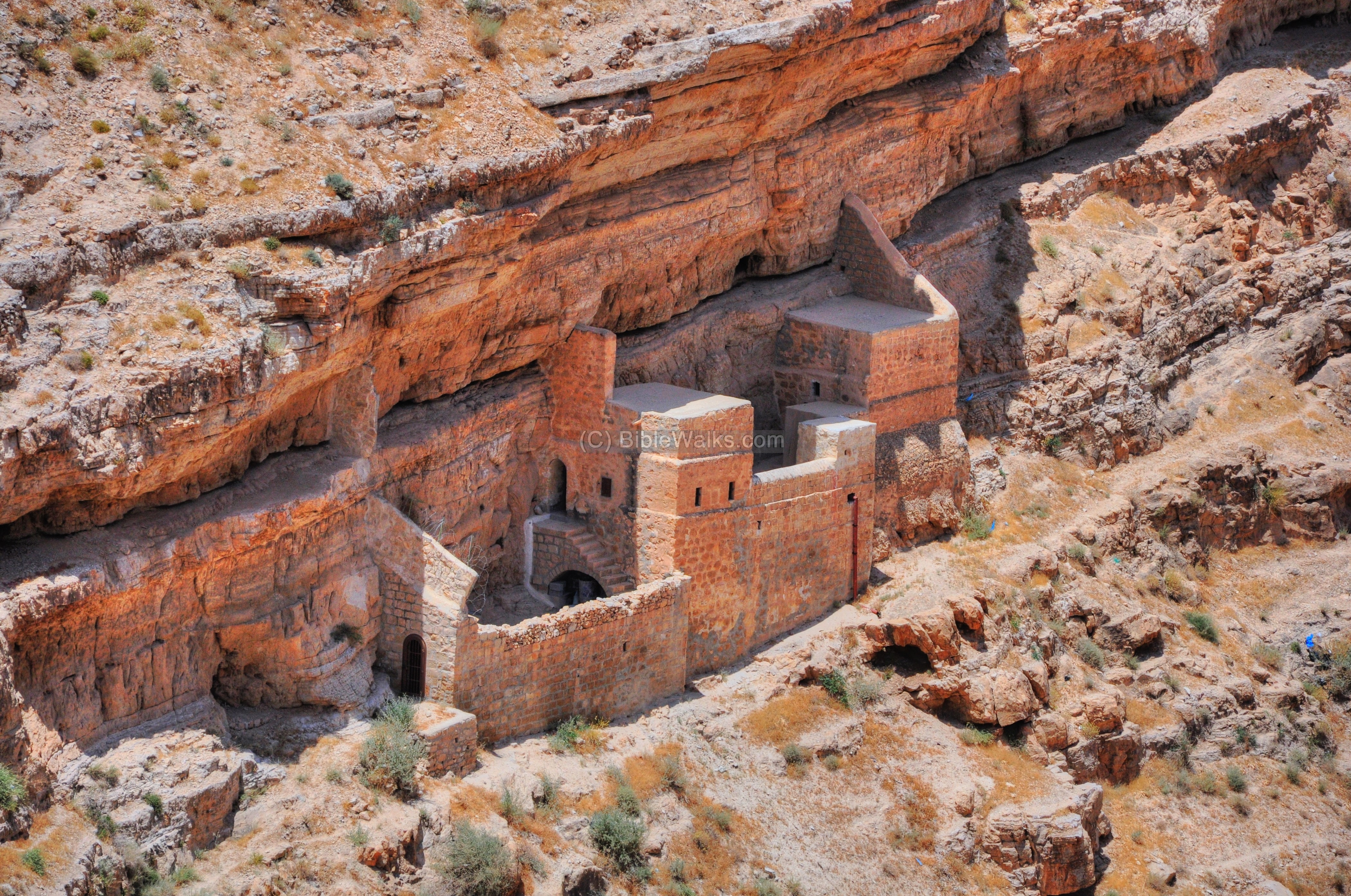
The following picture shows a closer view of one of the larger structures on the western side of the valley.
Links:
* External Links:
- Byzantine Monastic Foundation Documents – Sabas (pdf)
- Mar Saba – a great PowerPoint (Hebrew)
* Internal links:
- Judea sites gallery
- Byzantine monks – info page on Monasticism
* Sabas Monasteries nearby:
- Horkania/Hyrcania (Castellion)
- Nahal Sekhakha (Spelaion)
BibleWalks.com – walk with us through the sites of the Holy Land
<<< All Sites >>> —next Judea site—> Euthemius Monastery
This page was last updated on Feb 20, 2023 (new overview)