
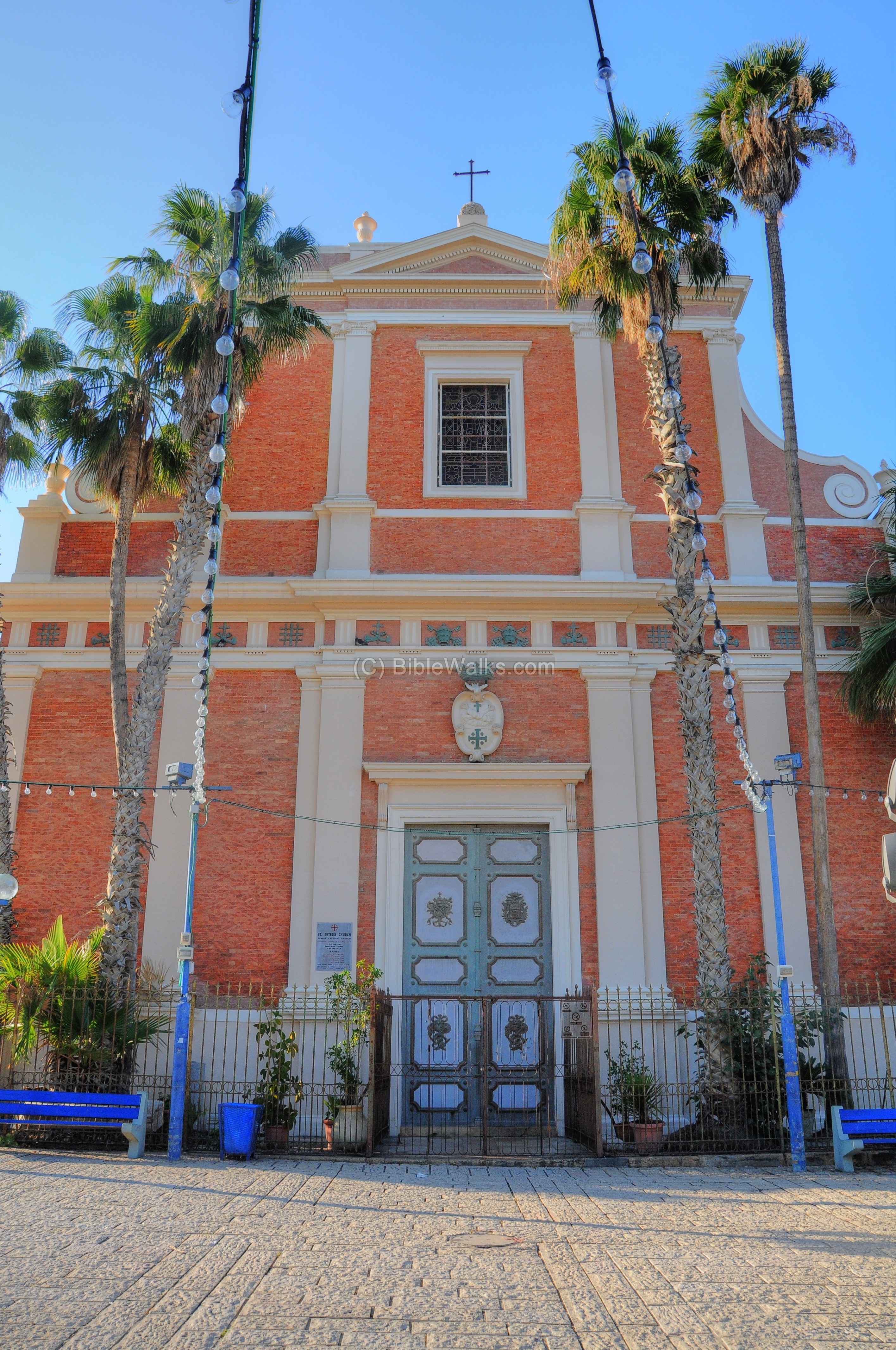
St. Peter’s is an old Franciscan Church, located in Old Jaffa.
Home > Sites > Sharon > Jaffa > St. Peter’s
Contents:
Overview
Location
History
St. Peter
Photos
* Exterior
* Interior
* Art
Biblical
Etymology
Links
Overview:
St. Peter’s is an old Franciscan Church, located in Old Jaffa. It commemorates the visit and miracle of St. Peter in Jaffa.
Acts 9 40: “But Peter put them all forth, and kneeled down, and prayed; and turning him to the body said, Tabitha, arise”.
Location:
St. Peter’s church is located above the ancient port of Jaffa, in the modern square of old Jaffa (“Kedumim square”). The church, as well as other featured places, is marked by a yellow square.

History:
- Crusaders – order of Franciscans
St. Peter’s church belongs to the Roman Catholic order known as the Franciscans.
The Franciscan order was established by Saint Francis, an Italian who lived in the late 12th century. The Franciscans presence in the Holy Land started in the early 13th century, when they resided in a small house in via Dolorosa.
In 1342 Pope Clement VI declared that the Franciscans are the official custodians of the Holy places (“Custodia Terroe Sanctoe”). This custody is still in effect to date, and includes St. Peter’s church.
The symbols of the Franciscans, as well as common Christian symbols, are seen above the entrance of the west facade, and are explained below:
The two hands on both sides of a cross – the symbol of the custody of the Holy places. The bare hand is the hand of Jesus, while the hand with a sleeve is St. Francis of Assisi, the founder. Both hands are perforated – the holes created by nails (Jesus on the cross, St. Francis of stigmata).
The 5-cross was originally the Crusaders’ sign of Jerusalem, and was adapted by the Franciscans. The 5-crosses motif is based on the 5 Holy wounds of the crucifixion of Jesus (2 in the hands, 2 in the legs, and one in the chest). The emblem in this detail has 4 sections from top to bottom: crown – dove – 2 hands – 5-cross.
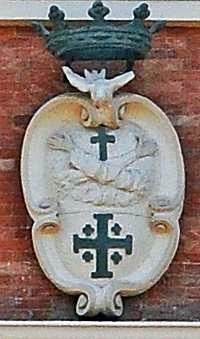
Franciscan emblem above the gate
The Crusaders built a church at this site, where according to the tradition was the house of Simon the Tanner. It was later destroyed after the defeat of the Crusaders in the 13th century.
- Ottomans
The church was initially built in 1654 over the ruins of a Crusader church. It was destroyed in the late 18th century, and rebuilt between 1888 and 1894. Renovations were conducted in 1903.
- Modern Period
You can visit inside the church during visiting hours, entering from “Kedumim” square in Old Jaffa.
Who was St. Peter?
Simon Bar-Yonah, later named by Jesus as Peter (“rock”), was one of the 12 apostles of Jesus. He is regarded as the most important and spokesman of the Apostles, and considered as the first Pope.
According to the New Testament, Simon/Peter was a fisherman, born in Bethsaida in the north of the Sea of Galilee. This fishermen town was the birthplace of the Apostles Andrew, Peter, and Philip (John 1:44): “Now Philip was of Bethsaida, the city of Andrew and Peter”.

Illustration of St. Peter’s – detail of picture in St. Peter Church, Jaffa
St. Peter has a prominent place in the Bible, with many references in the Canonical Gospels:
-
Peter joined Jesus as a disciple (Matthew 4 13): “And Jesus, walking by the sea of Galilee, saw two brethren, Simon called Peter, and Andrew his brother, casting a net into the sea: for they were fishers. And he saith unto them, Follow me, and I will make you fishers of men”.
-
Peter’s mother-in-law was healed by Jesus in Capernaum
-
Jesus performed the miracle of the feeding of multitude on Peter’s boat (Luke 5 3): “And he entered into one of the ships, which was Simon’s” – see drawing:
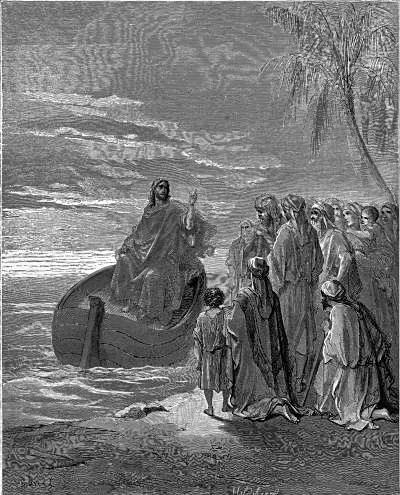
Jesus preaching on the boat of St. Peter
-Drawing by Gustav Dore (French artist, 1832-1883)
-
Jesus transfigured in front of Peter on the high mountain (Matthew 17 1): “And after six days Jesus taketh Peter, James, and John his brother, and bringeth them up into an high mountain apart, And was transfigured before them” – see drawing:
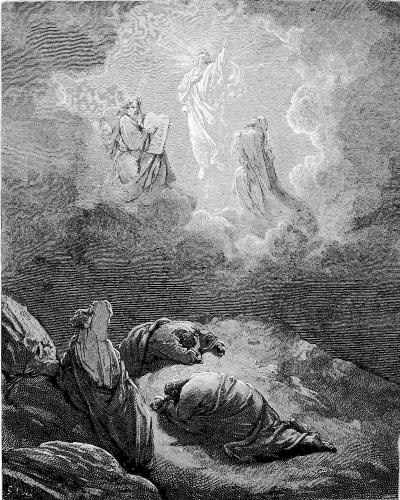
St. Peter with James and John witness the transfiguration
-Drawing by Gustav Dore (French artist, 1832-1883)
-
Peter confessed that Jesus was the Messiah on the trip to Banias (Mark 8 27-29): “And Jesus went out, and his disciples, into the towns of Caesarea Philippi: and by the way he asked his disciples, saying unto them, Whom do men say that I am? … And Peter answereth and saith unto him, Thou art the Christ.
-
Jesus blessed him in turn, giving him the nickname ‘Peter’ – meaning rock (Petros) in Greek (John 1 42): “And he brought him to Jesus. And when Jesus beheld him, he said, Thou art Simon the son of Jona: thou shalt be called Cephas, which is by interpretation, A stone”. Jesus added (Matthew 16:18): “That thou art Peter, and upon this rock I will build my church; and the gates of hell shall not prevail against it”. One interpretation of these words are that Peter will be the founder of the Church, which actually happened years later.
-
Peter reversed his recognition of Jesus, with his triple denial prior to Jesus arrest and trial (Mark 14 29-30): “But Peter said unto him, Although all shall be offended, yet will not I. And Jesus saith unto him, Verily I say unto thee, That this day, even in this night, before the cock crow twice, thou shalt deny me thrice”.
-
Peter witnesses the empty tomb, and was the first to see it according to the Gospel of John (20 1,6) :”Peter therefore went forth, and that other disciple, and came to the sepulchre… and went into the sepulchre, and seeth the linen clothes lie”. After then he left home without notifying the case.
-
Peter reaffirms his love to Jesus in one of the resurrection appearances, and Jesus reconfirm’s that Peter will lead the Church (John 21 17): “…Jesus saith unto him, Feed my sheep”.
Peter leads the early Christian community, as reported by Acts of the Apostles:
-
Delivers an open-air sermon during the Pentecost (Act 2 14): “Peter, standing up with the eleven, lifted up his voice”.
-
Finds a replacement for the dead Apostle, Judas Iscariot (Acts 1 15): “And in those days Peter stood up in the midst of the disciples, and said…”
-
Appears twice before the Sanhedrin (supreme court) defending their acts (Acts 4 8): “Then Peter, filled with the Holy Ghost, said unto them, Ye rulers of the people, and elders of Israel…”; and (Acts 5 29): “Then Peter and the other apostles answered and said, We ought to obey God rather than men…”.
-
Peter was imprisoned by King Herod, but the angle rescued him (Acts 12 1,5,17): “Now about that time Herod the king stretched forth his hands to vex certain of the church… Peter therefore was kept in prison…And he departed, and went into another place”. – see drawing on the right

St. Peter freed from prison
-Drawing by Gustav Dore (French artist, 1832-1883)
Peter then travels to Lydda (Lod), Joppa (Jaffa), Caesarea (Maritama) and Antioch on a missionary journey to convert gentiles:
Lydda: (Acts 9 32): “And it came to pass, as Peter passed throughout all quarters, he came down also to the saints which dwelt at Lydda.”
Joppa: (Acts 9 36-42): Now there was at Joppa a certain disciple named Tabitha… she was sick, and died… But Peter … presented her alive”.
Caesarea: (Acts 10 1, 10): “There was a certain man in Caesarea called Cornelius… Peter went up upon the housetop”.– see drawing :

St. Peter in the house of Cornelius (on right, holding his hand)
-Drawing by Gustav Dore (French artist, 1832-1883)
Antioch: He visited Antioch of Syria (Galatians 2:11): “But when Peter was come to Antioch…”.
Thus, Peter was one of the important apostles who was behind of turning the group of followers to the first stage of a newly founded Church. This was exactly as predicted by Jesus (Matthew 16:18): “upon this rock” – meaning Peter – “I will build my church”.
-
Peter (Simon Bar-Jonah) and Jonah
This church is named after St. Peter, who visited the city and revived Tabitha/Dorcas. It is also interesting to note that St. Peter, born as Simon Bar Yonah (Simon son of Jonah), is associated to the city through another Biblical book of Jonah, who sailed in the 8th C BC from Joppa (Jaffa) to flee from the Lord (Jonah 1:3): ” “But Jonah rose up to flee unto Tarshish from the presence of the LORD, and went down to Joppa…”. Although they are not family related, this can imply that Jonah’s descendent came back to the city, not running away from the presence of the Lord as in Jonah’s case, but rather spreading the word as the case of Simon Bar-Jonah.
Photos:
(a) Exterior:
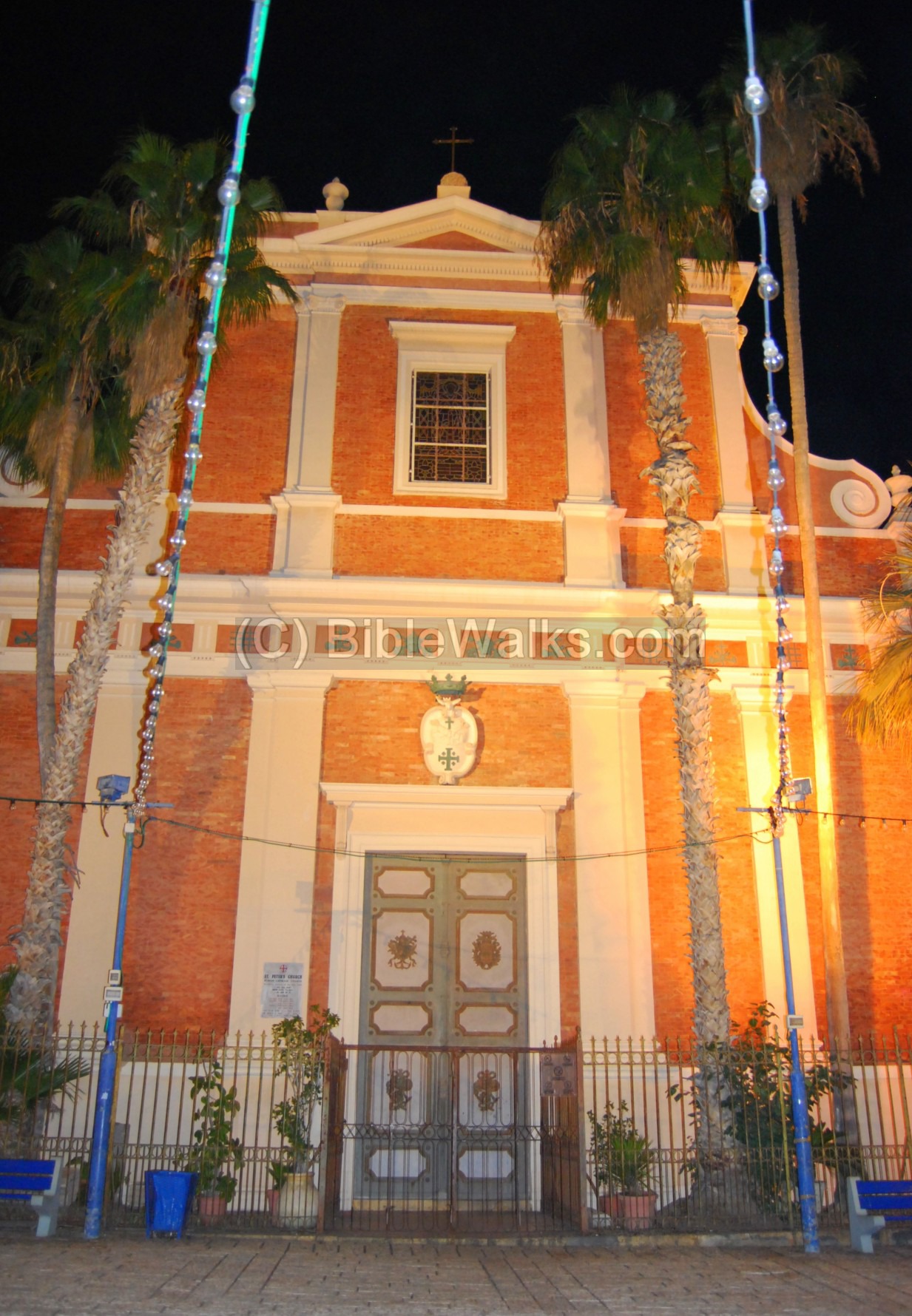
The church is located just above the ancient port of Jaffa. It is accessed from the Kedumim square in old Jaffa, a wide plaza where the underground history museum is located. This picture is shown from the east looking towards the sea.
Click on the photos to view in higher resolution…

The eastern facade, with the main entrance, is shown in the next photo.
A night view –
(b) Interior:
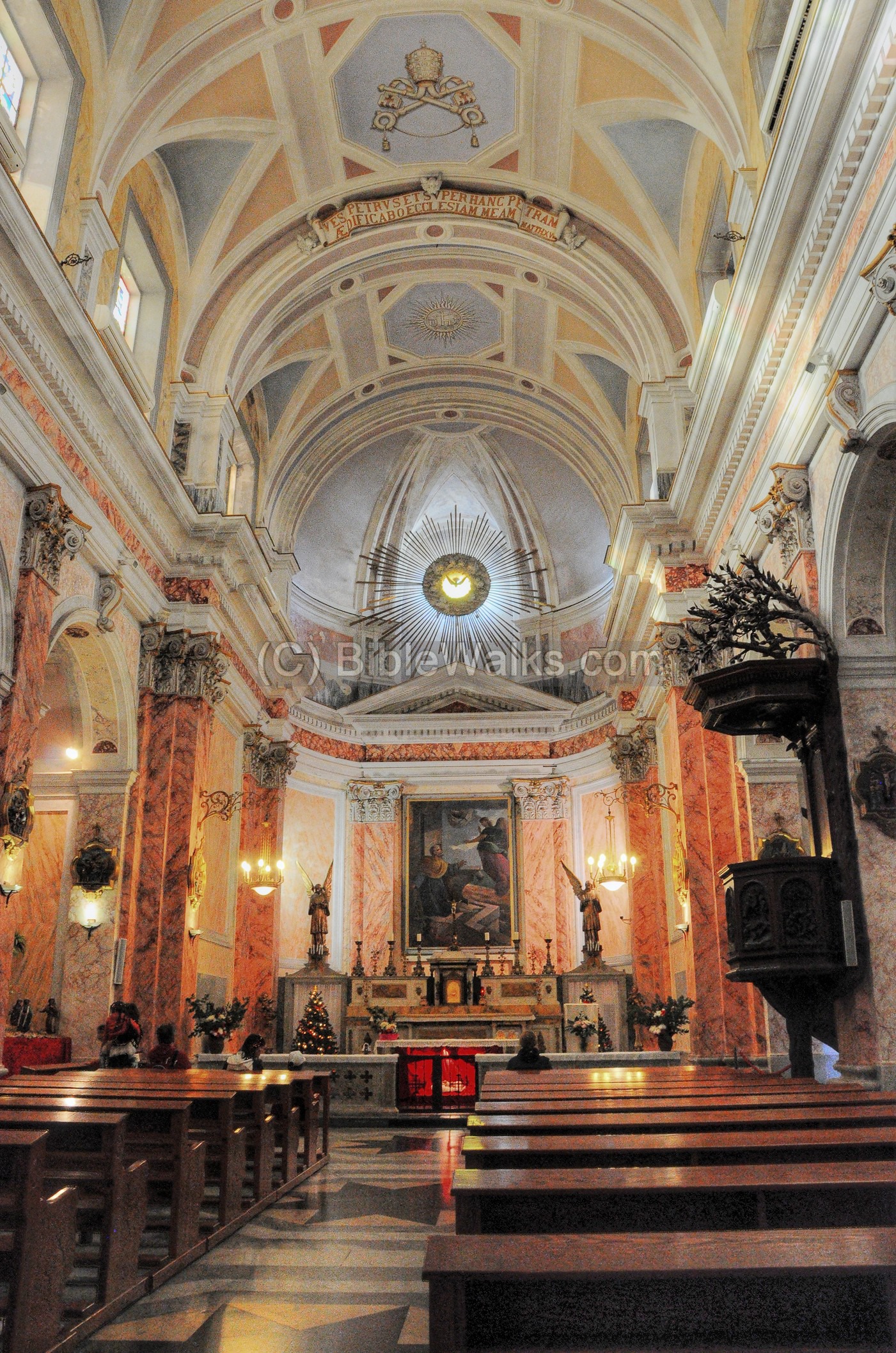
The interior of the church is shown in this picture.
A closer view of the main altar, which is facing west – an unusual orientation of the church. Most of the churches in the world face the east (towards Jerusalem), but here the orientation was reversed, probably to face the house of Simon the tanner where Peter was staying.
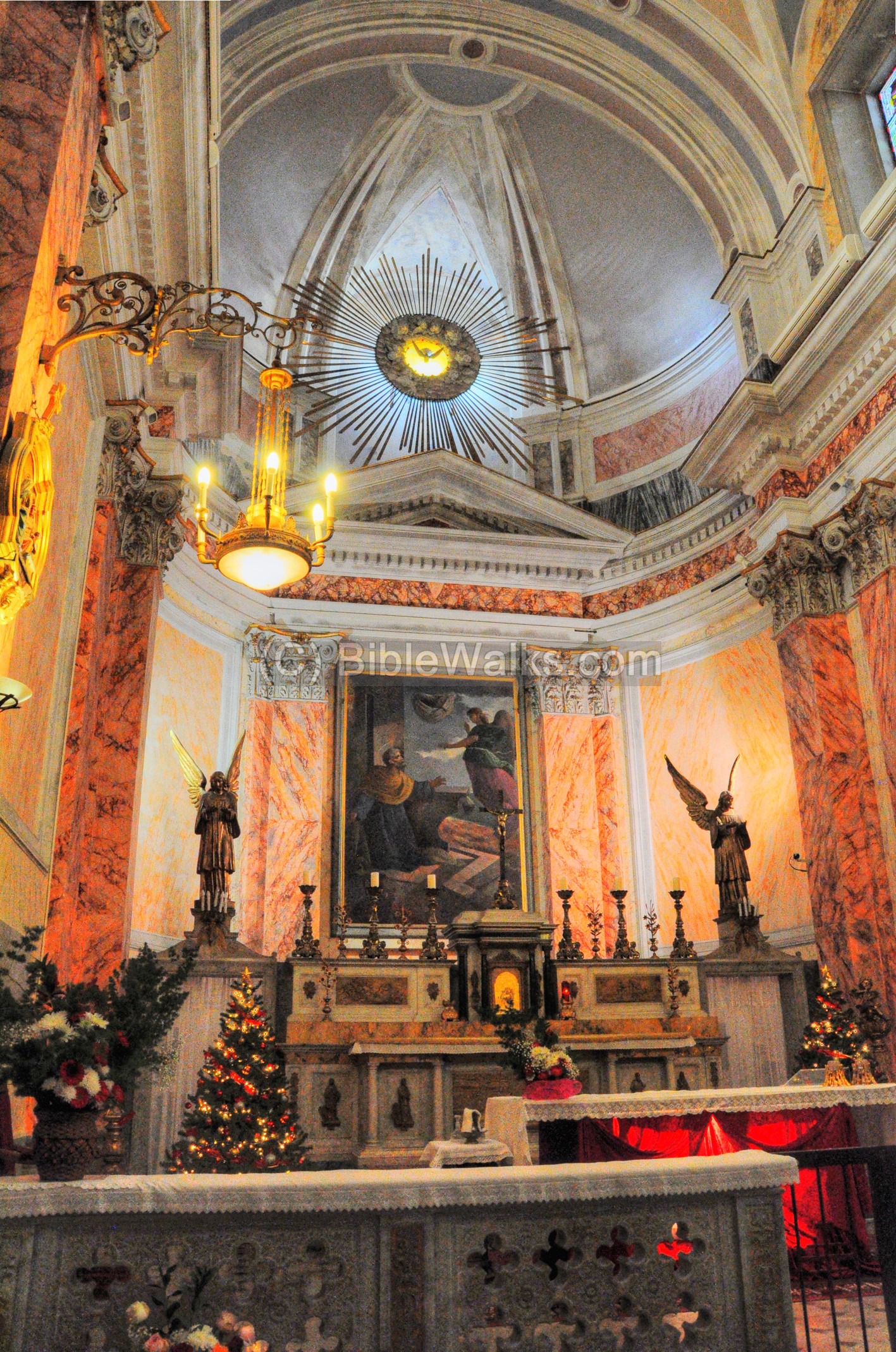
Note that according to the Roman Catholic tradition, the Tanner’s house was located at this site, although other traditions show it in a nearby house, closer to the ancient port.
(c) Art:
- St. Peter’s Dream:
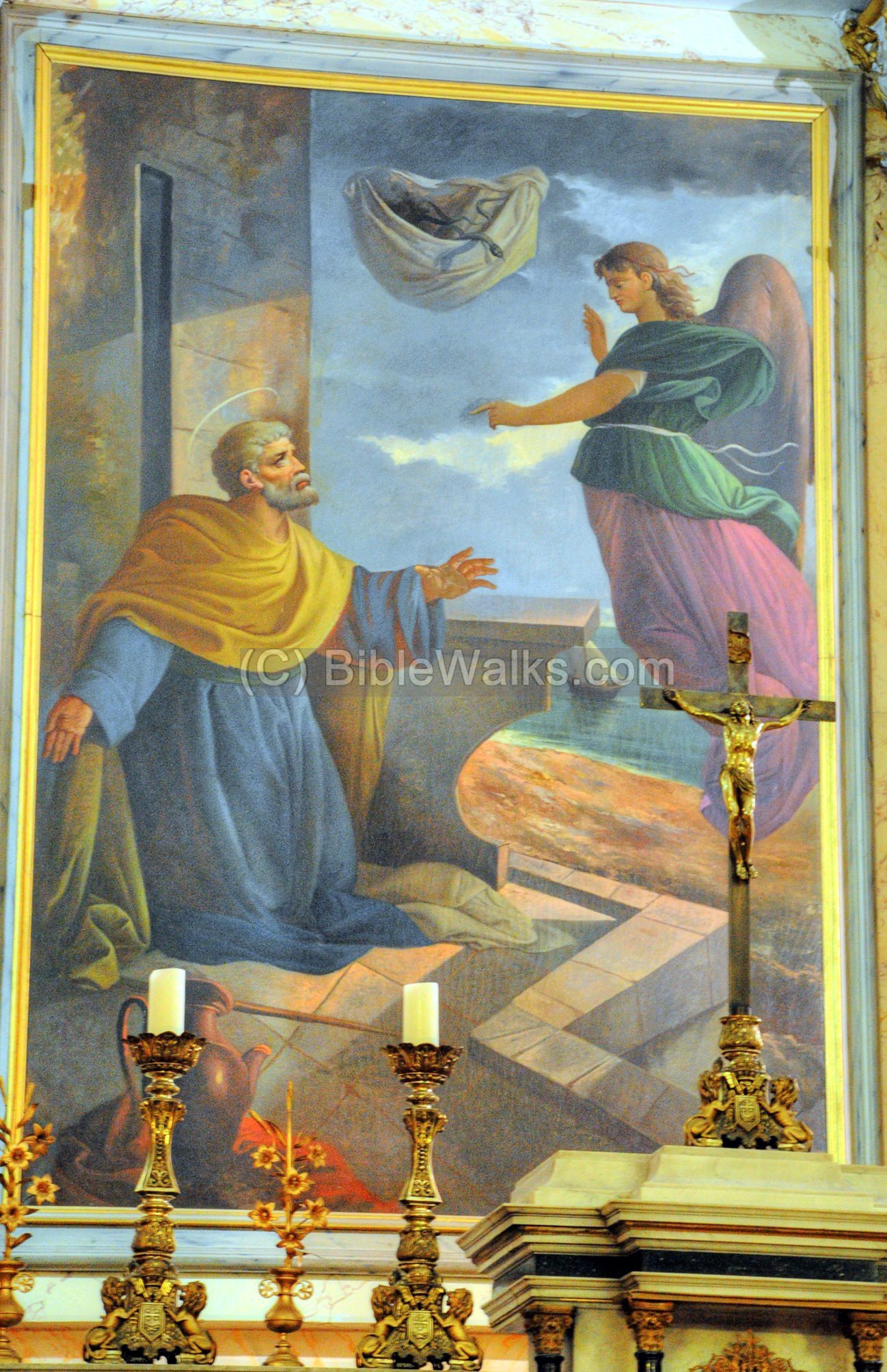
A closer view of the painting of St. Peter is shown below. It illustrates the dream Peter had in Jaffa (read the Biblical texts). This picture shows the “voice” as an angel on the right, a bag of snakes in the air above him, and the port of Jaffa in the lower background.
Acts 11 5-6: “I was in the city of Joppa praying: and in a trance I saw a vision, A certain vessel descend, as it had been a great sheet, let down from heaven by four corners; and it came even to me: Upon the which when I had fastened mine eyes, I considered, and saw fourfooted beasts of the earth, and wild beasts, and creeping things, and fowls of the air”.
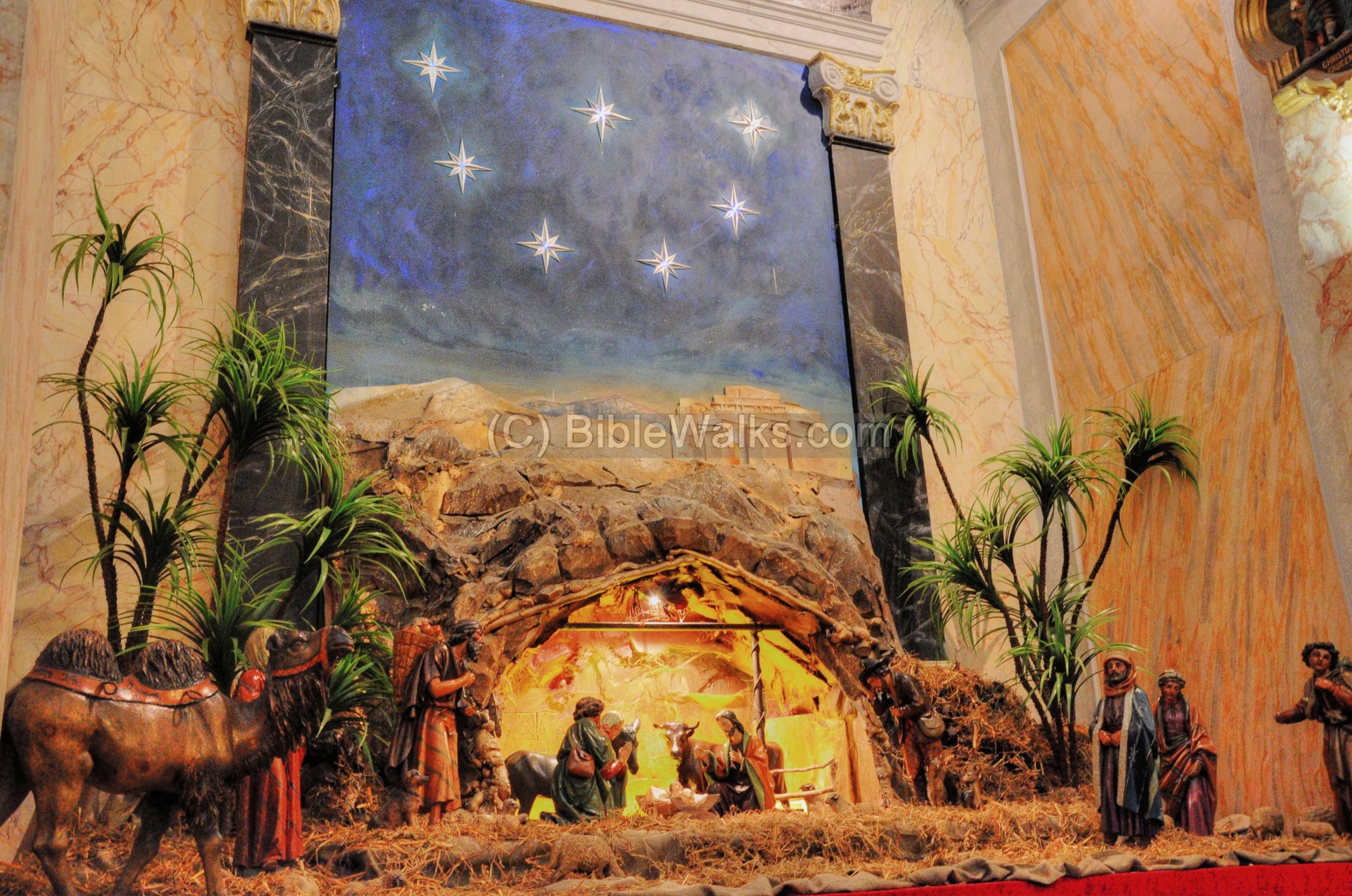
- Christmas:
A nativity display was arranged during Christmas:
Biblical:
(a) Acts 9 36-42:
Acts tells how Peter raised Tabitha/Dorcas from the dead, when he came from Lydda (Lod) to Joppa (Jaffa):
“Now there was at Joppa a certain disciple named Tabitha, which by interpretation is called Dorcas: this woman was full of good works and almsdeeds which she did. And it came to pass in those days, that she was sick, and died: whom when they had washed, they laid her in an upper chamber. And forasmuch as Lydda was nigh to Joppa, and the disciples had heard that Peter was there, they sent unto him two men, desiring him that he would not delay to come to them. Then Peter arose and went with them. When he was come, they brought him into the upper chamber: and all the widows stood by him weeping, and shewing the coats and garments which Dorcas made, while she was with them.
But Peter put them all forth, and kneeled down, and prayed; and turning him to the body said, Tabitha, arise. And she opened her eyes: and when she saw Peter, she sat up. And he gave her his hand, and lifted her up, and when he had called the saints and widows, presented her alive. And it was known throughout all Joppa; and many believed in the Lord”.
(b) Acts 10 36-42, Acts 11 4-13:
Acts illustrates the dream Peter had in the house of Simon the tanner, just before his visit in Caesarea at Cornelius house. After eating, he fell into a trance, and had this dream (which is illustrated in the painting in the church):
“On the morrow, as they went on their journey, and drew nigh unto the city, Peter went up upon the housetop to pray about the sixth hour: And he became very hungry, and would have eaten: but while they made ready, he fell into a trance, And saw heaven opened, and a certain vessel descending upon him, as it had been a great sheet knit at the four corners, and let down to the earth:
Wherein were all manner of fourfooted beasts of the earth, and wild beasts, and creeping things, and fowls of the air.
And there came a voice to him, Rise, Peter; kill, and eat. But Peter said, Not so, Lord; for I have never eaten any thing that is common or unclean. And the voice spake unto him again the second time, What God hath cleansed, that call not thou common. This was done thrice: and the vessel was received up again into heaven”.
St. Peter reports to the church on the previous events:
“But Peter rehearsed the matter from the beginning, and expounded it by order unto them, saying, I was in the city of Joppa praying: and in a trance I saw a vision, A certain vessel descend, as it had been a great sheet, let down from heaven by four corners; and it came even to me: Upon the which when I had fastened mine eyes, I considered, and saw fourfooted beasts of the earth, and wild beasts, and creeping things, and fowls of the air. And I heard a voice saying unto me, Arise, Peter; slay and eat. But I said, Not so, Lord: for nothing common or unclean hath at any time entered into my mouth. But the voice answered me again from heaven, What God hath cleansed, that call not thou common. And this was done three times: and all were drawn up again into heaven. And, behold, immediately there were three men already come unto the house where I was, sent from Caesarea unto me. And the Spirit bade me go with them, nothing doubting. Moreover these six brethren accompanied me, and we entered into the man’s house: And he shewed us how he had seen an angel in his house, which stood and said unto him, Send men to Joppa, and call for Simon, whose surname is Peter;”
This dream was a turning point in the Christian history. Peter, regarded as the first Pope, interpreted the dream as a need to convert gentiles (such as pagan Cornelius, a Roman from Caesarea), and include them in the newly founded church. This was the start of the split from the Jewish religion, where the faith was exclusive to the Jews.
Etymology (behind the name):
- Simon Bar-Yonah –
Yonah, Jonah, Jona – Hebrew: “Dove”.
Simon – Hebrew: Shimon, meaning: “He hears (God’s words)”. In the Old Testament, Shimon was the second son of Jacob and Leah. His descendants were nomads, living in the southern part of Judah.
Bar – Aramaic: “Son”. This was a common prefix to the family name, named after the father.
- Peter – Jesus give his Apostle, Simon Bar-Yonah, the nickname ‘Peter’ – meaning rock (Petros) in Greek (John 1 42): “And he brought him to Jesus. And when Jesus beheld him, he said, Thou art Simon the son of Jona: thou shalt be called Cephas, which is by interpretation, A stone”.
- Cephas – Aramaic for “rock” or “stone”
Links:
* External:
-
Map of old Jaffa (in Hebrew & English)
*Internal:
-
Jaffa – an overview
-
St. George Greek-Orthodox church
-
Simon the Tanner‘s house
-
Tel Yafo excavations
-
St. Peter – info page on Peter
BibleWalks.com – walk with us through the sites of the Holy Land
St. George <<<–previous site—<<< All Sites>>>– next Sharon site —>>> Tanner’s house
This page was last updated on Jan 27, 2012
Sponsored links: